- 1What Is Tour Operator Marketing Software?
- 2Why Do Tour Operators Need Marketing Software in 2026?
- The numbers behind the opportunity
- What marketplaces actually cost
- The insight most guides miss: the real prize is the second booking
- A simple model of OTA versus direct economics
- 3What Does Tour Operator Marketing Software Actually Do?
- Job 1: Capture every lead in one place
- Job 2: Build one guest database
- Job 3: Automate follow-up emails and messages
- Job 4: Recover abandoned bookings
- Job 5: Collect reviews and referrals
- Job 6: Support search visibility
- Job 7: Show attribution
- Job 8: Convert OTA guests into direct relationships
- 4What Types of Tour Operator Marketing Software Exist?
- 5The 9 Best Tour Operator Marketing Software Tools for 2026
- Quick comparison
- 1. TravelBoost: Tour Operator Marketing Software for Operators Who Sell Custom Trips
- 2. Xola: Tour Operator Marketing Software for Day Tours With Built-In Retargeting
- 3. Peek Pro: Booking, Automation and Marketing Analytics Together
- 4. FareHarbor: A Widely Used Booking Engine for Tours and Activities
- 5. Bókun: Managing OTA and Direct Bookings Together
- 6. HubSpot: The Flexible CRM and Marketing Hub
- 7. Brevo: Budget Email and Automation
- 8. Mailchimp: Simple Newsletters and Basic Automation
- 9. Google Business Profile and Google Analytics: The Free Foundation
- 6Which Tour Operator Marketing Software Fits Your Business?
- 7How Much Does Tour Operator Marketing Software Cost?
- Look for the variable costs
- A quick payback calculation
- 8Which Features Matter Most in Tour Operator Marketing Software?
- 9What Automated Campaigns Should Every Tour Operator Build First?
- Campaign 2 in detail: an abandoned booking recovery example
- Campaign 4 in detail: the review request
- A note on consent
- 10How Do You Set Up Tour Operator Marketing Software in 90 Days?
- Days 1 to 14: Measure the baseline
- Days 15 to 30: Choose and connect
- Days 31 to 60: Launch the core automations
- Days 61 to 90: Optimise with attribution
- 11What Metrics Should You Track With Tour Operator Marketing Software?
- 12How Does Tour Operator Marketing Software Fit Into a Wider Marketing Strategy?
- 13What Mistakes Should You Avoid When Choosing Tour Operator Marketing Software?
- 14When Should You NOT Buy Tour Operator Marketing Software?
- 15How Does TravelBoost Work as Tour Operator Marketing Software?
- 16Frequently Asked Questions About Tour Operator Marketing Software
- What is tour operator marketing software?
- What is the best tour operator marketing software?
- How much does tour operator marketing software cost?
- How do I get more direct bookings as a tour operator?
- Should tour operators stop using Viator and GetYourGuide?
- What is the difference between tour operator software and tour operator marketing software?
- Do I need a CRM for my tour company?
- How long does it take to see results from tour operator marketing software?
Tour Operator Marketing Software: The Complete 202è Guide to Winning More Direct Bookings
Tour operator marketing software captures leads, automates email and tracks every booking source so you win direct sales. See the 9 best tools for 2027

TL;DR — Key takeaways
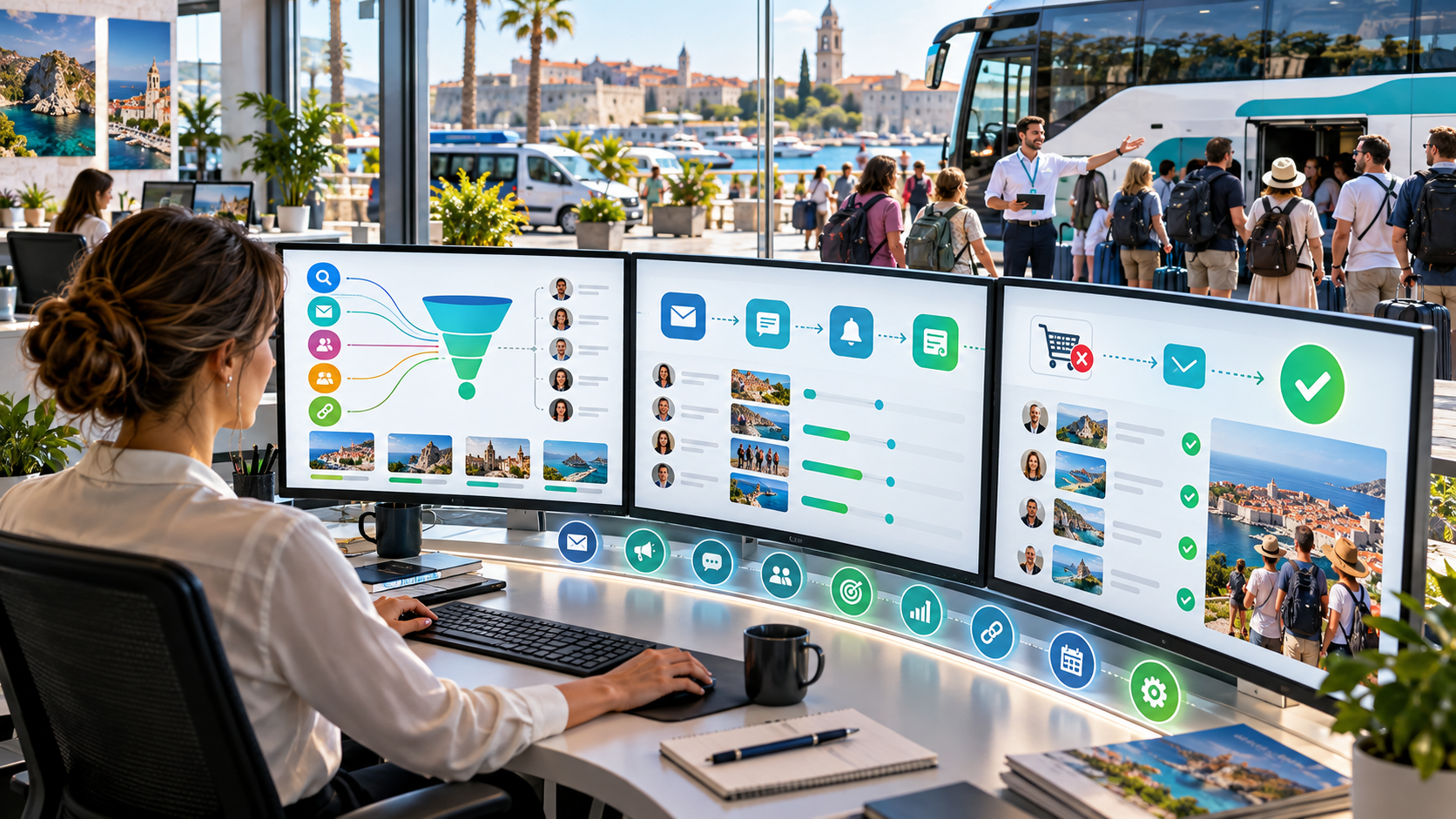
Tour operator marketing software is a system that captures leads, stores every guest in one database, automates email and messages, and shows which marketing channel produced each booking. Its main job is to move guests from expensive third-party channels to your own website.
The problem it solves is large. According to a Skift figure cited in a Travel Massive analysis, only 29% of tours and activities bookings were made online in 2023, and online travel agencies (OTAs) captured 81% of those online bookings versus 19% for operators' own websites.
OTA commissions typically run 20% to 30% on Viator and GetYourGuide, according to Zaui. On a $150 tour, a 25% commission costs $37.50, while a direct booking in our illustrative model costs about $18.89.
You do not need one giant tool. Entry-level stacks start at $0 to $18 per month for email (Brevo), $20 per seat per month for a CRM (HubSpot Starter), or a per-booking fee on platforms like Xola, while HubSpot Marketing Hub Professional starts at $890 per month plus a one-time onboarding fee.
The best choice depends on your tour type. Day-tour and activity operators usually want a booking platform with built-in marketing; multi-day, custom and group operators usually need a CRM with email automation and quoting.
Measure one number first: your direct booking share. If you cannot state it today, buying the software is step two, not step one.
Tour operator marketing software is the set of tools that helps a tour company find travellers, capture their details, follow up automatically, turn enquiries into bookings, and prove which marketing activity paid for itself. In 2026, the most effective setups combine a booking platform or CRM, an email and messaging automation tool, and simple analytics, all connected so that every guest and every booking source lives in one place.
We build travel business software, and we talk to tour operators regularly about the same frustration. They are busy, their tours get good reviews, and a large share of their guests still arrive through marketplaces that take a quarter of the price and keep the customer relationship. The operator pays commission, never emails the guest again, and starts from zero next season.
Tour operator marketing software exists to change that pattern. This guide explains what it is, what it does, which tools are worth looking at, what they cost, how to set one up in 90 days, which automated campaigns to build first, and when you should not buy anything yet. You will also find an honest section about where our own product fits and where it does not.
What Is Tour Operator Marketing Software?
Tour operator marketing software is any platform that helps a tour or activity business attract, convert and retain guests through its own channels. It usually combines a guest database (CRM), email or messaging automation, booking or enquiry capture, and reporting on which sources generate revenue.
To keep the terms clear, here are the definitions we use throughout this guide:
Tour operator CRM: a customer relationship management system that stores every enquiry, guest, booking, conversation and preference in one record.
Marketing automation: software that sends emails, texts or messages automatically based on triggers, such as a guest abandoning checkout or finishing a tour.
Direct booking: a booking made on your own website, phone line or email, as opposed to through a third-party marketplace.
OTA (online travel agency): a marketplace such as Viator, GetYourGuide or Expedia that sells your tours to its audience and keeps a commission.
Abandoned booking recovery: automated follow-up with people who started a booking but did not finish.
Attribution: tracking which source, such as Google search, Instagram, an OTA or a past guest, produced each booking.
Direct booking share: the percentage of your total bookings that come through your own channels.
It helps to separate three things people often confuse. Booking software takes reservations and manages availability. Marketing software gets the right people to your booking page and brings them back. Tour operator software is the broader category that can include both plus operations, guides, suppliers and finance. Many modern products blend the three, which is why buying decisions get confusing.
If you want the operations side explained first, our guide to tour operator software covers reservations, itineraries, suppliers and back-office tools in detail. This article focuses on the marketing layer.
Why Do Tour Operators Need Marketing Software in 2026?
Tour operators need marketing software in 2026 because most of their online bookings still flow through third-party marketplaces that charge high commissions and keep the guest relationship. Marketing software gives you the tools to build your own audience, follow up automatically and shift more bookings to channels you control.
The numbers behind the opportunity
The tours and activities segment has been slower to digitise than airlines and hotels. A Travel Massive discussion of the operator–OTA relationship cites a Skift figure showing that only 29% of tours and activities bookings were completed online in 2023. The same analysis states that OTAs such as Viator and GetYourGuide accounted for 81% of online bookings, compared with 19% made directly through operators' websites.
Those marketplaces are large. Understory's operator guide reports that GetYourGuide booked 33 million experiences in 2025 with more than 4 billion euros in booking value, and that Viator lists more than 300,000 bookable experiences across roughly 2,500 destinations and reported about $4.7 billion in gross bookings last year. They are not going away, and most operators should not leave them.
What marketplaces actually cost
According to Zaui's guide to OTA marketing, Viator and GetYourGuide typically charge commissions of 20% to 30% of booking value, with lower rates sometimes available to operators who commit to preferential pricing or exclusivity. Treat that range as an estimate and check your own contracts, because rates vary by destination, product type and any exclusivity you agree to.
Here is the same fact in operator language: if a quarter of the ticket price goes to a marketplace, a tour with a 40% gross margin keeps barely a third of its profit on that booking.
The insight most guides miss: the real prize is the second booking
Most articles frame this as "OTA versus direct" and tell you to cut commissions. In our experience, the more valuable question is what happens after the first booking.
When a guest books through a marketplace, you often get a first name and an email address that you may not be allowed to use for marketing. When that guest returns two years later, they search the marketplace again, and you pay commission again. Marketing software changes that when you capture consent at the right moments and keep the relationship yourself: a post-tour email asking for a review, a friendly message before their next holiday, a referral offer to a friend.
Zaui makes a related point: the path to lower OTA dependence runs through direct marketing investment, not through walking away from OTA channels, and the handoff from OTA discovery to a direct relationship is the critical mechanism. We agree. Marketing software is how you build that handoff.
A simple model of OTA versus direct economics
Here is an illustrative comparison for a $150 day tour:
Item | OTA booking | Direct booking |
|---|---|---|
Ticket price | $150.00 | $150.00 |
Channel cost | 25% commission = $37.50 | Marketing cost $15.00 + booking and payment fee about 2.6% ($3.89) |
Total channel cost | $37.50 | $18.89 |
Net after channel cost | $112.50 | $131.11 |
Difference per guest | +$18.61 |
Illustrative figures. The $15 direct marketing cost per guest is an assumption modelled on the kind of example Understory uses; the 2.6% fee reflects a reported 2.39% plus $0.30 per booking on Xola, as described in a Bókun pricing guide. Your numbers will differ.
If you shift just 1,000 guests a year from marketplaces to your own website, that is roughly $18,600 more net revenue at no change in ticket price. That is why even a modest improvement in direct booking share can pay for marketing software several times over.
Bókun's guidance on OTA and direct bookings adds a useful cost reference: the only fee on direct bookings is the booking-system fee, which it says typically runs between 1% and 8% depending on the software provider. That is far below marketplace commission, but it is not zero, so factor it into your model.
What Does Tour Operator Marketing Software Actually Do?
Tour operator marketing software does eight jobs: it captures leads, centralises guest data, automates follow-up, recovers abandoned bookings, collects reviews, helps you appear in search, tracks attribution, and hands OTA guests over to your direct channels. Not every product does all eight, so use this list as a checklist.
Job 1: Capture every lead in one place
Leads arrive from your website form, WhatsApp, Instagram messages, phone calls, email, travel agents and marketplaces. Without a system, they sit in five inboxes. Tour operator marketing software pulls them into one pipeline so nobody wonders whether an enquiry was answered.
Speed matters here. A guest asking about a 7-day trek is usually messaging three operators at once. The first useful reply with a clear price often wins. Look for software that assigns leads automatically, sends an instant acknowledgement and flags any lead that has waited too long.
Job 2: Build one guest database
A tour operator CRM stores contact details, tours booked, group size, dietary needs, language, source and consent status. This is the foundation of every other job, because you cannot send a relevant message to someone you cannot find.
Keep your fields practical. In our experience, the most useful ones are source, tour interest, travel month, group size, past tours and marketing consent. Everything else is optional.
Job 3: Automate follow-up emails and messages
This is where marketing software saves the most time, and it is the core of email marketing for tour operators and any serious tour marketing automation setup. Typical automations include a welcome email, a quote follow-up after 2 days and again after 5 days, a pre-trip information email, a post-tour thank-you and a review request. For a deeper look at the email side, see our guide to email marketing for travel agencies, which uses the same principles.
Job 4: Recover abandoned bookings
Guests often start a booking and leave. Abandoned booking recovery sends an automatic reminder, sometimes with an incentive such as a free upgrade, and brings back a share of them. We cover a worked example below.
Job 5: Collect reviews and referrals
Reviews drive tour bookings more than almost any other factor, so your software should ask every guest for one at the right moment, typically within 24 hours of the tour ending, with a direct link to the platform you care about most.
Job 6: Support search visibility
Your website needs to be found. Some tools include landing page builders, schema markup and local listing features. Even if your software does not, it should at least connect cleanly to your website so tour pages and booking widgets load fast and track properly.
Zaui notes that Google, unlike the major marketplaces, does not take commission on bookings in the same way, which makes it one of the higher-margin discovery channels for operators who connect their inventory to it. That is a strong reason to invest in your own listings and website rather than relying on marketplaces alone.
Job 7: Show attribution
You cannot improve what you cannot measure. Good tour operator marketing software tells you, for each booking, where the guest first came from and what they clicked before booking. Over three to six months, this tells you which campaigns pay and which do not.
Job 8: Convert OTA guests into direct relationships
The ethical, rules-compliant version of this is simple: provide an excellent tour, then invite guests to join your list, follow you, or return for a loyalty offer in line with each marketplace's terms. Marketing software makes the follow-through easy by keeping a record of consent and automating the invitation. Always read each marketplace's contract and data rules first.
What Types of Tour Operator Marketing Software Exist?
There are four main types of tour operator marketing software: booking platforms with built-in marketing, standalone email and automation tools, CRM and all-in-one agency systems, and distribution or channel management tools. Most operators end up combining two of them.
Type | What it does best | Examples | Best for |
|---|---|---|---|
Booking platform with marketing tools | Takes bookings and runs retargeting, email and promotions in one place | Xola, Peek Pro, FareHarbor | Day tours, activities, attractions |
Email and marketing automation | Newsletters, automated journeys, segmentation | Brevo, HubSpot, Mailchimp | Any operator with a guest list |
CRM and all-in-one systems | Leads, quotes, itineraries, bookings, invoices, follow-up in one record | TravelBoost, HubSpot CRM | Multi-day, custom, group and inbound operators |
Distribution and channel management | Keeps availability in sync across OTAs and your own site | Bókun and similar tools | Operators selling on several marketplaces |
The count of options is large. G2's tour operator category tracked 170 listings in 2026, and Capterra's category showed 218 products, so shortlist by type first and by brand second.
The 9 Best Tour Operator Marketing Software Tools for 2026
We reviewed each tool against the same questions: does it help you capture leads, automate follow-up, recover abandoned bookings, show attribution, and connect marketing to actual bookings? We used vendor pages and independent review directories for descriptions and prices, and we flag where a figure comes from a competitor. Prices change often, so confirm everything before you buy.
Quick comparison
Tool | Best for | Published entry price | Built-in marketing | Bookings and CRM |
|---|---|---|---|---|
TravelBoost | Multi-day, custom and group operators who need leads, quotes and follow-up connected | See TravelBoost pricing page | CRM-based follow-up and automation | Yes |
Xola | Day tours and activities wanting booking plus retargeting | No subscription; reported per-booking fee about 2.39% + $0.30 | Yes | Yes |
Peek Pro | Operators wanting booking, POS and marketing analytics | Contact vendor | Yes | Yes |
FareHarbor | Tour and activity operators wanting a widely used booking engine | Contact vendor | Partial | Yes |
Bókun | Operators selling across several OTAs | Contact vendor | Partial | Yes |
HubSpot | Operators wanting a flexible CRM and marketing hub | $20/seat/month Starter; Marketing Hub Pro from $890/month | Yes | CRM only |
Brevo | Budget email and automation | Free (300 emails/day); paid from $9/month | Yes | No |
Mailchimp | Simple newsletters and basic automation | Standard from about $20/month for 500 contacts | Yes | No |
Google Business Profile and Analytics | Local visibility and traffic measurement | Free | Partial | No |
Prices are published or reported figures as of October 2026; taxes, add-ons and usage fees are extra. "Contact vendor" means we did not find a reliable public entry price in the sources reviewed.
1. TravelBoost: Tour Operator Marketing Software for Operators Who Sell Custom Trips
TravelBoost is travel agency and tour business management software that connects leads, quotes, itineraries, bookings, invoices and follow-up in one system. We built it for businesses where an enquiry becomes a conversation and a quote, not a single click on a ticket button.
Strengths for marketing:
Every enquiry, from any channel, becomes a record in one pipeline, so follow-up does not depend on someone's memory.
Guest history, tours booked and notes stay attached to the contact, which makes repeat marketing relevant rather than generic.
Quotes, itineraries and invoices share the same data, which means your marketing numbers match your finance numbers.
It suits multi-market teams, including operators and agencies working in the Middle East and North Africa across several languages.
Limitations to consider: if your business is high-volume, fixed-departure day tours with live availability widgets and on-the-spot ticketing, a dedicated booking platform such as Xola, Peek or FareHarbor may be a closer fit, and TravelBoost can sit beside it as the relationship and follow-up layer.
Best for: multi-day, bespoke, group and inbound operators who need their marketing, quoting and bookings in one connected record. See our guide to tour operator software for how this fits the wider operations picture.
2. Xola: Tour Operator Marketing Software for Day Tours With Built-In Retargeting
Xola describes itself on G2 as a unified booking, sales and marketing platform for tour operators and attractions. A Bókun pricing guide notes that Xola has no subscription fee and instead charges a partner fee per booking, usually around 2.39% plus 30 cents of the booking total, though it can vary for international transactions. That figure comes from a competitor's comparison, so verify it with Xola.
Strengths:
Online booking, reservations management, availability and payment processing in one dashboard.
Built-in marketing tools to support retargeting campaigns, which reviewers on Bókun's guide highlight.
Email confirmations, reminders and booking notes that keep communication consistent.
Limitations to consider: GetApp's summary of reviews notes that some reviewers find it pricier than alternatives, and that recent price increases and commission-based pricing are drawbacks. Per-booking pricing also means your software cost rises with your success.
Best for: day-tour and activity operators who want booking and marketing together and prefer a variable-cost model.
3. Peek Pro: Booking, Automation and Marketing Analytics Together
Peek Pro is described on G2 as combining online booking, point-of-sale and hundreds of automation tools, including inventory management, dynamic pricing, waivers and marketing analytics.
Strengths: it covers the full day-of-tour workflow and includes marketing analytics, so you can see which sources fill capacity.
Limitations to consider: it is built around activity and attraction operations. Operators selling long, customised itineraries may find the workflow less natural. Public entry pricing was not clearly available in the sources we reviewed, so request a quote.
Best for: operators who want one platform that runs bookings, front desk and analytics.
4. FareHarbor: A Widely Used Booking Engine for Tours and Activities
FareHarbor is listed on Capterra as a leading booking solution for tour, activity and attraction operators, with a 4.7 out of 5 rating across more than 1,100 reviews.
Strengths: strong adoption, a familiar booking experience for guests, and tools to sell and manage services.
Limitations to consider: its marketing features are lighter than a full marketing automation tool, so many operators pair it with an email platform. Confirm pricing and terms directly.
Best for: operators prioritising a proven booking engine who will add email automation separately.
5. Bókun: Managing OTA and Direct Bookings Together
Bókun's own guidance focuses on how operators manage bookings across marketplaces and their own site, and it recommends aiming for a mix of OTA and direct bookings as you grow. It also states that when travellers find your tours in search, Google can direct them to your site to book directly.
Strengths: helpful for operators who sell through several OTAs and need availability kept in sync, which reduces double bookings.
Limitations to consider: its centre of gravity is distribution rather than deep marketing automation, so most operators add a separate email tool. Confirm features and fees with the vendor.
Best for: operators with meaningful OTA volume who want one place to manage inventory.
6. HubSpot: The Flexible CRM and Marketing Hub
HubSpot is a general-purpose CRM and marketing platform used well beyond travel. According to a 2026 HubSpot pricing explainer, the Starter tier costs $15 per seat per month on annual billing or $20 month-to-month, while Marketing Hub Professional starts at $890 per month with 3 seats and 2,000 contacts, plus a mandatory $3,000 onboarding fee in year one. That works out to $13,680 in year one for a team on that plan.
Strengths: powerful automation, reporting and integrations, plus a free CRM tier to start with.
Limitations to consider: it is not built for tours, so you will configure fields, pipelines and booking links yourself. The jump from Starter to Professional pricing is large, which is why the same explainer calls it a cliff.
Best for: operators with a dedicated marketing person who want maximum flexibility.
7. Brevo: Budget Email and Automation
Brevo prices by emails sent rather than contacts stored. Independent pricing guides report a free plan with 300 emails per day and unlimited contacts, a Starter plan from $9 per month, and a Standard plan with automation from $18 per month, with a Professional tier from $499 per month.
Strengths: very low entry cost, automation on the Standard plan, and SMS and WhatsApp available as usage-based add-ons.
Limitations to consider: it is only an email and messaging tool. The free plan caps sending at 300 emails a day and carries Brevo branding, and it will not take bookings or manage tours.
Best for: small operators who want to start automated email at minimal cost.
8. Mailchimp: Simple Newsletters and Basic Automation
Mailchimp remains a familiar choice for newsletters. A 2026 comparison reports its Standard plan starting at around $20 per month for 500 contacts, rising with list size.
Strengths: easy setup, recognisable templates, and plenty of tutorials.
Limitations to consider: pricing rises with contacts, and it has no concept of tours, quotes or bookings, so you will need integrations or manual list uploads.
Best for: operators with a small list who mainly send newsletters.
9. Google Business Profile and Google Analytics: The Free Foundation
These are free tools rather than full software, but every operator should use them. A complete Google Business Profile with photos, hours, booking links and reviews supports local discovery, and analytics shows which pages and campaigns drive traffic.
Limitations to consider: they do not manage guests or send messages. Treat them as the measurement and visibility layer under your other tools.
Best for: every operator, regardless of size.
Which Tour Operator Marketing Software Fits Your Business?
The right tour operator marketing software depends on how your guests buy. Operators selling instant-booking day tours need different tools from operators selling quoted, multi-day journeys. Use this table as a starting point:
Your business | Main marketing need | Shortlist |
|---|---|---|
Day tours and activities, instant booking | Fill capacity, retarget visitors, collect reviews | Xola, Peek Pro, FareHarbor + Brevo |
Selling heavily through OTAs | Keep availability synced, grow direct share | Bókun + an email tool |
Multi-day, custom or bespoke tours | Nurture enquiries, send quotes, follow up | TravelBoost, HubSpot |
Group and incentive tours | Manage long sales cycles and many contacts | TravelBoost, HubSpot |
Inbound operator or DMC selling to agents | Agent relationships, repeat business | TravelBoost, HubSpot |
Brand new operator on a tiny budget | Cheap and simple | Google tools + Brevo free |
A useful test: ask whether your guests usually book instantly or after a conversation. If most book in one visit, prioritise a booking engine with built-in marketing. If most book after messages and a quote, prioritise a CRM that tracks the conversation.
How Much Does Tour Operator Marketing Software Cost?
Tour operator marketing software costs anywhere from free to more than $13,000 in the first year, depending on the tools you combine. Small operators can start for under $250 per year in software, while a full professional marketing hub costs roughly 50 times more.
Here is how three typical stacks compare, using the published prices above:
Stack | Tools | Software cost (approx.) | Best for |
|---|---|---|---|
Lean | Google Business Profile + Analytics, Brevo Standard (entry volume), booking platform on per-booking fee | About $216/year for email, plus booking fees | New and small operators |
Mid | CRM at $20/seat/month (HubSpot Starter) or an all-in-one system, plus Brevo | From about $240 to $456/year per seat for CRM, plus email | Growing teams of 2 to 5 |
Professional | HubSpot Marketing Hub Professional | $890/month, or $13,680 in year one including onboarding | Larger operators with a marketing hire |
Calculated from published or reported prices: Brevo Standard at $18 per month; HubSpot Starter at $15 to $20 per seat per month; HubSpot Marketing Hub Professional at $890 per month plus $3,000 onboarding. Volume, contacts and add-ons change totals.
Look for the variable costs
Three costs catch buyers out:
Per-booking fees. A reported 2.39% plus $0.30 on a $150 booking is about $3.89. On 1,000 bookings that is roughly $3,885 a year, which may beat a fixed subscription at low volume and lose at high volume.
Contact and send limits. Email tools charge by contacts or sends. Your bill rises as your list grows.
Onboarding and seats. HubSpot's Professional tier adds $45 per extra seat and a $3,000 onboarding fee, as the pricing explainer reports.
A quick payback calculation
Using our earlier illustration of $18.61 more net revenue per guest shifted from OTA to direct, a stack costing $1,000 a year pays for itself after about 54 guests (1,000 ÷ 18.61 = 53.7). For an operator with thousands of guests, that is a small hurdle.
Which Features Matter Most in Tour Operator Marketing Software?
The features that matter most in tour operator marketing software are a single guest database, automation triggers, consent tracking, booking-source attribution and easy integration with your booking and payment tools. Fancy design tools matter less than reliable data.
Feature | Why it matters | Priority |
|---|---|---|
One guest database (CRM) | Every message depends on it | Essential |
Consent and unsubscribe tracking | Protects you legally and protects deliverability | Essential |
Automation triggers (booking, abandon, tour end) | Sends the right message at the right moment | Essential |
Source attribution | Shows which channels pay | Essential |
Booking and payment integration | Connects marketing to real revenue | Essential |
Abandoned booking recovery | Recovers lost sales without extra ad spend | High |
Segmentation (tour type, month, language) | Makes messages relevant | High |
Review request automation | Builds search and marketplace ranking | High |
WhatsApp and SMS support | Many guests respond faster there | High |
Landing page and form builder | Speeds up campaign launches | Medium |
Multi-language templates | Serves international guests | Medium |
Reporting dashboard | Shows revenue per campaign | Medium |
If you remember one row, remember source attribution. Without it, every marketing decision becomes a guess.
What Automated Campaigns Should Every Tour Operator Build First?
Every tour operator should build six automated campaigns first: enquiry follow-up, abandoned booking recovery, pre-trip information, post-tour thank-you with review request, early-bird or seasonal offers, and a win-back message to past guests. Together they cover the guest journey from first contact to repeat booking.
Campaign | Trigger | Timing | Goal |
|---|---|---|---|
1. Enquiry follow-up | Enquiry received | Instant reply; follow-ups at 2 and 5 days | Win the quote |
2. Abandoned booking recovery | Checkout started, not completed | 1 hour, then 24 hours | Recover the sale |
3. Pre-trip information | Booking confirmed | 7 days and 1 day before | Reduce questions and no-shows |
4. Thank-you and review request | Tour completed | Within 24 hours | Earn a review |
5. Seasonal or early-bird offer | Calendar | 8 to 12 weeks before season | Fill future departures |
6. Win-back | No booking in 12 months | Once a year | Bring guests back directly |
Campaign 2 in detail: an abandoned booking recovery example
Here is an illustrative example for a tour operator marketing software setup:
Assumption | Value |
|---|---|
Checkout starts per month | 1,000 |
Share that abandon | 70% (700 people) |
Recovery rate with 2 automated emails | 8% |
Recovered bookings | 56 |
Average booking value | $150 |
Recovered revenue per month | $8,400 |
Illustrative figures for planning purposes, not benchmarks. Your abandon and recovery rates will differ.
Even at half those rates, that is $4,200 a month from guests who had already shown intent. This is why abandoned booking recovery sits near the top of our list.
Campaign 4 in detail: the review request
This is the simplest win in email marketing for tour operators, because the guest has just had a good experience and the message costs almost nothing to send.
Ask for the review while the memory is fresh. A simple structure works:
Thank them by name and mention the guide's name.
Ask one clear question: "How was your tour?" with a one-tap link.
Send happy guests to your preferred review site and unhappy ones to a private feedback form so you can fix problems quickly. Check each platform's rules, since some prohibit selectively gating reviews.
Add a soft invitation to join your email list for seasonal offers.
A note on consent
Email and messaging rules differ by country. In many markets, you need clear consent before sending marketing messages and must include an unsubscribe option. Your software should record where and when consent was given. This is general information, not legal advice; check the rules in the countries where your guests live.
How Do You Set Up Tour Operator Marketing Software in 90 Days?
You can set up tour operator marketing software in about 90 days by measuring your baseline first, connecting your data second, launching four core automations third, and optimising with attribution last. This phased plan works for most small and mid-sized operators.
Days 1 to 14: Measure the baseline
Write down five numbers before you buy anything:
Total bookings in the last 12 months.
Bookings by source: your website, OTAs, agents, repeat guests, walk-ins.
Your direct booking share.
Average booking value.
Your approximate marketing spend and OTA commissions.
If you cannot produce these numbers, your first project is a spreadsheet, not software. Those numbers also give you the benchmark you need to prove the software worked.
Days 15 to 30: Choose and connect
Shortlist two tools from the types above. Run a free trial on each using a real tour and a real guest list. Test the questions that matter: can you import contacts with consent status, can you see the source of each booking, and does it connect to your payments and website?
Days 31 to 60: Launch the core automations
Build, in this order:
An instant enquiry reply and two follow-ups.
Abandoned booking recovery.
Post-tour thank-you and review request.
Pre-trip information emails.
Keep copy short, personal and branded. Send test messages to yourself and colleagues on mobile and desktop.
Days 61 to 90: Optimise with attribution
Review which sources produce bookings, which emails get opened and which automations recover revenue. Cut campaigns that do not produce bookings. Add one new campaign at a time, such as an early-bird offer for next season.
At the end of 90 days, compare your direct booking share with the baseline. Even a gain of three to five percentage points is a strong result.
What Metrics Should You Track With Tour Operator Marketing Software?
You should track direct booking share, cost per booking by channel, enquiry-to-booking conversion rate, abandoned booking recovery rate, repeat guest rate and review volume. These six metrics tell you whether your marketing software is paying for itself.
Metric | How to calculate it | Why it matters |
|---|---|---|
Direct booking share | Direct bookings ÷ total bookings | The headline measure of channel independence |
Cost per booking by channel | Channel spend (including commission) ÷ bookings from that channel | Shows true channel cost |
Enquiry-to-booking rate | Bookings ÷ qualified enquiries | Measures sales effectiveness |
Abandoned booking recovery rate | Recovered bookings ÷ abandoned checkouts | Measures automation value |
Repeat guest rate | Guests who booked again ÷ total guests | Shows loyalty and lifetime value |
Review velocity | New reviews per month | Predicts future visibility |
Do not obsess over open rates. Judge every campaign by revenue and bookings, not by clicks. An email with a 60% open rate that produces no bookings is worse than one with a 25% open rate that fills a departure.
How Does Tour Operator Marketing Software Fit Into a Wider Marketing Strategy?
Tour operator marketing software supports your strategy but does not replace it. It automates and measures the work, while your positioning, tour quality, photos, pricing and channel choices still decide results. Our guide to tourism marketing strategy covers the strategic layer in more detail.
A simple way to connect the two is the capture, convert, keep model:
Capture attention through search, social media, partnerships and marketplaces.
Convert it into bookings with a fast website, clear pricing, social proof and an easy checkout.
Keep the guest with automated follow-up, reviews, referrals and repeat offers.
Most operators spend 90% of their effort on capture and almost none on keep. Marketing software is mainly a keep tool, and keeping a guest is almost always cheaper than finding a new one. That is why tour marketing automation, done well, usually delivers its return in the second and third booking, not the first.
What Mistakes Should You Avoid When Choosing Tour Operator Marketing Software?
The most common mistakes are buying a tool before measuring your baseline, choosing for features you will not use, ignoring consent, skipping integration checks, and measuring clicks instead of bookings. Here are the seven we see most often:
Buying software before knowing your direct booking share. Without a baseline, you cannot prove the investment worked.
Choosing the most powerful tool instead of the most usable one. A simple tool that your team actually uses beats an advanced one that sits idle.
Ignoring integrations. If the marketing tool cannot see bookings, it cannot recover abandoned ones or measure revenue.
Mixing up consent. Uploading contacts you have no permission to email can damage your sender reputation and breach local rules.
Over-automating. Automation should save time on routine messages, not replace the human reply a guest needs when they ask a real question.
Leaving OTAs abruptly. As Zaui notes, operators who pull back from marketplaces before building equivalent direct volume simply lose bookings. Grow direct first, then renegotiate.
Measuring vanity metrics. Followers and open rates feel good. Bookings and net revenue pay the bills.
When Should You NOT Buy Tour Operator Marketing Software?
You should not buy tour operator marketing software yet if you have very few guests, if your website cannot take enquiries or bookings properly, or if your main problem is product quality rather than marketing. We build software, so we will be direct about this:
You get fewer than about 10 enquiries a month. A shared inbox, a spreadsheet and a free email plan are enough for now.
Your website is slow, unclear or has no booking path. Fix the website before automating anything. Software will only send more people to a page that does not convert.
You have no review base. If reviews are poor, fix the experience first. Marketing amplifies what exists.
Your team will not use it. A tool half the team ignores creates two sources of truth.
You already own a system with these features. Many operators pay for overlapping tools. Audit what you have before adding more.
And one honest note on fit: if you run a high-volume ticketed attraction or a fixed-departure day tour with live availability and on-site check-in, a dedicated booking platform will probably serve you better than our system, and you may want to pair it with an email tool.
How Does TravelBoost Work as Tour Operator Marketing Software?
TravelBoost works as tour operator marketing software for businesses that sell custom, multi-day and group trips by connecting leads, guest records, quotes, itineraries, bookings and invoices in a single system. Because your marketing data and your booking data share the same record, you can see which enquiries became revenue.
With TravelBoost, tour operators can:
Capture enquiries in a visual pipeline and see every stage from first message to confirmed booking.
Keep one guest record with conversations, tours booked, preferences and notes.
Build quotes and itineraries from the same record, so the numbers match your invoices.
Follow up systematically so no enquiry goes quiet after one message.
Track commissions and supplier costs alongside bookings so your marketing return reflects real margin.
We would also be clear about scope: TravelBoost is built as a business management and CRM system for travel businesses, so if your priority is a public-facing, live-inventory ticketing widget for hundreds of daily guests, consider pairing it with a specialised booking tool. Please confirm current features and pricing on the TravelBoost site before you decide.
If you sell tours where every guest needs a conversation, a quote and a follow-up, start with TravelBoost and map your first enquiry-to-booking pipeline this week.
Frequently Asked Questions About Tour Operator Marketing Software
What is tour operator marketing software?
Tour operator marketing software is a set of tools that helps a tour company capture leads, store guest data, automate emails and messages, recover abandoned bookings and track which channels produce bookings. Its main purpose is to increase direct bookings and repeat guests while reducing dependence on marketplace commissions.
What is the best tour operator marketing software?
The best tour operator marketing software depends on how your guests book. Day-tour operators often choose a booking platform with built-in marketing such as Xola or Peek Pro, budget operators combine Brevo with Google tools, and operators selling custom or group trips often choose a CRM-based system such as TravelBoost or HubSpot.
How much does tour operator marketing software cost?
Tour operator marketing software costs from free to over $13,000 in the first year. Brevo offers a free plan and paid plans from about $9 per month, HubSpot Starter is about $20 per seat per month, and HubSpot Marketing Hub Professional starts at $890 per month plus a $3,000 onboarding fee, according to 2026 pricing guides.
How do I get more direct bookings as a tour operator?
You get more direct bookings by making your website easy to book on, capturing every enquiry in a CRM, following up automatically, recovering abandoned checkouts, asking every guest for a review and inviting past guests back with offers. Marketing software automates these steps and shows which ones work.
Should tour operators stop using Viator and GetYourGuide?
No. Most tour operators should keep marketplaces while building direct channels. Marketplaces typically charge commissions of 20% to 30%, but they also fill seats you may not fill yourself. Pulling back before direct volume is established usually lowers total bookings and revenue.
What is the difference between tour operator software and tour operator marketing software?
Tour operator software manages operations such as reservations, itineraries, suppliers and finance. Tour operator marketing software focuses on attracting, converting and retaining guests through lead capture, email automation and attribution. Many modern platforms combine both.
Do I need a CRM for my tour company?
You need a CRM once you handle more enquiries than you can track in a spreadsheet or inbox, or once repeat guests matter to your revenue. A CRM keeps every conversation, quote and booking in one record and powers automated follow-up.
How long does it take to see results from tour operator marketing software?
Most operators see early results from enquiry follow-up and abandoned booking recovery within 30 to 60 days, while attribution and repeat-guest effects take three to six months of clean data. Measure your direct booking share before you start so you can compare.
Want a CRM that's actually built for travel?
Leads, bookings, suppliers, Hajj operations, tours, car rental, finance — all in one platform. Set up in 10 minutes.
Start free 14-day trialLe guide hebdomadaire des dirigeants d'agences de voyages
Un e-mail par semaine — nouveautés produit, benchmarks et coulisses. Zéro spam.
Related articles

SEO for Travel Website: The Complete 2027 Guide to Architecture, Technical Health, Content and Trust

SEO for Tour Operators: The Complete 2027 Guide to Free Organic Bookings From Google, AI Search and Everywhere Travellers Look