
- 1Key Takeaways
- 2Why Email Marketing for Travel Agencies Works So Well
- 3What Is Email Marketing for Travel Agencies?
- 4The 9 Smart Email Campaigns That Convert
- 1. The Welcome Series
- 2. The Travel Agency Newsletter
- 3. Abandoned-Quote Recovery
- 4. Personalised Trip Recommendations
- 5. Seasonal and Flash-Deal Campaigns
- 6. Post-Trip Follow-Up and Review Requests
- 7. Re-Engagement and Win-Back Campaigns
- 8. Loyalty and Referral Campaigns
- 9. Automated Milestone Emails (Birthday & Anniversary)
- 5SMS Marketing for Travel Agencies: The Perfect Email Companion
- 6Email Marketing Benchmarks for Travel Agencies in 2026
- 7What Is the Best Email Marketing Software for Travel Agencies?
- 8How Often Should a Travel Agency Send Emails?
- 9How Do You Build an Email List for a Travel Agency?
- 10Is Email Marketing Still Effective for Travel Agencies in 2026?
- 11Email Marketing Best Practices and Compliance
- 12Your 30-Day Email Marketing Action Plan
- 13Common Email Marketing Mistakes to Avoid
- 14Frequently Asked Questions
- 15Final Thoughts and Your Email Marketing Checklist
Email Marketing for Travel Agencies: 9 Smart Campaigns That Convert in 2026
Email marketing for travel agencies delivers up to $42 per $1 spent — discover 9 smart email campaigns that convert leads into booked trips in 2026.

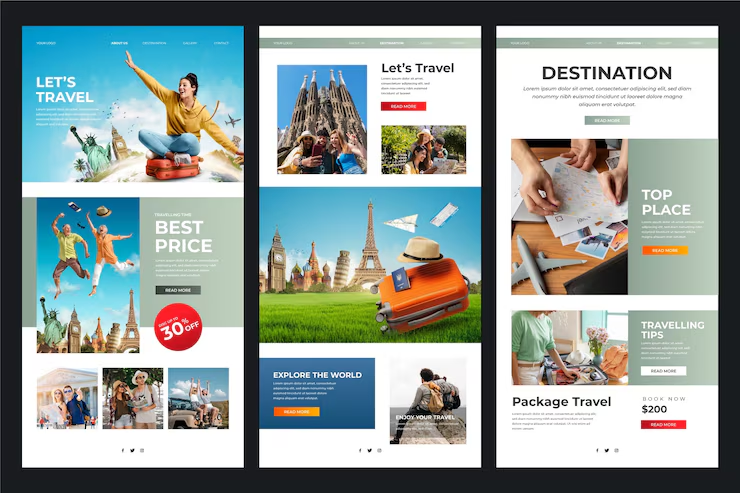
Email marketing for travel agencies is the highest-ROI channel available, returning roughly $36–$42 for every $1 spent, and the 9 smart campaigns that convert are the welcome series, the newsletter, abandoned-quote recovery, personalised trip recommendations, seasonal and flash-deal emails, post-trip follow-ups, re-engagement campaigns, loyalty and referral emails, and automated milestone messages. Set up these nine flows and you'll turn cold leads into booked trips — and one-time travellers into repeat clients — mostly on autopilot.
That's the strategy in one paragraph. Below, we break down all nine campaigns in detail, with real 2026 benchmarks, subject-line tips, SMS add-ons, and the automation tools we build for agencies here at TravelBoost. Whether your list has 50 subscribers or 5,000, email marketing for travel agencies is the single most cost-effective way to grow your bookings.
Key Takeaways
Email is the ROI king. Email marketing returns roughly $36–$42 for every $1 spent — far ahead of paid search ($2) or social ads ($2.80).
Travel emails perform. The travel and hospitality sector sees some of the highest engagement, with open rates that regularly top 30% and strong click rates driven by high-interest booking content.
Automation drives outsized revenue. Automated emails make up a small share of sends but can drive around 30% of email revenue, earning far more per message than one-off blasts.
Personalisation pays. Personalised subject lines are about 27% more likely to be opened, and segmented, personalised emails drive multiples more sales.
SMS supercharges email. SMS marketing for travel agencies boasts a ~98% open rate and a 45% response rate — a powerful complement to email for time-sensitive messages.
Welcome and follow-up win. Welcome emails see open rates as high as 82%, making the first message you send the most valuable one in your funnel.
Why Email Marketing for Travel Agencies Works So Well
Email marketing for travel agencies works because it's the one channel you own — a direct line to your clients that no algorithm can throttle. While social media reach rises and falls with platform changes, your email list is yours. And the numbers make the case better than we can.
The return on investment is unmatched. According to industry benchmarks compiled by sources like HubSpot and Litmus, email marketing generates an average of $36–$42 for every $1 spent — and high-intent sectors like travel and retail can see up to $44 per $1. Data from Litmus and other email research firms consistently ranks email as the highest-ROI digital channel, year after year.
Travel is especially well-suited to email. Per Brevo's 2026 marketing benchmark, the travel and hospitality industry enjoys some of the strongest engagement of any sector, because booking-related content is genuinely high-interest — people want to open emails about their next trip. Meanwhile, Statista projects the global email user base will reach roughly 4.7–4.8 billion people by the end of 2026, with about 392 billion emails sent per day — email isn't dying; it's the most stable channel you have.
At TravelBoost, we help agencies automate exactly these campaigns, and the pattern we see is consistent: agencies that email consistently book more repeat business than those that rely on social media alone. The travel demand is there — Skift Research forecasts continued industry growth in 2026 — so the agencies that capture attention in the inbox win. Let's build your system.
What Is Email Marketing for Travel Agencies?
Email marketing for travel agencies is the practice of sending targeted, relevant emails to prospects and clients to nurture relationships, promote trips, and drive bookings. It ranges from a simple monthly newsletter to sophisticated automated flows triggered by client behaviour.
A few core terms defined up front, since we'll use them throughout:
Segmentation is dividing your email list into groups (by niche, past trips, or engagement) so you can send more relevant messages.
Automation (or a drip campaign) is a series of emails sent automatically based on triggers like signing up or booking.
A welcome series is the automated set of emails a new subscriber receives right after joining your list.
Open rate is the percentage of recipients who open an email; click-through rate (CTR) is the percentage who click a link.
Personalisation means tailoring content to the individual — their name, past trips, or preferences.
A lead magnet is a free resource (a guide or checklist) offered in exchange for an email address.
A CRM (customer relationship management) system stores client data and powers your automated emails.
SMS marketing is sending promotional or transactional text messages to opted-in subscribers.
CAN-SPAM is the US law governing commercial email; compliance is legally required.
With the vocabulary set, here are the nine campaigns that make email marketing for travel agencies convert.
The 9 Smart Email Campaigns That Convert
Here's the full system at a glance before we detail each one. Together, these nine campaigns form a complete email marketing engine for your agency.
# | Campaign | Trigger / timing | Primary goal |
|---|---|---|---|
1 | Welcome series | New subscriber | Build trust, first booking |
2 | Newsletter | Weekly/monthly | Stay top of mind |
3 | Abandoned-quote recovery | Quote not booked | Recover lost bookings |
4 | Personalised recommendations | Segment/behaviour | Relevant upsells |
5 | Seasonal & flash deals | Calendar/promo | Drive urgency bookings |
6 | Post-trip follow-up | After travel | Reviews & referrals |
7 | Re-engagement / win-back | Inactive 3–6 mo | Revive cold leads |
8 | Loyalty & referral | Post-booking | Repeat & referred clients |
9 | Milestone (birthday/anniversary) | Client date | Personal touch, rebooking |
1. The Welcome Series
The welcome series is the most important campaign in email marketing for travel agencies, because it sets the tone for the entire relationship. Welcome emails maintain open rates as high as 82% — your new subscriber will never be more interested than right now. Send a 3–5 email sequence over the first two weeks: introduce yourself and your niche, share your best free resource, tell a client success story, and invite them to book a discovery call. First impressions in the inbox are everything.
2. The Travel Agency Newsletter
A regular newsletter keeps you top of mind so that when a subscriber is ready to travel, you're the first person they call. Well-run travel agency newsletters mix inspiration (destination spotlights), value (planning tips), and soft promotion (a featured trip). Aim for consistency over frequency — a reliable monthly or biweekly newsletter beats sporadic bursts. This is the workhorse of email marketing for travel agencies: low effort, high long-term payoff, and the glue that holds your list together between bookings.
3. Abandoned-Quote Recovery
In e-commerce, abandoned-cart emails recover lost sales; for agencies, the equivalent is the abandoned-quote email. When a prospect requests a quote but doesn't book, an automated follow-up sequence recovers bookings that would otherwise vanish. Abandoned-cart-style emails achieve open rates above 50% and are one of the highest-converting automated flows. Send a gentle reminder, address common objections, add a testimonial, and create light urgency ("prices may rise"). This single campaign often pays for your entire email tool.
4. Personalised Trip Recommendations
Generic blasts underperform; personalised, segmented emails convert. Segment your list by niche, past trips, or stated interests, then send tailored recommendations — "Since you loved Italy, here's a Tuscany villa escape." Personalised subject lines are roughly 27% more likely to be opened, and personalised emails drive several times more sales than generic ones. This is where a CRM earns its keep, letting you deliver one-to-one relevance at scale across your whole list.
5. Seasonal and Flash-Deal Campaigns
Travel is seasonal, and email campaigns for travel that tap into timing convert well. Send targeted promotions around booking windows (New Year "book your summer" campaigns), supplier flash sales, and last-minute deals. Urgency and scarcity — real deadlines, limited availability — drive action. Keep these balanced with value emails so your list doesn't feel constantly "sold to." Seasonal campaigns are where your email marketing for travel agencies turns inspiration into dated, booked revenue.
6. Post-Trip Follow-Up and Review Requests
The moment a client returns home, delighted, is your single best opportunity for reviews and referrals. An automated post-trip sequence thanks them, requests a review, asks for a referral, and plants the seed for their next trip. Transactional and follow-up emails have exceptional open rates because they're expected and personal. This campaign turns one happy trip into reviews, referrals, and repeat bookings — the compounding engine of a travel business.
7. Re-Engagement and Win-Back Campaigns
Not every subscriber stays active. A re-engagement campaign targets contacts who haven't opened or clicked in 3–6 months with a "we miss you" message, a special offer, or a simple "are you still planning to travel?" This revives cold leads and cleans your list — an important step, since a healthy list protects your deliverability. Winning back an existing subscriber costs far less than acquiring a new one.
8. Loyalty and Referral Campaigns
Your existing clients are your cheapest source of new business. A loyalty and referral campaign rewards repeat clients and incentivises them to send friends your way — a discount, an upgrade, or a gift for every referral. Because about half of travellers rely on friend and family recommendations, systematising referrals through email is one of the smartest moves in email marketing for travel agencies. Automate the ask so no happy client is ever missed.
9. Automated Milestone Emails (Birthday & Anniversary)
Small personal touches build loyalty. Automated milestone emails — a birthday greeting, a "one year since your Bali trip" note with a rebooking offer — feel personal but run entirely on autopilot from your CRM. These emails have high open rates because they're genuinely personal, and they're a gentle, welcome nudge toward the next booking. They're the easiest campaign to set up once and benefit from forever.
SMS Marketing for Travel Agencies: The Perfect Email Companion
While email is your foundation, SMS marketing for travel agencies — sending short text messages to opted-in clients — is the ideal complement for time-sensitive, high-priority messages. The engagement numbers are staggering.
SMS boasts a ~98% open rate, with roughly 90% of messages read within three minutes, according to data cited by Forbes and research firms like Gartner. Compare that to email's 20–30% open rate. SMS also drives a 45% response rate versus about 6% for email, and only about 3% of texts are marked as spam, versus nearly half of all emails. With around 97% of adults owning a mobile phone capable of texting (per Pew Research), your message reaches virtually everyone.
Where SMS shines for agencies:
Trip reminders and travel-day alerts ("Your flight departs in 24 hours — safe travels!").
Flash deals and limited availability where speed matters.
Booking confirmations and urgent updates (gate changes, weather delays).
Appointment reminders for consultations, cutting no-shows.
A word of caution: SMS is intimate, so use it sparingly and always with explicit consent. In the US, text marketing requires TCPA compliance and 10DLC registration; sending without written opt-in is both illegal and a fast way to lose trust. Used well — one or two texts a week at most — SMS marketing for travel agencies and email together form an omnichannel system that reaches clients wherever they are.
Channel | Open rate | Response rate | Best for |
|---|---|---|---|
20–35% | ~6% | Storytelling, newsletters, nurturing | |
SMS | ~90–98% | ~45% | Urgent, time-sensitive, confirmations |
The takeaway: email does the heavy lifting of relationship-building; SMS handles the urgent, can't-miss moments. Together they convert.
Email Marketing Benchmarks for Travel Agencies in 2026
How do you know if your email marketing for travel agencies is performing? Compare against these 2026 benchmarks. Remember that Apple Mail Privacy Protection inflates open rates, so click-through rate and conversions are now the most reliable metrics to track.
Metric | Average benchmark (2026) | Good target |
|---|---|---|
Open rate (travel) | 30%+ | 35%+ |
Click-through rate | ~2–4% | 3.5%+ |
Click-to-open rate | ~7–10% | 12%+ |
Unsubscribe rate | <0.5% | <0.2% |
Bounce rate | <2% | <1% |
ROI | $36–$42 per $1 | $44+ per $1 |
Use these as a compass, not a rigid goal. The smartest approach, as most benchmark reports advise, is to establish your own baseline from your last six months of data and aim for steady, incremental improvement — especially in clicks and conversions, which reflect real human engagement. For context on where marketing fits in your broader budget, see our guide to travel agency startup costs.
What Is the Best Email Marketing Software for Travel Agencies?
The best email marketing software for travel agencies is one that integrates with your CRM, so your emails are powered by real client data — past trips, preferences, and booking history. Standalone tools like Mailchimp, Brevo, and Klaviyo handle email well, but they don't know your clients the way your booking system does.
That's the gap we built TravelBoost to close: it unifies your client CRM, bookings, itineraries, and automated email follow-up in one system, so campaigns like abandoned-quote recovery and post-trip reviews trigger automatically from actual booking activity — no manual list-juggling. When your email marketing lives inside the same platform that manages your bookings, personalisation and automation become effortless. You can start a free trial and put these nine campaigns on autopilot today.
Whatever tool you choose, prioritise: strong automation, easy segmentation, good deliverability, and CRM integration. The tool matters less than the system — but the right tool makes the system run itself.
How Often Should a Travel Agency Send Emails?
A travel agency should email its list at least once or twice a month to stay top of mind, with automated flows (welcome, abandoned-quote, post-trip) firing based on behaviour on top of that regular cadence. The exact frequency depends on your audience and content quality.
Here's a simple frequency guide:
Email type | Recommended frequency |
|---|---|
Newsletter | 1–2× per month |
Seasonal promotions | Around booking windows |
Automated flows | Triggered by behaviour (always on) |
SMS | 1–2× per week maximum |
The golden rule: relevance over frequency. Sending more emails that people don't want raises unsubscribes and hurts deliverability. Sending fewer, highly relevant emails keeps your list engaged and your sender reputation strong. When in doubt, lead with value, not promotion.
How Do You Build an Email List for a Travel Agency?
You build an email list for a travel agency by offering something valuable in exchange for an email address, then capturing sign-ups everywhere your audience appears. The foundation is a strong lead magnet — a free destination guide, a packing checklist, or a "questions to ask before you book" PDF.
Proven list-building tactics:
Add a lead-magnet sign-up form to your website and blog.
Promote your freebie on social media and in your bio links.
Collect emails at every client touchpoint — inquiries, consultations, bookings.
Run a giveaway (a travel-themed prize) to attract your niche.
Ask for the opt-in during and after every trip.
Never buy email lists — they destroy deliverability and violate anti-spam laws. A smaller list of engaged, opted-in subscribers always outperforms a large purchased one. Growing your list is a long game, but it's the most valuable marketing asset your agency will ever own. If you're just launching, our guide on how to start a travel agency covers where email fits in your first 90 days.
Is Email Marketing Still Effective for Travel Agencies in 2026?
Yes — email marketing for travel agencies is more effective than ever in 2026, and the data proves it. With an ROI of $36–$42 per $1, a stable and growing user base of nearly 4.8 billion people, and unmatched targeting through segmentation and automation, email consistently outperforms social media and paid ads for actual bookings.
What has changed is how you measure success. Apple's Mail Privacy Protection made open rates less reliable, so the winning agencies now focus on click-through rate, conversions, and automated lifecycle flows. Email has also become more powerful thanks to AI, which improves subject lines and send-time optimisation. Far from fading, email remains the backbone of smart travel agency marketing — and pairing it with SMS only strengthens it. Any agency serious about growth should treat email as a core system, not an afterthought.
Email Marketing Best Practices and Compliance
To get the most from email marketing for travel agencies while staying legal, follow these essentials:
Get explicit consent. Only email people who opted in. In the US, comply with the CAN-SPAM Act — the FTC requires a clear sender identity, a valid physical address, and a working unsubscribe link in every email. If you email EU residents, GDPR applies too.
Write compelling subject lines. Keep them under ~50 characters, personalise where possible, and A/B test.
Design for mobile. Around 64% of emails are opened on mobile, so single-column, tap-friendly layouts win.
Use one clear call to action. Emails with a single CTA can generate dramatically more clicks than cluttered ones.
Segment and personalise. Relevance is the difference between a booking and an unsubscribe.
Keep your list clean. Remove inactive subscribers to protect deliverability.
Automate everything you can. Set up the nine campaigns once and let them run.
Follow these and your email marketing will stay effective, compliant, and profitable. A solid travel agency business plan should include your email and content marketing strategy from day one.
Your 30-Day Email Marketing Action Plan
Knowing nine campaigns is one thing; rolling them out without overwhelm is another. Here's the phased plan our team recommends for launching email marketing for travel agencies from scratch in about a month.
Week 1 — Foundation. Choose your email platform (ideally one connected to your CRM), import and clean your existing contacts, and confirm they've opted in. Create one lead magnet and add a sign-up form to your website so your list starts growing immediately. Draft your sender identity and a compliant email footer.
Week 2 — Welcome and newsletter. Build and switch on your welcome series — the single highest-ROI flow, since welcome emails see open rates up to 82%. Write and schedule your first newsletter. These two campaigns alone put your email marketing for travel agencies to work while you build the rest.
Week 3 — Automation. Set up abandoned-quote recovery and post-trip follow-up flows. These behaviour-triggered emails run forever once built and quietly recover bookings and generate reviews. Segment your list by niche so future sends are personalised.
Week 4 — Layer and optimise. Add seasonal, loyalty, and milestone campaigns, then connect SMS for urgent messages. Review your first metrics — focusing on clicks and conversions, not just opens — and A/B test a subject line. From here, your system largely runs itself.
The mistake we see most often is agencies trying to build all nine campaigns in one weekend, burning out, and abandoning email entirely. A steady, four-week rollout is how email marketing for travel agencies becomes a lasting revenue engine rather than a one-time project. Track your progress monthly and refine what converts.
Common Email Marketing Mistakes to Avoid
Even great campaigns fail with these errors:
Only sending when you want to sell. Lead with value, or your open rates collapse.
No segmentation. Blasting everyone the same message wastes your list's potential.
Ignoring automation. Manual-only email means missed abandoned-quote and follow-up revenue.
Buying lists. It kills deliverability and breaks the law.
Inconsistency. Emailing for a month then going silent erases the trust you built.
Weak subject lines. If it's not opened, nothing else matters.
Skipping compliance. Missing an unsubscribe link or physical address risks real penalties.
Avoid these, stay consistent, and your email marketing for travel agencies will compound month after month.
Frequently Asked Questions
Is email marketing effective for travel agencies? Yes, extremely. Email marketing for travel agencies returns roughly $36–$42 for every $1 spent — the highest ROI of any channel. Travel content enjoys strong engagement because people want to open emails about their next trip, and automation lets agencies nurture leads and drive repeat bookings on autopilot.
How often should a travel agency send marketing emails? At least once or twice a month for your newsletter, plus automated flows (welcome, abandoned-quote, post-trip) triggered by behaviour. Prioritise relevance over frequency — sending fewer, highly relevant emails keeps engagement high and protects deliverability.
What is the best email marketing software for a travel agency? The best software integrates with your CRM so emails are powered by real client data. All-in-one platforms like TravelBoost combine bookings, client data, and automated email, so campaigns trigger from actual activity. Standalone tools like Mailchimp, Brevo, and Klaviyo work but lack booking-level personalisation.
Should travel agencies use SMS marketing too? Yes, as a complement to email. SMS marketing for travel agencies has a ~98% open rate and 45% response rate, ideal for urgent messages like trip reminders and flash deals. Use it sparingly (1–2 texts weekly) and always with explicit opt-in, complying with TCPA rules in the US.
What are travel agency newsletters and what should they include? Travel agency newsletters are regular emails that keep you top of mind between bookings. The best ones mix inspiration (destination spotlights), value (planning tips), and soft promotion (a featured trip), sent consistently once or twice a month.
How do I build an email list for my travel agency? Offer a valuable lead magnet (a free guide or checklist) in exchange for email addresses, add sign-up forms to your site and social profiles, and collect opt-ins at every client touchpoint. Never buy lists — engaged, opted-in subscribers always outperform purchased ones.
Final Thoughts and Your Email Marketing Checklist
You now have nine proven email campaigns to grow your agency in 2026. You don't have to launch all nine at once — start with the highest-impact flows and add the rest as you go. Here's your quick-start checklist:
✅ Set up a welcome series for new subscribers
✅ Launch a consistent monthly newsletter
✅ Automate abandoned-quote recovery
✅ Segment your list for personalised recommendations
✅ Add post-trip review and referral follow-ups
✅ Layer in SMS for urgent, time-sensitive messages
✅ Stay compliant (consent, unsubscribe, physical address)
The agencies that win in 2026 treat email marketing for travel agencies as a core revenue system, not an afterthought. Start with the welcome series and abandoned-quote recovery — the two highest-ROI flows — and build from there, letting automation do the heavy lifting.
Ready to put these campaigns on autopilot? Start your free TravelBoost trial to unify your bookings, client CRM, and automated email in one place — and download our free email campaign templates and marketing checklist to launch this week.
Want a CRM that's actually built for travel?
Leads, bookings, suppliers, Hajj operations, tours, car rental, finance — all in one platform. Set up in 10 minutes.
Start free 14-day trialWeekly playbook for travel-agency operators
One email a week — product updates, benchmarks, and behind-the-scenes changelog. No spam.