- 1What Is a Travel Influencer? The Starting Point for How to Become a Travel Influencer
- Travel Influencer, Travel Blogger or Content Creator: Which Fits How to Become a Travel Influencer?
- 2Is It Still Worth Learning How to Become a Travel Influencer in 2026?
- The demand side: how travellers use creators
- The supply side: how crowded is it?
- The Insight Most Guides on How to Become a Travel Influencer Miss: Trust Beats Reach
- 3How Much Do Travel Influencers Really Earn? The Income Reality Behind How to Become a Travel Influencer
- Per-post rates: a range, not a rule
- The Income Streams of a Working Travel Creator: Travel Influencer Income Explained
- Affiliate income in travel: what the commissions look like
- The Reality Check on How to Become a Travel Influencer
- 4Which Platform Should You Choose When Learning How to Become a Travel Influencer?
- Why not just chase the biggest platform?
- 5What Does It Cost to Start Learning How to Become a Travel Influencer?
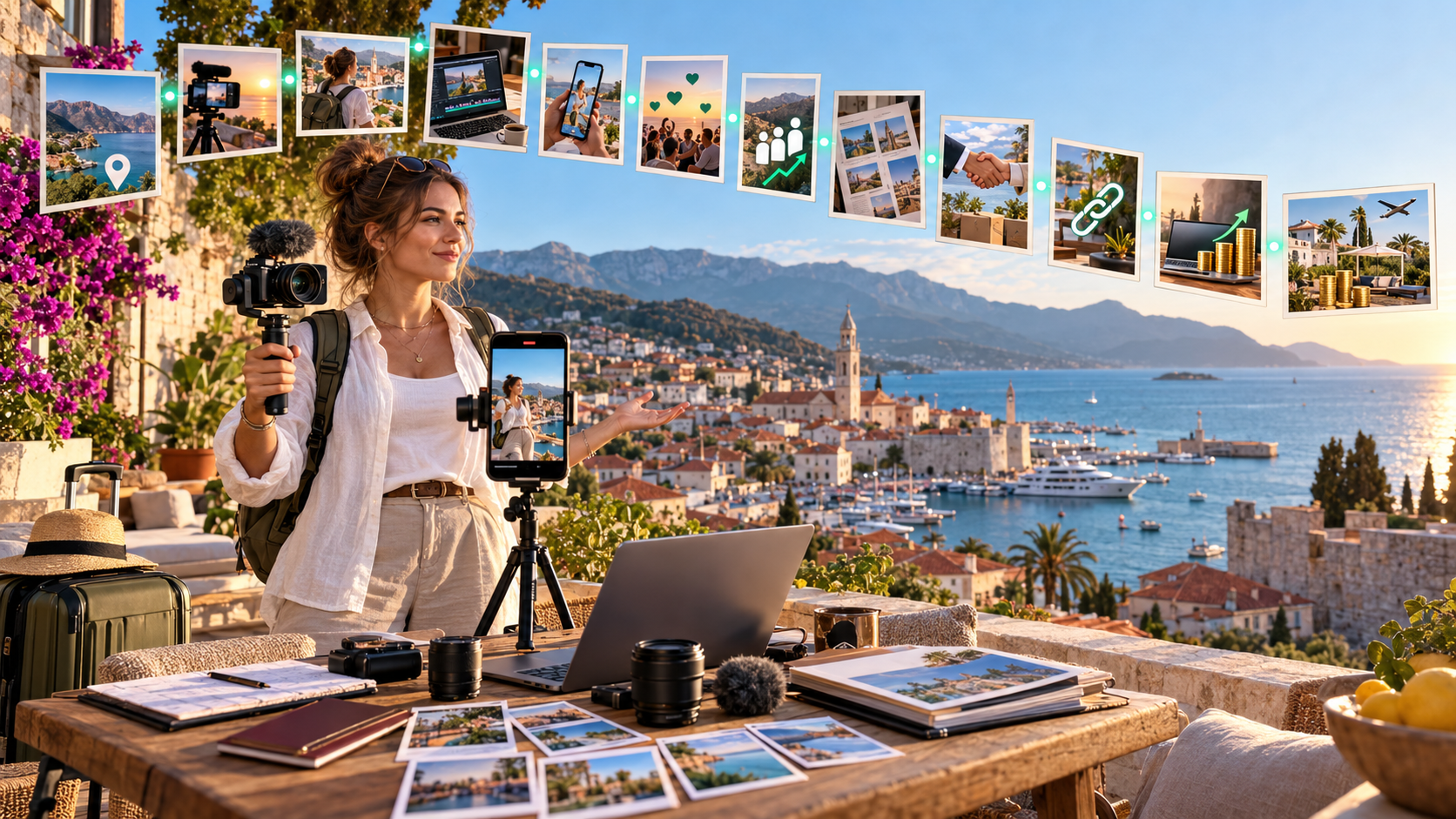
- 6How to Become a Travel Influencer: The 12-Step Roadmap
- Step 1: Define Your Goal Before You Learn How to Become a Travel Influencer
- Step 2: Choose a Niche That Fits How to Become a Travel Influencer
- Step 3: Pick the Right Platforms When Learning How to Become a Travel Influencer
- Step 4: Build Your Brand as You Learn How to Become a Travel Influencer
- Step 5: Set Up Gear and Workflow for How to Become a Travel Influencer Without Overspending
- Step 6: Create a Content System for How to Become a Travel Influencer
- Step 7: Grow Your Audience the Right Way When Learning How to Become a Travel Influencer
- Step 8: Build an Audience You Own, the Safeguard in How to Become a Travel Influencer
- Step 9: Build Travel Influencer Income Streams in a Sensible Order
- YouTube Monetisation Rules in How to Become a Travel Influencer: The 2027 Change
- Step 10: Create a Travel Influencer Media Kit and Pitch Partners
- Is a Free Trip Worth It? A Simple Test for Anyone Learning How to Become a Travel Influencer
- Step 11: Contracts, Disclosure and Ethics for How to Become a Travel Influencer
- Step 12: Measure and Scale Your Plan for How to Become a Travel Influencer
- 7What Does a 12-Month Plan Look Like for How to Become a Travel Influencer?
- 8Can Travel Agents and Agency Owners Become Travel Influencers?
- 9How Can Agencies and Tour Operators Work With Travel Influencers?
- 10What Mistakes Should You Avoid When Learning How to Become a Travel Influencer?
- 11When Is Becoming a Travel Influencer NOT the Right Move?
- 12How Does TravelBoost Fit Into How to Become a Travel Influencer?
- 13Frequently Asked Questions About How to Become a Travel Influencer
- How to Become a Travel Influencer With No Followers
- How many followers do you need to become a travel influencer?
- How much do travel influencers make?
- Which platform is best for travel influencers?
- Do I need to disclose free trips and affiliate links?
- How do travel influencers get free trips?
- Can travel agents become travel influencers?
- How long does it take to become a travel influencer?
- Is it too late to become a travel influencer in 2027?
How to Become a Travel Influencer: 12 Proven Steps to Win in 2027
How to become a travel influencer: pick a niche, choose one platform, post consistently and monetise with brands, affiliates and ads. Follow 12 steps for 2027.
TL;DR — Key takeaways
How to become a travel influencer comes down to six moves: choose a narrow niche, pick one or two platforms where travellers actually look, publish consistently with a recognisable point of view, build an audience you own (email or a website), add several income streams, and run it like a small business.
Most travel creators earn modestly at first. One 2026 rate roundup puts the average sponsored-post rate at $221 across 38,000+ influencers, with the largest group charging under $50, and travel nano-influencers are often paid in free stays rather than cash. Treat early years as building an asset, not a salary.
Where you post matters. A 2026 US survey found YouTube was the top source of travel inspiration at 34%, and Gen Z leaned on TikTok at 52%, while a 2026 UK study found YouTube and Instagram were the most influential platforms for holiday decisions.
YouTube monetisation is about to get harder. From February 1, 2027, new YouTube Partner Program applicants will need 8,000 watch hours or 20 million Shorts views for ad revenue, up from 4,000 and 10 million. The 1,000-subscriber requirement stays, and existing members are not affected by that threshold change.
Disclose every free trip. In the US, free flights, hotel stays and experiences are "material connections" that must be disclosed clearly, and a 2024 FTC rule also targets buying fake followers or views. Brands can be liable too.
Free travel is not income. In our illustrative example, a $900 comped stay costs a creator about $1,000 once flights, meals and 20 hours of work are counted, so it only makes sense for trips you would have taken anyway.
Show Image
How to become a travel influencer is a question about building trust at scale: you create travel content that a specific audience finds useful or inspiring, grow that audience on one or two platforms, and then earn from the relationship through brand partnerships, affiliate commissions, advertising revenue, products and services. The glamorous version, flying business class for free, is rare. The realistic version is a small media business that starts slowly, rewards consistency and compounds over years.
We build software for travel agencies, tour operators and destination companies, so we see this world from the other side of the table. We see creators pitching tourism boards, advisors turning social followings into client lists, and tour operators deciding which creators to host. That vantage point shows what works and what is wasted effort, and it is why this guide answers how to become a travel influencer step by step. This guide uses it to give you a practical route, with 2026 data on where travellers look, what creators earn, how platform monetisation is changing and what the rules require.
Whether you want to learn how to become a travel influencer to travel more, earn a side income, build a full-time career or support a travel business, the steps below apply. We also include a section for travel agents who want to become influencers, and one for agencies and operators who want to work with creators.
What Is a Travel Influencer? The Starting Point for How to Become a Travel Influencer
Understanding the role is the first step in how to become a travel influencer. A travel influencer is a creator who shares travel experiences, advice or inspiration with an audience on social platforms, video channels, blogs or newsletters, and who has enough trust with that audience to affect what people book, buy or visit. The term covers solo backpackers, luxury hotel reviewers, family travel bloggers, tour guides, food travellers, travel advisors and many other types.
These are the terms we use in this guide:
Niche: the specific topic or audience you serve, such as solo female travel in Southeast Asia or accessible travel in Europe.
Content pillar: a recurring theme within your niche that structures your content.
Engagement rate: interactions such as likes, comments, shares and saves divided by reach or followers.
Nano, micro, mid-tier and macro influencer: size bands, usually roughly 1,000 to 10,000 followers (nano), 10,000 to 100,000 (micro), 100,000 to 500,000 (mid-tier) and 500,000 or more (macro).
Media kit: a short document showing who you are, your audience, your rates and your past work.
Affiliate link: a tracked link that pays you a commission when someone books through it.
Fam trip (familiarisation trip): a trip hosted by a destination, hotel or operator so that you can experience and promote it.
Usage rights: permission for a brand to reuse your content in its own marketing, which is normally priced separately.
Material connection: any benefit you receive from a brand that might affect how your audience views your endorsement. It must be disclosed.
YouTube Partner Program (YPP): YouTube's programme for earning ad revenue and other income.
Travel Influencer, Travel Blogger or Content Creator: Which Fits How to Become a Travel Influencer?
The words overlap. A travel blogger usually publishes written guides on a website and earns from search traffic. A travel influencer usually builds attention on social platforms. A travel content creator is the broadest term and often means someone who produces photos, video or writing for their own channels and for brands. Many successful creators do all three. If your interest is the writing and website side, you will find the discipline closely related to the search and content work covered in our guide to niche tourism, which explains how focused travel segments build loyal audiences.
Is It Still Worth Learning How to Become a Travel Influencer in 2026?
It is worth learning how to become a travel influencer in 2026 if you treat it as a business with a long runway, because travellers are using video, social media and AI to plan trips, brands still pay for trusted voices, and your audience becomes an asset you own. It is not worth it if you expect fast fame or free luxury travel.
The demand side: how travellers use creators
YouTube leads for inspiration in the US. A Talker Research survey of 2,000 Americans found YouTube was the top travel-inspiration source at 34%, ahead of family at 30% and friends at 28%. Among Gen Z, TikTok led at 52%. It also found 29% of respondents had asked AI where to go.
Social shapes UK decisions. MMGY Travel Intelligence's 2026 study, reported by Hospitality Net, found 46% of UK travellers say social media influences their holiday decisions, with YouTube and Instagram the most influential for inspiration, and 52% use AI for trip planning.
TikTok inspires younger travellers. Aer Lingus research reported in the Meath Chronicle found 45% of 18 to 34 year olds in Ireland say TikTok inspires their travel choices.
The supply side: how crowded is it?
It is crowded, and most creators earn little. A Neal Schaffer rate roundup reports an average rate of $221 per post across 38,000+ influencers, with the largest group charging under $50, and describes nano-influencers earning $10 to $100 per post, micro-influencers $100 to $1,000, macro-influencers $1,000 to $10,000 and mega-influencers $10,000 to over $100,000. A travel-focused article from Explurger says nano and micro travel creators often earn a few hundred dollars a month and are frequently paid in free flights, stays and experiences rather than cash.
The Insight Most Guides on How to Become a Travel Influencer Miss: Trust Beats Reach
Most advice about how to become a travel influencer focuses on follower counts. The more useful variable is trust within a specific audience. Travel is a high-consideration purchase. People book flights and hotels based on whether they believe the person recommending them. A creator with 8,000 followers who consistently helps solo travellers plan safe, affordable trips in one region can drive more bookings than a creator with 200,000 followers who posts pretty pictures from everywhere.
Vendor data points the same way, though it should be read with caution. LaunchPoint's guide to travel nano-influencer rates claims travel nano-influencers deliver a 7% average conversion rate per post versus 3% for macro-influencers and engagement as high as 10.3% on TikTok. Those are marketing-vendor figures, not independent research, but they match what many brands report: small, trusted creators can outperform large, passive ones per dollar.
That is good news if you are starting out. You do not need a million followers. You need a clear niche and an audience that believes you.
How Much Do Travel Influencers Really Earn? The Income Reality Behind How to Become a Travel Influencer
Travel influencers earn anywhere from nothing to six figures, and most earn modest amounts in the early years, often mixing small cash payments with free stays. Published rate cards differ widely, so treat any single number as a rough guide and expect your income to depend on niche, engagement, platform and how many income streams you build.
Per-post rates: a range, not a rule
Source | Tier | Estimated rate per sponsored post |
|---|---|---|
Neal Schaffer (all niches) | Nano | $10 to $100 |
Neal Schaffer (all niches) | Micro | $100 to $1,000 |
Neal Schaffer (all niches) | Macro | $1,000 to $10,000 |
Elev8or Creator Rate Report, June 2026 (travel niche) | Micro (10K to 100K) | $300 to $1,800 |
Elev8or Creator Rate Report (travel niche) | Mid (100K to 500K) | $1,800 to $6,000 |
Elev8or Creator Rate Report (travel niche) | Macro (500K+) | $6,000 to $14,400 |
LaunchPoint (US travel nano) | Nano | $50 to $500, often comped rooms |
The Elev8or Creator Rate Report is a marketplace's modelled estimate rather than a survey of payments, and it describes micro creators as earning $250 to $1,500 per post as a baseline before niche adjustments. Real deals are negotiated, and many small creators accept less, or accept products and trips instead of cash.
The Income Streams of a Working Travel Creator: Travel Influencer Income Explained
Stream | How it works | When it becomes realistic |
|---|---|---|
Brand partnerships | Paid posts, videos or campaigns for hotels, tour operators, destinations and gear brands | Often from a few thousand engaged followers, but small at first |
Affiliate commissions | Earn a percentage when followers book through your links | From day one, but income scales with traffic |
Platform ad revenue | Paid by platforms such as YouTube | After meeting monetisation thresholds |
Digital products | Itineraries, guides, presets, templates | Once you have a recurring audience question |
Services | Consulting, trip planning, content creation for brands | Once you have proof of results |
Trips and tours | Host paid group trips or retreats | Once you have a loyal audience and local partners |
Newsletter and membership | Sponsorships or subscriptions | When you have an engaged email list |
Affiliate income in travel: what the commissions look like
Affiliate rates vary and change. A Track360 rate-card benchmark reports Viator at about 8% on booking value and GetYourGuide at about 8%, and explains that Booking.com and Expedia pay a share of their own commission rather than a share of the trip price, so a 25% to 40% share of a 10% to 15% commission nets the partner a low single-digit percentage of the trip price. A Stay22 roundup gives wider ranges across programs, from about 4% to 40% depending on program and product. Check each program's current terms, cookie windows and rules before you promote.
Practical meaning: a $200 tour booked through your link at 8% earns $16. You need volume, and you need to recommend products your audience actually wants.
The Reality Check on How to Become a Travel Influencer
Realistic travel influencer income comes from the middle of the market, not the top. Do not plan around the top. Plan around the middle. A realistic first year looks like building skills, a portfolio and an audience, with modest income from affiliates and perhaps a few small brand deals. Full-time income, when it comes, usually arrives after years of consistent work and several income streams, not from a single viral post.
Which Platform Should You Choose When Learning How to Become a Travel Influencer?
Choose the platform where your target audience already looks for travel ideas, where your content format fits and where monetisation is realistic for your timeline. For most beginners, one video platform plus an owned channel such as email beats trying to be everywhere.
If your goal is... | Lean toward | Why | Watch out for |
|---|---|---|---|
Fast discovery with a young audience | TikTok and Reels | Short video is easy to discover; Gen Z leans on TikTok for inspiration | Reach is volatile and loyalty is lower |
Long-term search traffic and trust | YouTube | Videos keep working for years and can carry chapters and links | Higher production effort; stricter monetisation thresholds from 2027 |
Brand deals and visual partnerships | Strong for hotels, destinations and aesthetic niches | Algorithm changes and competition | |
Affiliate and planning income | Blog or website plus Pinterest | Planners search for guides and itineraries | Slower start |
Direct relationships and sponsors | Newsletter | You own the list | Needs a lead magnet and regular sends |
A practical combination for a small team of one: make one longer piece a week (a video or a guide), cut it into three or four short clips, and send one newsletter. That workflow serves search, discovery and ownership without tripling your workload.
Why not just chase the biggest platform?
Because audience fit beats raw scale. The 2026 survey data shows that preferences differ by age and country: YouTube led overall in the US survey, TikTok led among Gen Z, and YouTube and Instagram led in the UK study. A platform where your audience is not present will not pay you back for the effort.
What Does It Cost to Start Learning How to Become a Travel Influencer?
You can start with almost nothing, because a phone, natural light and free editing tools are enough, and your main cost is time and, if you travel, the trips themselves. Budget for gear, software, a website and the trips you take on your own account.
Item | Typical starting range (illustrative) | Notes |
|---|---|---|
Phone | $0 if you already own one | Recent phones shoot excellent video |
Microphone | $30 to $100 | Audio quality matters more than video quality |
Tripod or small gimbal | $20 to $150 | Stability for walking and timelapse shots |
Editing software | $0 to $30 a month | Free tools are enough to start |
Domain and hosting | $60 to $200 a year | Needed for a website or blog |
Email platform | $0 to $20 a month | Free tiers exist for small lists |
Backup storage | $50 to $150 | Protects your footage |
Travel costs | Variable | The largest cost; keep a budget per trip |
Time | 8 to 15 hours a week | The real investment |
The common trap is buying a camera kit before you have proved the habit. Spend on audio and consistency first, and on travel only as far as your income supports. If you earn nothing for a year and spend $5,000 on trips, you have a hobby, not a business, and that is fine as long as you know which one you are running.
How to Become a Travel Influencer: The 12-Step Roadmap
How to become a travel influencer in 12 steps: define your goal, choose a niche, pick your platforms, build your brand, set up your gear and workflow, create a content system, grow your audience, build an owned audience, add income streams, create a media kit and pitch brands, handle contracts and disclosure, and measure and scale. The order matters because each step supports the next.
Step | Action | Output |
|---|---|---|
1 | Define your goal and model | A one-sentence reason and income target |
2 | Choose a niche | A clear audience and promise |
3 | Pick one or two platforms | A focused channel plan |
4 | Build your brand | Name, bio, visual identity |
5 | Set up gear and workflow | A repeatable production routine |
6 | Create a content system | Pillars, formats and a calendar |
7 | Grow your audience | Distribution and community habits |
8 | Build an owned audience | Email list or website |
9 | Add income streams | A monetisation stack |
10 | Create a media kit and pitch | Brand and destination partnerships |
11 | Handle contracts, disclosure and ethics | Clean, compliant deals |
12 | Measure and scale | A monthly review and a growth plan |
Step 1: Define Your Goal Before You Learn How to Become a Travel Influencer
Your goal decides everything else. Common goals include:
Side income of a few hundred dollars a month.
A full-time career replacing a salary.
A business accelerator, such as growing a tour company, a guiding business or a travel advisory.
Creative expression and community, with money as a bonus.
Write one sentence: "In 12 months I want [outcome] by serving [audience] with [content]." Then decide how much time you can give. A creator posting four times a week for a year is in a different league from one posting twice a month.
Step 2: Choose a Niche That Fits How to Become a Travel Influencer
A niche is the narrowest audience you can serve well while still having enough people to grow. The broad niche "travel" competes with every creator on earth. A narrower niche gives you a place to stand.
Niche example | Audience | Why it works |
|---|---|---|
Solo female travel in a region | Women planning first solo trips | Clear safety and planning questions |
Family travel with toddlers | Parents of young children | High-consideration, repeat questions |
Budget backpacking | Young travellers with limited money | Large audience, many affiliate options |
Luxury and boutique stays | High-income travellers | High-value brand partners |
Accessible travel | Travellers with mobility needs | Underserved, high trust |
Food and culinary travel | Travellers organised around eating | Strong visual content |
Slow and sustainable travel | Conscious travellers | Distinct values and partnerships |
Adventure and hiking | Active travellers | Strong gear and tour affiliate fit |
Digital nomad life | Remote workers | Tools, visas, coworking |
Local expert in one destination | Visitors to that destination | Deep knowledge, tour and guide opportunities |
Use three tests:
Do you know it, or can you learn it faster than anyone else? First-hand experience beats generic content.
Is there an audience with money or intent? Planning questions lead to bookings.
Can you make 100 pieces of content about it without repeating yourself?
Combine a topic (family travel), a place (Portugal) and a point of view (low-stress, slow itineraries). That combination is hard to copy.
Step 3: Pick the Right Platforms When Learning How to Become a Travel Influencer
You cannot be everywhere at the start. Choose by audience, format and your strengths.
Platform | Strength for travel | Typical audience | Notes |
|---|---|---|---|
YouTube | Search, long-term traffic, trust, ad revenue | Broad; strong for planning | Top inspiration source in the US survey |
TikTok | Discovery, short video, younger audiences | Gen Z and younger millennials | Fast reach, less loyalty |
Visual brands, Reels, collaborations | Millennials and above | Strong for brand deals | |
Blog or website | Search traffic, affiliate income, ownership | Planners | Slower but compounding |
Newsletter | Direct relationship, sponsorships | Loyal followers | Owned audience |
Planning inspiration, evergreen traffic | Planners | Useful for guides and itineraries | |
Business and professional travel niches | Professionals | Niche but valuable |
The survey data suggests a sensible default. For planners and a general audience, YouTube and a website pair well. For a younger audience, TikTok and Instagram lead. Pick one primary platform to master and one secondary to repurpose content. Expand only when the first is producing.
Step 4: Build Your Brand as You Learn How to Become a Travel Influencer
Your brand is the promise people remember. Keep it simple.
Name and handle: easy to say, spell and search; consistent across platforms.
Bio: who you help and what they get, in one line. For example: "Slow, low-stress family itineraries for Portugal."
Profile photo and banner: a clear face or a strong logo.
Visual style: a consistent set of colours, fonts and editing habits.
Voice: how you sound. Friendly expert, funny storyteller, calm guide.
Proof: a few strong pieces pinned or featured.
Check that your handle is available on the main platforms and, if you plan a website, that the domain is free.
Step 5: Set Up Gear and Workflow for How to Become a Travel Influencer Without Overspending
You do not need expensive equipment to start. A recent smartphone, natural light and decent audio get you far.
Item | Starter option | Upgrade when |
|---|---|---|
Camera | Your phone | You need better low-light or lens options |
Audio | A small clip-on or wireless microphone | Voice-led content is core |
Stabilisation | A compact gimbal or tripod | You shoot walking footage often |
Editing | A phone or desktop editing app | You publish long-form video |
Storage | Cloud backup plus an external drive | You shoot lots of video |
Power | Portable battery pack | Always |
Organisation | A notes app and a shot list | Always |
A simple workflow keeps you consistent: plan, capture, edit, publish, review. On trips, capture more than you need: wide shots, close-ups, people, food, transport, signs, prices. Keep a daily note of costs, times and tips, because facts become content.
Step 6: Create a Content System for How to Become a Travel Influencer
Random posting burns out creators. A system gives you ideas on demand.
Content pillars. Choose three to five themes. For a family travel creator in Portugal these might be itineraries, practical tips, where to eat with kids, budget breakdowns and honest reviews.
Formats. Mix:
Short video for discovery.
Long video or written guides for depth and search.
Carousels or saved posts for itineraries and checklists.
Stories or community posts for conversation.
Hooks. The first few seconds decide whether anyone watches. Lead with the promise or the surprise: "This is what a 7-day Portugal trip with a toddler really costs."
Searchable titles and captions. Many travellers search on YouTube, Google, TikTok and Instagram. Use plain, specific wording that people actually type: place, activity, season, budget, traveller type.
Calendar. Plan a month at a time. A realistic cadence for a beginner is two to four pieces a week on the primary platform. Consistency beats bursts.
Original value. For each piece, ask: what does this add that a generic search result does not? Prices you checked, maps you drew, mistakes you made, and details you measured make content worth saving.
Step 7: Grow Your Audience the Right Way When Learning How to Become a Travel Influencer
Growth comes from three things: being discoverable, being worth following and being present.
Be discoverable.
Use searchable titles, captions and on-screen text.
Post natively on each platform instead of cross-posting watermarked clips.
Make thumbnails and covers clear and honest.
Add chapters and descriptions to YouTube videos, and link related guides.
Be worth following.
Give a clear reason to follow: a series, a recurring format, a promise.
Reuse your best-performing ideas in new ways.
Study the comments. Questions from viewers are your next ten videos.
Be present.
Reply to comments and messages, especially in the first hours after posting.
Collaborate with creators in adjacent niches, not competitors in identical ones.
Join communities where your audience gathers and be useful without spamming.
Do not buy followers, views or comments. Fake engagement hurts your credibility and your reach, brands increasingly check for it, and in the US a 2024 FTC rule targets the sale and purchase of fake indicators of social influence, as summarised in a 2026 Beancount guide to the FTC's crackdown. A smaller real audience is worth more than a larger fake one.
Step 8: Build an Audience You Own, the Safeguard in How to Become a Travel Influencer
Social platforms change their rules, their algorithms and their payouts. An owned audience protects you.
Owned channel | What it gives you | How to start |
|---|---|---|
Email newsletter | Direct access to your most engaged followers | Offer a free itinerary, packing list or checklist in exchange for an email address |
Website or blog | Search traffic, affiliate income, a home for guides | Publish your best planning guides and link them from your profiles |
Community | A place to talk with followers | A free group or channel once you have regular readers |
A simple lead magnet works well in travel: "My 7-day Portugal itinerary with real prices," or "Packing list for a carry-on-only month." Link it in every bio and at the end of videos. If you later build a website, our guide to building a travel agency website shows how the pages and structure work together, and the same logic applies to a creator site.
Step 9: Build Travel Influencer Income Streams in a Sensible Order
To monetise a travel channel, do not wait for brand deals. Build a stack, in this order.
Phase | Timing (typical) | Income focus |
|---|---|---|
Foundation | Months 1 to 6 | Affiliate links on genuinely useful content; small gifted collaborations; skills and portfolio |
Early income | Months 6 to 12 | First paid collaborations; a digital product such as an itinerary pack; email list sponsorships |
Growth | Year 2 | Platform monetisation; repeat brand partners; services and consulting |
Scale | Year 2 onwards | Paid trips or retreats; team and production; multiple products |
These are illustrative timelines. Your pace depends on niche, effort and luck.
YouTube Monetisation Rules in How to Become a Travel Influencer: The 2027 Change
If YouTube is part of your plan, timing matters. According to AIR Media-Tech's summary and vidIQ's guide:
Programme tier | Today | From February 1, 2027 (new applicants) |
|---|---|---|
Fan funding and Shopping | 500 subscribers, 3 public uploads in 90 days, plus 3,000 watch hours or 3 million Shorts views | Reported as unchanged |
Ad revenue | 1,000 subscribers plus 4,000 watch hours in 12 months, or 10 million Shorts views in 90 days | 1,000 subscribers plus 8,000 watch hours, or 20 million Shorts views |
AIR notes that YouTube announced the change on August 10, 2026, that existing members are not affected by the new entry threshold, and that from the same date, keeping Shorts revenue specifically will require staying above 10 million qualified Shorts views in the trailing 90 days. If you are close to the current thresholds, apply before the change takes effect. If you are far away, plan for the higher bar and build other income streams in parallel. Check YouTube's own Studio page for current terms in your country, because programme rules vary by region.
Step 10: Create a Travel Influencer Media Kit and Pitch Partners
A media kit is a one- or two-page summary you can send in seconds.
What goes in a media kit:
Who you are: a short bio and a clear photo.
Your niche and promise.
Audience data: follower counts, average views, engagement, top countries, age and gender split, from your platform analytics.
Past work: three to five examples with results.
Services and rates: or a "from" price for packages.
Contact details and links.
How to set a rate. Start with expected performance, not follower count. A simple illustrative formula is:
Rate = average views × (CPM ÷ 1,000) + extras
If your videos average 20,000 views and a fair CPM for your niche is $25, the base is $500. Add fees for extra deliverables, rush work, usage rights and exclusivity. Compare with the ranges earlier, then adjust for your audience quality, since a highly relevant micro audience can justify more than the average.
Where to pitch.
Partner type | What they want | Your pitch angle |
|---|---|---|
Hotels and resorts | Content, bookings, reviews | Audience fit; past content; proposed deliverables |
Tour operators and DMCs | Bookings and quality content | A specific itinerary idea and expected audience |
Tourism boards | Destination awareness | Alignment with their themes and target markets |
Airlines and transport | Reach | Audience size and region |
Gear and tech brands | Product demonstrations | Relevant trips and honest reviews |
Booking platforms | Affiliate traffic | Content that drives conversions |
A short pitch template:
Subject: [Destination] content idea for [Your Niche] travellers
Hi [Name], I create [niche] content for [audience size and platform], with an average of [views] per video and [top market]. I'd like to propose [specific idea] during [dates]. I'd deliver [deliverables], tag your property and share results afterward. My media kit is attached. Would you be open to a call this week? Thanks, [Name]
Keep it short, specific and about their goals.
Is a Free Trip Worth It? A Simple Test for Anyone Learning How to Become a Travel Influencer
The "free travel" promise misleads many beginners. Use this test: net value = cash fee + the value of items you would have bought anyway − your out-of-pocket costs − the value of your time.
Item | Illustrative amount |
|---|---|
Comped 3-night stay (retail value) | $900 |
Cash fee | $0 |
Value of the stay you would have bought anyway | $0 (you would not have booked it) |
Flights you pay for | $350 |
Meals and local transport | $150 |
Content time: 20 hours at $25 an hour | $500 |
Total cost to you | $1,000 |
Net outcome | about −$1,000, before any content or exposure value |
Illustrative figures.
The lesson: a freebie only counts when it replaces something you would have paid for. Before you accept a comped trip, ask whether you would have taken it anyway, whether the deliverables are reasonable and whether you will earn usable content for your portfolio or your own channels. Some free stays are good investments, particularly early, when you need portfolio pieces. Many are not.
Step 11: Contracts, Disclosure and Ethics for How to Become a Travel Influencer
This step protects your income and your audience's trust.
Disclosure rules. Rules differ by country, but the principle is consistent: tell people when you have a commercial relationship.
United States. The FTC requires clear and conspicuous disclosure of any "material connection," which includes payment, free products, brand trips, hotel stays, meals and experiences, as summaries such as JoinBrands' FTC guide explain. The rules apply regardless of follower count, and affiliate commissions count too. Placing the disclosure at the start of a caption or early in a video is safer than burying it among hashtags.
United Kingdom. Traverse Legal's summary notes the Advertising Standards Authority expects labels such as "Ad" or "Advert" at the beginning of posts.
Brands share liability. Several 2026 guides state that brands can be liable if an influencer fails to disclose, so many brands will insist on disclosure clauses.
Fake engagement. The 2024 FTC rule on fake reviews and fake indicators of social influence carries civil penalties, according to the Beancount summaries.
This is general information, not legal advice. Check the rules where you live and where your audience lives, and take advice for larger deals.
What a contract should cover.
Clause | Why it matters |
|---|---|
Deliverables and deadlines | Avoids scope creep |
Payment amount, schedule and method | Protects your cash flow |
Approval rounds | Limits endless revisions |
Usage rights and duration | Reuse should cost extra |
Exclusivity | Restricts working with competitors; should be paid for |
Disclosure requirements | Keeps you compliant |
Cancellation and kill fee | Covers flights and changes |
Travel logistics and costs | Clarifies what is covered |
Content ownership | Who owns raw footage and final edits |
Ethics in travel content.
Be honest about comps. Say when a trip was hosted.
Be honest about safety and conditions. Do not hide risks to get a better shot.
Respect local people and places. Ask permission for portraits, follow rules on drones and protected areas, and avoid promoting overtourism hotspots without context.
Think about your audience. If you promote a destination with entry or safety concerns, link official advice.
Do not make unverifiable claims about prices, availability or health.
Step 12: Measure and Scale Your Plan for How to Become a Travel Influencer
Review monthly. Track what you can influence.
Metric | What it shows |
|---|---|
Reach and views | Whether content is discoverable |
Average view duration or watch time | Whether content holds attention |
Saves, shares and comments | Whether content is useful |
Follower growth | Whether your audience is building |
Link clicks and conversion | Whether your content drives action |
Affiliate earnings per click | Which links and topics pay |
Email subscribers | Your owned audience |
Revenue by stream | Which income sources work |
Hours worked | Whether the business is sustainable |
Scale carefully:
Double down on what works. Make more of the formats and topics that perform.
Systemise. Template your planning, shot lists, editing and posting.
Outsource the low-value work, such as editing or captioning, once income allows.
Diversify. Add a second platform or product only when the first is stable.
Protect your health. Burnout is common; plan rest and slower seasons.
What Does a 12-Month Plan Look Like for How to Become a Travel Influencer?
A 12-month plan for how to become a travel influencer builds foundations in the first quarter, finds your formats in the second, begins monetising in the third and expands in the fourth. Use it as a template and adjust to your time and niche.
Months | Focus | Key actions | Target |
|---|---|---|---|
1 to 3 | Foundation | Choose niche and platform; set up profiles; publish 30 to 50 pieces; start an email list | Consistent habit; first 1,000 followers or subscribers |
4 to 6 | Find your formats | Analyse your best content; refine pillars; add a searchable long-form format; join affiliate programs | Repeatable content system; first affiliate income |
7 to 9 | Start monetising | Create a media kit; pitch 20 relevant partners; launch a simple digital product | First paid collaboration; email list of a few hundred |
10 to 12 | Expand and review | Add a second platform or website; negotiate repeat partners; plan year two | Several income streams; a clear plan |
Treat the targets as examples, not promises. Audience growth is uneven and depends heavily on niche, quality and luck.
Can Travel Agents and Agency Owners Become Travel Influencers?
Yes. Travel agents and agency owners can become travel influencers, and for them how to become a travel influencer is as much about conversion as audience. The combination is powerful, because an advisor-creator has both an audience and a way to turn trust into bookings. The key is to be transparent about commissions and to follow both advertising rules and your local rules for selling travel.
Why it works. A creator can inspire and educate but often cannot book the trip. An advisor can book but may struggle to reach new clients. Combining the two means your content generates enquiries rather than just likes.
What to adapt.
Creator habit | Advisor adaptation |
|---|---|
Pretty destination content | Content that answers planning questions and shows real itineraries |
Affiliate links | Direct enquiry forms and quotes, plus commissions disclosed |
Brand deals | Supplier partnerships and fam trips for training |
Followers as the goal | Enquiries, quotes and bookings as the goal |
What to watch.
Disclose commissions and relationships with suppliers in your content.
Know your licensing and consumer-protection obligations for selling travel in your market.
Capture and follow up enquiries fast. Social enquiries go cold quickly.
Separate personal and business accounts where appropriate.
If you are considering the agent side of this combination, our guide on how to become a travel agent explains qualifications, models and the path to selling travel professionally, which we do not repeat here.
How Can Agencies and Tour Operators Work With Travel Influencers?
Agencies and tour operators can work with travel influencers by choosing creators whose audience matches their guests, agreeing clear deliverables and disclosure, tracking results with unique links, and following up fast on enquiries. Small, trusted creators often fit small operators best.
Agencies that understand how to become a travel influencer, including its economics, negotiate better and choose better partners.
Define the goal. Bookings, enquiries, content for your own channels or awareness.
Choose the right creator. Look at audience location, engagement quality and relevance, not just follower count.
Check authenticity. Review comment quality and growth patterns, and ask for platform analytics.
Agree deliverables and rights. Number of posts, timelines, usage rights and exclusivity.
Require disclosure. Put it in the contract. Brands can be liable for missing disclosure.
Give a trackable link or code, so you can attribute bookings.
Prepare for the response. Have a booking path and a fast reply process ready.
Review and repeat with creators who deliver.
For ideas on structuring social activity as part of your wider marketing, see our guide to social media marketing for travel agencies.
What Mistakes Should You Avoid When Learning How to Become a Travel Influencer?
The most common mistakes are choosing no niche, copying everyone else, chasing followers instead of trust, accepting bad free deals, ignoring disclosure, buying engagement and building only on one platform. Here are twelve:
No niche. "Travel" is too broad to stand out.
Copying viral formats without a point of view.
Spreading across five platforms and doing none well.
Chasing follower counts instead of engaged, relevant followers.
Accepting free trips that cost more than they return.
Skipping disclosure or hiding it in hashtags.
Buying followers, views or comments.
Ignoring owned channels, so one algorithm change wipes out your reach.
Underpricing and giving away usage rights.
Posting inconsistently, then quitting after three months.
Faking a lifestyle. Audiences notice, and travel is full of real constraints and costs.
Ignoring ethics and safety, from drone rules to local customs.
When Is Becoming a Travel Influencer NOT the Right Move?
Becoming a travel influencer is not the right move if you need reliable income soon, dislike being on camera or writing regularly, or are unwilling to be transparent about sponsored content. We build business software and will be direct:
You need a salary now. Income takes time and is uneven.
You cannot publish consistently. The model rewards regular output.
You expect free luxury travel. The economics rarely work that way.
You are uncomfortable disclosing relationships. Disclosure is not optional.
You would rather sell travel than create content. The agent route may fit better.
If those points describe you, how to become a travel influencer may not be the right question yet. If your real goal is a travel career, the creator path is one of several. Advisory, guiding, operations and content roles all exist.
How Does TravelBoost Fit Into How to Become a Travel Influencer?
TravelBoost is not an influencer tool. It is useful if your content leads to travel sales, for example if you are a travel advisor, a small agency owner or a tour company that works with creators. It captures the enquiries your content produces, records where they came from, helps you follow up quickly and shows which sources become bookings.
With TravelBoost you can:
Capture every enquiry in one pipeline, whether it came from a reel, a video, a newsletter or a creator partner.
Record the source on each lead, such as a specific creator link or code.
Send an automatic acknowledgement and set a reminder for a personal reply, because social enquiries go cold fast.
Build quotes and itineraries and follow up if the client goes quiet.
Convert accepted quotes into bookings, invoices and payment schedules.
Track commissions and costs alongside bookings, so you can see which content and partnerships are profitable.
It does not edit your videos, schedule your posts or track your followers. Use your platform analytics and creator tools for that. Confirm in your trial exactly how enquiries from your website forms and messaging channels reach your pipeline. If your content is already producing enquiries you cannot track, start with TravelBoost and set up source tracking first.
Frequently Asked Questions About How to Become a Travel Influencer
How to Become a Travel Influencer With No Followers
Start by choosing a narrow niche and one primary platform, then publish consistently for at least three to six months. Focus on useful, specific content for a defined audience, ask for follows from people who benefit, and build an email list. Followers come from consistency and clarity, not from posting everywhere.
How many followers do you need to become a travel influencer?
There is no fixed minimum. Brands work with nano-influencers from about 1,000 followers, and engagement and audience fit matter more than raw numbers. Platform monetisation has its own thresholds, such as YouTube's requirement of 1,000 subscribers plus watch hours or Shorts views for ad revenue.
How much do travel influencers make?
Earnings vary widely. One 2026 roundup puts the average sponsored-post rate at $221 across more than 38,000 influencers, with the largest group charging under $50, while travel micro-influencers are estimated at $300 to $1,800 per post in one marketplace report. Many early creators earn little cash and receive free stays.
Which platform is best for travel influencers?
It depends on your audience. A 2026 US survey found YouTube was the top travel inspiration source at 34%, while Gen Z leaned toward TikTok at 52%, and a UK study found YouTube and Instagram most influential. Choose one primary platform that fits your audience and format, and repurpose to a second.
Do I need to disclose free trips and affiliate links?
Yes. In the US, free trips, hotel stays, meals, products and affiliate commissions are material connections that must be clearly and conspicuously disclosed, regardless of your follower count. The UK expects labels such as "Ad" at the start of posts. Check the rules in each country where your audience lives.
How do travel influencers get free trips?
They pitch hotels, tour operators, destinations and tourism boards with a media kit and a specific content proposal, or they are approached after building an audience. Offers range from comped stays to paid campaigns. Weigh the true cost of flights, time and deliverables before accepting.
Can travel agents become travel influencers?
Yes. Agents who create content can turn trust into enquiries and bookings. They should disclose commissions and supplier relationships, follow local rules for selling travel, and have a fast process for capturing and following up enquiries from social platforms.
How long does it take to become a travel influencer?
Most creators need many months of consistent posting to find their niche and formats, and often a year or more to earn meaningful income. Growth is uneven, and a single breakout post is rarely the foundation of a sustainable business.
Is it too late to become a travel influencer in 2027?
No, but the market rewards specificity and trust over generic content. Travellers still use creators and video heavily for inspiration, and brands still pay for trusted voices. A narrow niche, original first-hand detail and several income streams give new creators a realistic path.
Want a CRM that's actually built for travel?
Leads, bookings, suppliers, Hajj operations, tours, car rental, finance — all in one platform. Set up in 10 minutes.
Start free 14-day trialWeekly playbook for travel-agency operators
One email a week — product updates, benchmarks, and behind-the-scenes changelog. No spam.