- 1Key Takeaways
- 2Why Does Content Marketing Travel Agency Strategy Look Different in 2026?
- The statistic that should shape your entire approach
- 3The 9 Content Marketing Travel Agency Tactics That Work in 2026
- Tactic 1: Choose a niche narrow enough to be boring at parties
- Tactic 2: Map content to the 141-page research journey
- Tactic 3: Publish the things AI cannot know
- Tactic 4: Turn every trip you sell into content
- Tactic 5: Make short-form video the front door
- Tactic 6: Systematise user-generated content
- Tactic 7: Answer the questions in your actual inbox
- Tactic 8: Repurpose one asset into twelve
- Tactic 9: Build branded mentions, not just backlinks
- Does this change for adventure tourism or tour operators?
- 4How Should You Sequence Your Content Marketing Travel Agency Plan?
- 5What Does a Content Marketing Travel Agency Budget Look Like?
- 6What Should You Measure?
- 7What Should You Stop Doing in Content Marketing Travel Agency Work?
- 8What About Hiring a Travel Content Marketing Agency?
- 9Frequently Asked Questions
- What is a content marketing travel agency strategy?
- Does content marketing still work now that AI generates so much content?
- How often should a travel agency publish content?
- What type of content converts best for travel agencies?
- Is video worth it for a small travel agency?
- How do I get user-generated content from my travellers?
- Should I use AI to write travel content?
- Should I hire a travel content marketing agency or do it in-house?
- 10The Bottom Line
Content Marketing Travel Agency Playbook: 9 Proven Tactics to Win Clients in 2026
Content marketing travel agency tactics that still work in 2026, when 74% of new web pages are AI-generated and only 3% of pure AI pages survive 90 days.


Key Takeaways
Travellers consume roughly 141 pages of content before booking a trip. Almost none of it is yours. Content marketing is the work of changing that ratio.
The constraint has shifted. 74.2% of all new web pages now contain AI-generated content, so production capacity is no longer scarce — differentiation is.
The most important statistic in this article: only 3% of pure AI-generated pages remain in the top 100 after 90 days. What survives is AI-assisted, human-edited content with original perspective and verified facts.
Travel agencies hold the one asset AI cannot fabricate: first-hand experience of the places they sell. Almost nobody exploits it systematically.
Short-form video is the highest-ROI content format available, ranked first by 49% of marketers, with long-form video at 29%. Production quality is not the driver — specificity is.
92% of consumers trust peer content over brand advertising, and the travel UGC market is valued at roughly $8.7 billion in 2026.
Content marketing generates 3x more leads than outbound at 62% lower cost, yet fewer than one in four operators rate their own marketing as effective.
Why Does Content Marketing Travel Agency Strategy Look Different in 2026?
Content marketing travel agency strategy in 2026 means producing fewer, more specific, experience-backed assets rather than more content — because AI has made volume worthless and first-hand knowledge scarce. The agencies winning at content marketing travel agency work are not out-publishing anyone. They are publishing things nobody else can.
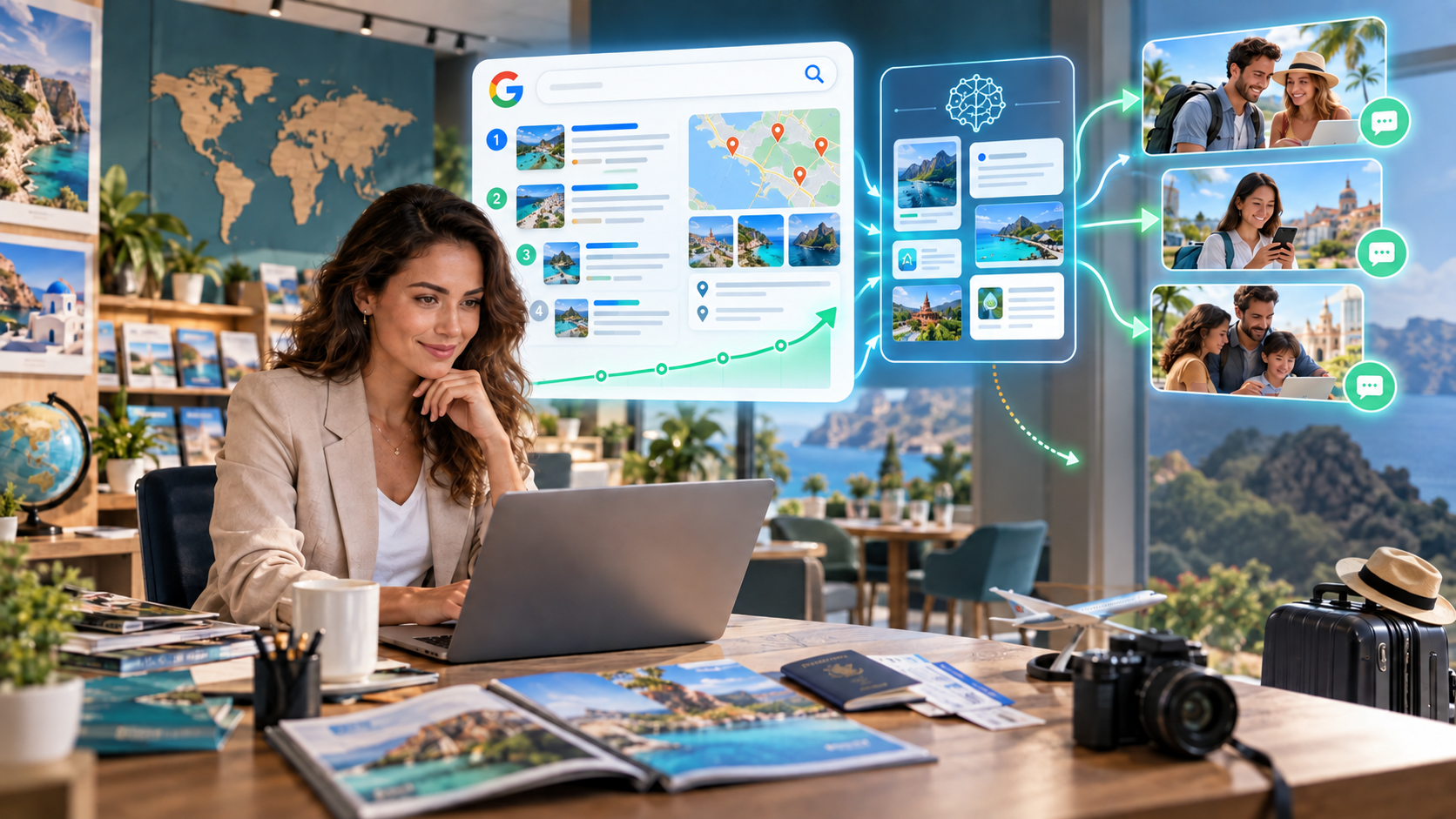
Start with the demand-side reality, because it sets the scale of the content marketing travel agency opportunity. According to research summarised by AtlasPerk's travel content strategy analysis, travellers consume around 141 pages of content before deciding to book, drawing on Expedia Group data. Seventy-five per cent say social media influences their destination choice, 46% start with a search engine, and 92% trust peer recommendations over branded messaging.
That is an enormous surface area of influence, and your agency currently occupies almost none of it.
Now the supply-side reality, which is what changed. Roughly 74.2% of all new web pages contain AI-generated content in some form, and 86.5% of top-ranking pages contain at least some AI-written text, according to 2026 analysis of AI content data. Ninety-six per cent of content marketers have adopted AI tools and 94% plan to use them for content creation this year, with 85.1% using them specifically for blog content.
So the internet now has infinite mediocre destination guides. Producing another one accomplishes nothing, and most content marketing travel agency plans still begin by doing exactly that.
The statistic that should shape your entire approach
Here is the finding I would build a content marketing travel agency strategy around: by 90 days, only 3% of pure AI-generated pages remain in the top 100 search results. Pages that persist are AI-assisted but human-edited, carrying original perspective and verified facts.
Google does not penalise content for being AI-generated. It penalises low-quality content regardless of origin — a distinction its helpful content guidance makes explicit. The practical effect for content marketing travel agency owners is the same: generic content decays, specific content compounds.
As eMarketer's analysis of AI saturation puts it, content marketing's primary constraint has shifted from production capacity to differentiation and performance. That is genuinely good news for content marketing travel agency teams, because differentiation is the one thing you can manufacture and a content farm cannot.
The economics still justify the effort: content marketing generates roughly three times more leads than outbound at 62% lower cost, a ratio that has held across three years of measurement. And yet, per Arival's operator research, while most operators name direct bookings as their top priority, fewer than one in four rate their own marketing as effective. The gap between those two facts is the opportunity.
The 9 Content Marketing Travel Agency Tactics That Work in 2026
Tactic 1: Choose a niche narrow enough to be boring at parties
Every content marketing travel agency plan fails at the same point: trying to be interesting to everyone. Narrowing is the first and hardest decision.
"Best things to do in Lisbon" is unwinnable — it competes with TripAdvisor, Lonely Planet, every tourism board and ten thousand bloggers, and it triggers an AI summary. "Lisbon in four days for first-timers who hate tourist traps" is winnable, searchable, saveable and forwardable.
Specificity is not a stylistic preference. It is the mechanism by which small publishers beat large ones.
How to find yours: intersect what you sell, who you sell it to, and what you know first-hand that others do not. Accessible travel for wheelchair users. Dive trips for newly certified divers. Multi-generational Italy for families with teenagers and grandparents. Faith-based group travel. Our guide to niche tourism covers how to select and validate a specialism properly.
The test: if a competitor could publish your content calendar without changing anything, your niche is too broad.
Tactic 2: Map content to the 141-page research journey
Content marketing travel agency planning should follow how people actually buy. Travellers do not consume content randomly. They move through stages, and each stage needs different material.
Stage | What they are asking | Content that works | Your goal |
|---|---|---|---|
Dreaming | Where could I go? | Short-form video, photo essays, "X vs Y" destination comparisons | Get discovered |
Considering | Is this right for me? | Honest guides, who-it-suits-and-who-it-does-not, sample itineraries | Build trust |
Researching | Can I actually do this? | Practical logistics, costs, permits, seasons, fitness levels | Prove expertise |
Deciding | Why book with you? | Trip reports, client stories, guide profiles, transparent pricing | Differentiate |
Booked | What now? | Pre-departure guides, packing lists, local etiquette | Reduce anxiety, prompt referral |
Most travel agencies publish only in the dreaming stage — pretty destination content — and wonder why it produces engagement but no enquiries. The researching and deciding stages are where content converts, and they are also the least competitive, because they require knowledge rather than photographs.
Tactic 3: Publish the things AI cannot know
This is the content marketing travel agency moat, and it is more defensible than it sounds.
A language model can generate a plausible paragraph about the Amalfi Coast. It cannot tell you that the 8:40 ferry gets you to Positano before the day-trippers, that the third switchback has the only safe pull-in for photographs, or that the restaurant everyone recommends has changed chefs and is no longer worth the walk.
You know things like that. Write them down.
Concretely, publish:
Specific timings, sequences and logistics from trips you have actually run
Prices you have actually paid, dated
What went wrong and how you handled it
Who a trip is not suitable for
Named people — guides, hosts, drivers — with photographs
Seasonal detail at a granularity guidebooks do not reach
And attribute it properly: named authors, real bios, credentials, dates. That signals experience to both readers and ranking systems.
The honest limitations point deserves emphasis. Publishing "this trek is unsuitable if you have knee problems or cannot walk six hours at altitude" costs you a handful of unqualified enquiries and earns disproportionate trust with everyone else. It is also exactly the kind of balanced, specific claim that AI engines quote.
Tactic 4: Turn every trip you sell into content
This is the tactic that separates operators who sustain content marketing travel agency programmes from those who abandon them in month four.
You already produce the raw material. Every departure generates photographs, questions, problems solved, client reactions and logistical detail. The failure is not creative — it is that nobody captures it systematically.
Build a capture routine:
Brief your guides to photograph and note three things per departure: one logistics insight, one client moment, one thing that surprised them.
Log every client question in one place. Each recurring question is a content asset.
Ask returning clients two questions in your post-trip email: what surprised you, and what would you tell someone considering this?
Photograph on every departure — even phone footage. Shoot destination material one to two months before peak booking windows so assets are ready when demand arrives.
Review the log monthly and commission content from it.
Six months of that discipline produces a content library no competitor can replicate, because it is derived from operations they do not have.
Tactic 5: Make short-form video the front door
Of all content marketing travel agency formats, the data here is the least ambiguous. According to HubSpot research summarised in 2026 travel marketing analysis, the top three ROI-driving content formats are all video: short-form video leads at 49%, long-form video at 29%, and live-streaming at 25%. No other format comes close.
Two findings matter more than the headline.
Production value is not the driver. Research shows high production quality does not correlate with higher engagement, and content answering specific traveller questions outperforms polished brand campaigns regardless of budget. Your phone is sufficient.
Platform roles differ. YouTube serves long-form guides and builds evergreen search visibility. TikTok drives discovery among younger travellers. Instagram Reels and Stories capture mid-funnel consideration, particularly for luxury. LinkedIn is underused for business travel decision-makers.
A workable cadence: three to five short-form posts per week, each answering one specific question, each derived from the capture routine in tactic 4. Pair every written guide with a video summary and a Pinterest-optimised image set.
One caveat worth stating, because most articles omit it. Creator-led travel videos are frequently reported at 8–12% engagement against under 2% for polished corporate content. That gap is real but overstated as a format argument — it partly reflects audience self-selection, since people who follow creators are predisposed to engage. Authentic beats overproduced. It does not beat it by six times.
Tactic 6: Systematise user-generated content
92% of consumers trust peer content over brand advertising, and the travel UGC market is valued at roughly $8.7 billion in 2026, projected toward $23 billion by 2035. Meanwhile Phocuswright research found 62% of social media users made a specific trip decision after viewing social content.
UGC is the cheapest and most persuasive content marketing travel agency asset, and collecting it is an operational problem rather than a creative one.
What works:
A branded hashtag mentioned in pre-departure material, not just at booking
Explicit permission requests built into your post-trip email
Photo-friendly moments designed into the itinerary if you have fixed locations
Short client interviews captured on-site, on a phone
A simple incentive — a future discount, a feature, a print
What does not: hoping clients tag you. They will not unless asked, and asked specifically. Our guide to social media marketing for travel agencies covers distribution once you have the assets.
Tactic 7: Answer the questions in your actual inbox
The highest-converting content marketing travel agency asset already exists in your email history.
Every question a client asks before booking is a question a hundred prospects are asking silently. "Do I need a yellow fever certificate for Kenya?" "Is the Inca Trail too hard for a 60-year-old?" "How far ahead do I need to book Japan in cherry blossom season?"
These queries are specific, low-competition, high-intent and — crucially — you answer them better than anyone because you answer them weekly.
The method: keep a running list of every pre-booking question for one month. Group them. Publish an answer to each as a standalone piece with a question-formatted heading. Add the best ones as an FAQ block on the relevant trip page.
This is also the most direct content-to-enquiry route available, which is why it pairs closely with travel agency lead generation work.
Tactic 8: Repurpose one asset into twelve
Sustainable content marketing travel agency output is a production system, not a burst of enthusiasm.
One substantial piece — a detailed trip report from a departure you ran — becomes:
The long-form guide on your site
A short-form video summary
Three to five individual video clips answering single questions
A photo carousel for Instagram
A Pinterest image set
An email to your list
Three social posts pulling single insights
An FAQ block on the relevant trip page
A section in your pre-departure pack
A quote or statistic for future pieces
A podcast or audio segment if you run one
Sales collateral your advisors can send directly
This is where AI earns its place. Use it for repurposing, outlining, translating and drafting — not for generating source material. The 3% survival rate for pure AI pages is a warning about origination, not assistance. Human-edited AI content is what actually performs, with reported bounce rate reductions of up to 73% versus raw output.
One firm rule: never publish AI-written travel specifics unchecked. Models hallucinate permit rules, opening hours, visa requirements and prices. In travel, those errors reach a client standing at a closed gate.
Tactic 9: Build branded mentions, not just backlinks
This is the newest content marketing travel agency tactic here and the least practised.
Analysis published in 2026 found that branded web mentions correlate with AI Overview appearances at 0.664, against 0.218 for backlinks. Related work suggests a 10% increase in review volume produces roughly a 2% increase in AI citations. Meanwhile McKinsey has noted that around 84% of brands have no visibility into how they appear in AI answers at all.
The implication for content marketing travel agency work is practical: being mentioned matters more than being linked.
How to earn mentions:
Get quoted in travel press — journalists need operators who can speak specifically
Publish original data nobody else has: booking lead times in your niche, seasonal price movement, a survey of your clients
Appear on podcasts serving your niche
Contribute expert commentary to industry publications
Build review volume systematically across Google, TripAdvisor and relevant platforms
Partner with complementary businesses who reference you by name
Then measure it. Once a month, prompt ChatGPT, Gemini, Perplexity and Google's AI Mode with the ten questions your clients actually ask. Record who gets named. That is your AI visibility baseline, and almost none of your competitors have one.
Does this change for adventure tourism or tour operators?
The nine tactics hold, but the emphasis shifts, and I think two variants are worth calling out.
Content marketing for adventure tourism leans much harder on tactic 3. Your buyers are making a risk assessment as much as a purchase decision, so the questions that matter are physical and specific: how many hours a day on foot, what altitude, what the accommodation is genuinely like on night four, what happens if someone cannot continue. Publishing honest difficulty gradings and explicit unsuitability criteria converts better here than anywhere else in travel, because content marketing for adventure tourism succeeds on credibility rather than aspiration. Aspirational imagery attracts people who will cancel.
Tour operator content marketing shifts weight toward tactic 4, because operators generate far more raw material than retail agencies and capture almost none of it. If you run departures, every trip produces photographs, guide observations, client questions and logistical detail that a retail agency has to invent. Tour operator content marketing works best when the capture routine is built into departure debriefs rather than treated as a marketing task — the guide who noticed the trail conditions changed is producing content whether anyone writes it down or not.
In both cases the underlying principle is unchanged: publish what you know that a model cannot infer.
How Should You Sequence Your Content Marketing Travel Agency Plan?
Phase | Weeks | Focus | Output |
|---|---|---|---|
Foundation | 1–4 | Tactics 1, 7 — niche definition, inbox question log | A content plan derived from real demand |
Capture | 5–8 | Tactic 4 — guide briefings, client question log, photo routine | A pipeline of raw material |
Publish | 9–16 | Tactics 3, 5, 8 — experience-led guides, short-form video, repurposing | 8–12 assets across formats |
Amplify | 17–24 | Tactics 6, 9 — UGC collection, mentions and reviews | Social proof and AI visibility |
Compound | Ongoing | Tactic 2 — fill gaps across the journey stages | Coverage of the full 141 pages |
Realistic expectations: content marketing travel agency programmes compound over 6 to 12 months. Anything promising faster is describing advertising, which is a different thing with a different cost structure.
What Does a Content Marketing Travel Agency Budget Look Like?
The honest answer is that content marketing travel agency work costs time before it costs money, and most agencies underestimate the first and overestimate the second.
Resourcing model | Monthly cost | Realistic output | Best for |
|---|---|---|---|
Owner-produced, in-house | $0–$100 in tools | 2 long-form + 12 short videos | Solo advisors, new agencies |
In-house plus freelance editor | $500–$1,500 | 4 long-form + 20 short videos | Agencies with an operating owner |
Part-time content hire | $1,500–$3,500 | 6–8 assets weekly across formats | Established multi-advisor agencies |
Retained travel content marketing agency | $2,500–$10,000 | Full programme, managed | Agencies with capital and no time |
I have watched agencies attempt each of these, and two observations hold consistently.
The cheapest model is often the most effective. An owner who genuinely knows the destinations, publishing twice a month, will outperform a $4,000 monthly retainer producing generic guides — because the differentiator is knowledge, not production polish. AI tools have reduced production costs by an estimated 30–40%, which further shifts the advantage toward whoever holds the expertise rather than whoever holds the budget.
The failure mode is always consistency, not quality. Agencies do not abandon content marketing because the writing was poor. They abandon it because peak season arrived, nobody had capacity, and three months of silence reset the compounding. Budget for the season when you have no time, not the month you are enthusiastic.
A practical rule for sizing the commitment: whatever cadence you are considering, halve it, then ask whether you could sustain that through your busiest eight weeks. If the answer is no, halve it again. Two reliable pieces a month beats twelve pieces and a year of nothing, and the Content Marketing Institute's ongoing research consistently identifies consistency as the strongest predictor of programme outcomes.
What Should You Measure?
Metric | Source | Why it matters |
|---|---|---|
Enquiries attributed to content | CRM | The only number that pays salaries |
Assets published per month | Your calendar | Consistency predicts outcomes |
Video views to profile visits | Platform analytics | Measures whether discovery converts |
Email list growth from content | Email platform | Your compounding owned asset |
Branded search volume | Search Console | Proxy for content-driven awareness |
AI citation appearances | Manual monthly prompting | The new visibility frontier |
Content cost per enquiry | Books + CRM | Compare honestly against paid media |
One discipline worth adopting: only 19% of teams using AI daily track any AI-specific KPI, and organisations that close that measurement gap report meaningfully better content returns. Decide what each asset is for before you publish it.
For how this channel sits alongside everything else you run, our travel agency marketing playbook covers the full mix.
What Should You Stop Doing in Content Marketing Travel Agency Work?
Generic destination guides. The default content marketing travel agency output, and the internet has enough. Yours will not rank and will not convert.
Publishing on a schedule you cannot sustain. Two genuinely good pieces a month beats eight thin ones, then silence.
Unedited AI content. Three per cent survival at 90 days. The maths is not ambiguous.
Chasing volume keywords. "Things to do in Bali" is a vanity target with no commercial intent and a guaranteed AI summary.
Writing for other travel agencies. Industry-facing content flatters your peers and reaches no clients.
Treating content as separate from operations. Your departures are the content engine. Disconnecting them is why most programmes stall.
Measuring engagement instead of enquiries. A viral reel that produces no bookings is a hobby.
What About Hiring a Travel Content Marketing Agency?
Worth addressing, since many people researching content marketing travel agency options are weighing outsourcing.
An external travel content marketing agency can be genuinely useful for production capacity, distribution mechanics, technical execution and editorial discipline. What it cannot supply is the thing that actually differentiates you — first-hand knowledge of the trips you run.
The workable division: you supply raw material and expertise, they supply production and process. That works well.
The failing arrangement: you outsource wholesale and receive competent, generic content indistinguishable from what a competitor's agency produces, because both are working from the same public sources. In an environment where three-quarters of new pages already contain AI content, buying more generic material is buying the problem.
If you do hire, ask one question: how will you extract what I know that nobody else does? An agency without a good answer is selling volume.
Frequently Asked Questions
What is a content marketing travel agency strategy?
Content marketing for a travel agency is the practice of publishing genuinely useful material — guides, videos, trip reports, itineraries, answers to traveller questions — that attracts prospective clients during research and builds enough trust to convert them into bookings. Travellers consume roughly 141 pages of content before booking, so the goal is occupying more of that research journey with your material rather than a competitor's or an OTA's.
Does content marketing still work now that AI generates so much content?
Yes, but only the differentiated kind. Around 74.2% of new web pages now contain AI-generated content, so volume has become worthless while specificity has become scarce. The decisive statistic is that only 3% of pure AI-generated pages remain in the top 100 search results after 90 days. What persists is AI-assisted, human-edited content carrying original perspective and verified facts — which is exactly what a travel agency with first-hand destination experience can produce and a content farm cannot.
How often should a travel agency publish content?
Consistency matters more than frequency. Two genuinely good long-form pieces per month plus three to five short-form videos per week is a sustainable and effective baseline for most small agencies. The common failure is starting at eight pieces a month, exhausting the team, and stopping entirely by month four. Set a cadence you can maintain through your busiest season, because content compounds over 6 to 12 months and gaps reset that compounding.
What type of content converts best for travel agencies?
Content in the researching and deciding stages, not the dreaming stage. Practical logistics, honest assessments of who a trip suits and who it does not, dated real prices, detailed sample itineraries, trip reports from departures you actually ran, and named guide profiles. Most agencies publish only aspirational destination content, which generates engagement but few enquiries. The converting material requires knowledge rather than photography, which is also why it is far less competitive.
Is video worth it for a small travel agency?
Yes — it is the highest-ROI format available. HubSpot research places short-form video first at 49%, followed by long-form video at 29% and live-streaming at 25%, with no other format close. Crucially, high production value does not correlate with higher engagement, and content answering specific traveller questions outperforms polished brand campaigns regardless of budget. A phone, good light and a specific question are sufficient to start.
How do I get user-generated content from my travellers?
Ask specifically, and build the ask into your operations rather than hoping. Mention a branded hashtag in pre-departure material rather than only at booking, request permission explicitly in your post-trip email, capture short client interviews on-site during departures, and offer a modest incentive such as a future discount or a feature. UGC matters because 92% of consumers trust peer content over brand advertising, and 62% of social media users report making a specific trip decision after seeing social content.
Should I use AI to write travel content?
Use it for assistance, not origination. AI is genuinely valuable for outlining, repurposing one asset into many formats, translating, and drafting from your own notes — and human-edited AI content performs well, with reported bounce rate reductions of up to 73% versus raw output. What fails is publishing unedited AI-generated material, which shows only a 3% survival rate in the top 100 after 90 days. Never publish AI-written travel specifics without verification, because models hallucinate visa rules, permit requirements, opening hours and prices.
Should I hire a travel content marketing agency or do it in-house?
A hybrid usually works best. An external agency can supply production capacity, distribution mechanics, technical execution and editorial discipline, all of which are genuinely hard to sustain in-house. What it cannot supply is first-hand knowledge of the trips you operate, which is your only real differentiator. The productive arrangement is that you provide raw material and expertise while they provide process and production. If you interview agencies, ask how they intend to extract what you know that nobody else does.
The Bottom Line
The content marketing travel agency owners were taught to do — publish destination guides consistently and wait for traffic — stopped working, and the reason is simple. Three-quarters of new web pages now contain AI-generated content, so producing more competent, generic material adds nothing to a market already drowning in it.
What survives content marketing travel agency saturation is what cannot be generated: the specific timing, the honest limitation, the named guide, the price you actually paid last season, the thing that went wrong and how you fixed it. You have all of that already. It is sitting in your inbox, in your guides' heads and in the photographs from last month's departure, uncaptured.
So the content marketing travel agency job is less about writing and more about capturing. Define a niche narrow enough to feel uncomfortable. Log every client question for a month. Brief your guides to bring back three things per departure. Then publish steadily from that pipeline, repurpose each asset a dozen ways, and use AI to multiply your own material rather than to replace it.
That is a slower start than buying traffic and a far more durable one. In an internet where anyone can produce infinite content, the only defensible position is having actually been there.
Your bookings are your content pipeline. TravelBoost keeps client questions, enquiries, bookings and departure records in one place — so the material your operations generate every week is captured and searchable instead of scattered across inboxes. Start your free TravelBoost trial.
Want a CRM that's actually built for travel?
Leads, bookings, suppliers, Hajj operations, tours, car rental, finance — all in one platform. Set up in 10 minutes.
Start free 14-day trialWeekly playbook for travel-agency operators
One email a week — product updates, benchmarks, and behind-the-scenes changelog. No spam.