- 1Key Takeaways
- 2What Is Search Everywhere Optimization?
- 3The Numbers Behind the Shift
- AI has become a primary research surface
- Clicks are falling even where you rank
- But travel has an unusual advantage
- 4What This Means for a Small Travel Agency
- 5Core Web Vitals
- 6Crawlability and Indexation
- 7Structured Data
- 8Accessibility Is Now a Legal Requirement
- 9The Consumer vs Owner Problem
- 10The Four Intent Types That Matter
- 11How to Build a Travel Keyword Map
- 12The Long-Tail Argument, With Numbers
- 13The Page-Level Checklist
- 14The One Change That Matters Most
- 15Write for Extractability
- 16Internal Linking as Architecture
- 17Why Topical Authority Is the Whole Game
- 18The Cluster Model
- 19What to Write, in Priority Order
- 20The AI Content Question, Honestly
- 21Publishing Cadence
- 22What GEO Actually Is
- 23The Finding That Changes Everything for Small Agencies
- 24The Second Finding: Where Citations Actually Come From
- 25What Works: The Evidence-Based Tactics
- 1. Front-load complete answers
- 2. Original statistics and data
- 3. FAQPage schema
- 4. Unambiguous authorship and entity clarity
- 5. Third-party citations and brand mentions
- 6. Bing visibility
- 7. Allow AI crawlers
- 8. Comparison and "best of" content
- 9. Freshness
- 26What Does Not Work: The Tactics Being Sold Anyway
- llms.txt does nothing
- "AI schema" is not a thing
- Content chunking
- The honest summary
- 27Measuring AI Visibility
- Track citations directly
- Track AI referral traffic in GA4
- The metrics that matter
- 28Google Business Profile
- 29Reviews as an AI Signal
- 30Local Content
- 31What E-E-A-T Means Here
- 32The Experience Signal Is Your Advantage
- 33Trust Signals That Belong on Every Page
- 34The Shift From Links to Mentions
- 35What Actually Earns Links and Mentions in Travel
- 1. Original data and research
- 2. Being the quotable specialist
- 3. Supplier and DMO relationships
- 4. Industry directories and associations
- 5. Genuine community participation
- 6. Guest content on genuinely relevant sites
- 7. Local press
- 36What to Avoid
- 37YouTube
- 38TikTok and Instagram
- 39Pinterest
- 40Reddit and Forums
- 41Review Platforms
- 42Google Things to Do
- 43The Metrics That Matter
- 44The Reporting Discipline
- 45Attribution in Travel Is Genuinely Hard
- 46The pillar page
- 47The supporting pages
- 48The original data piece
- 49What happens next
- 50The Lead Time Problem
- 51Keeping Seasonal Pages Alive
- 52Using the Quiet Season
- 53Identify Who Really Ranks
- 54Find the Gaps
- 55The Two-Hour Audit
- 56Month 1: Foundations and Baseline
- 57Month 2: Decide the Niche and Map the Cluster
- 58Month 3: Google Business Profile and Reviews
- 59Months 4–6: Build the First Cluster
- 60Months 7–9: Authority and Mentions
- 61Months 10–12: Expand and Refine
- 62What to Expect, Honestly
- 63Common Mistakes in SEO for Travel Agency Websites
- 64Frequently Asked Questions
- What is SEO for a travel agency?
- What is the difference between SEO and GEO?
- Can a small travel agency compete with Expedia and Booking.com in search?
- Does llms.txt help with AI search visibility?
- How long does SEO take for a travel agency?
- What content should a travel agency write first?
- How do you get cited by ChatGPT and other AI engines?
- Is AI-generated content bad for SEO?
- Do travel agencies need local SEO if they serve clients nationally?
- How do you measure AI search visibility?
- What is the biggest SEO mistake travel agencies make?
- Should travel agencies still invest in SEO given AI Overviews?
- 65The Bottom Line
SEO for Travel Agency: Complete 2026 Guide to Free Clients
SEO for travel agency in 2026 means Google plus AI engines. The complete guide to search everywhere optimization — and the GEO tactics that don't work.

Key Takeaways
Search is no longer one channel . Google AI Overviews reach over 2 billion monthly users, ChatGPT serves around 800 million weekly, and Phocuswright found search engines falling from 51% to 36% as a traveller research tool between late 2024 and the second half of 2025.
The single most important finding in this guide: ChatGPT cites pages ranked 21 or deeper in Google almost 90% of the time. AI citation is not simply a reward for ranking first, which means a small agency can be cited without out-ranking Expedia.
Best-of listicles account for 43.8% of ChatGPT's citations for recommendation queries. Being mentioned in other people's lists matters as much as publishing your own.
Several widely sold GEO tactics do nothing. Google's John Mueller has confirmed no major AI service uses llms.txt, and "AI schema" and content-chunking carry no evidence. Vendors sell them anyway.
What does work is measurable: Princeton research indicates GEO techniques can lift visibility in AI responses by 30–40%, and most brands see citation improvements within 4–8 weeks.
AI Overviews cut top-position click-through by up to 58%, and zero-click searches rose from 54% to 72% in one randomised field experiment. Ranking first is worth less than it was.
Travel has a specific advantage: travellers consume roughly 141 pages of content before booking. That is an enormous surface area for a specialist agency to occupy.
What Is Search Everywhere Optimization?
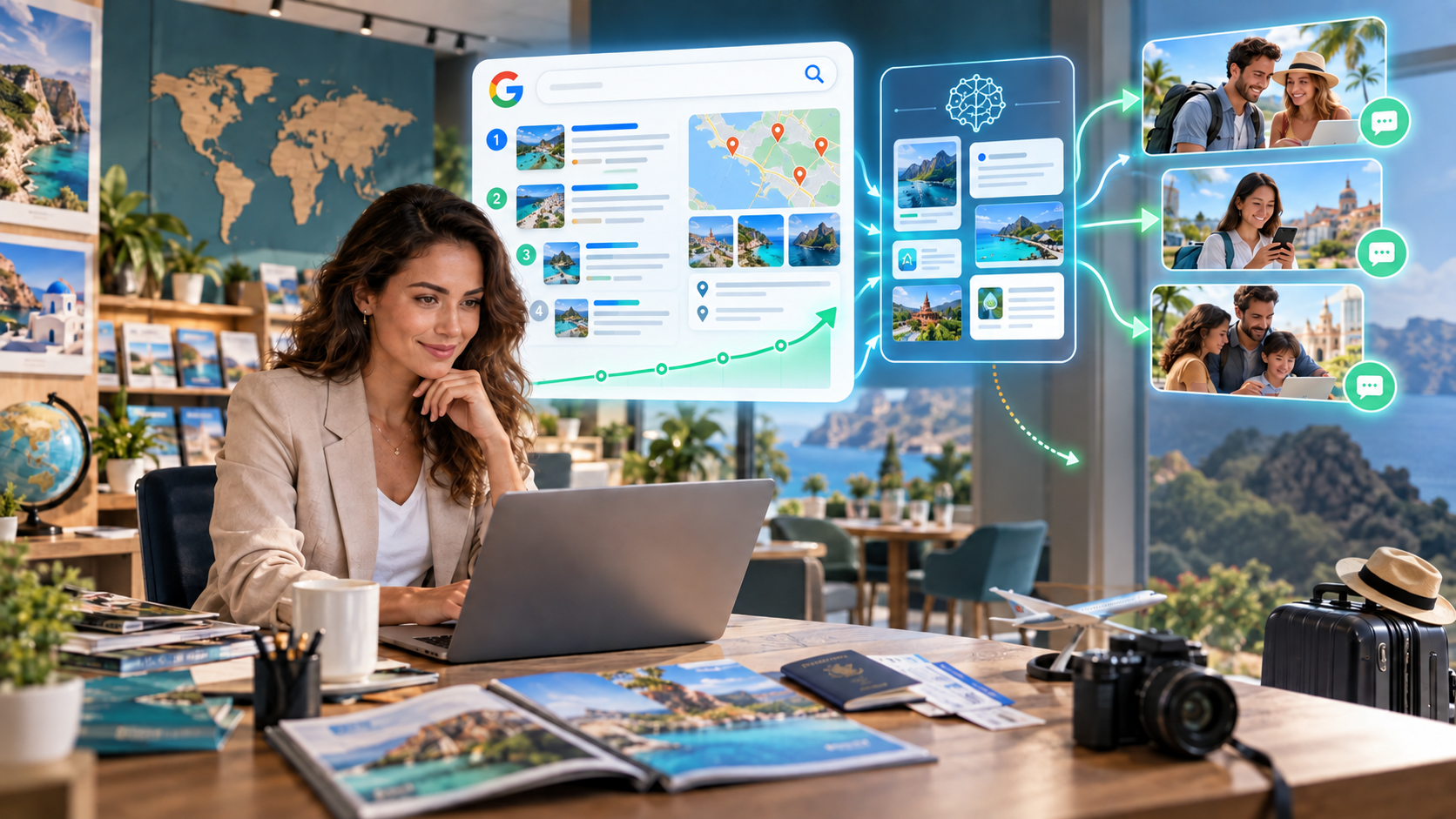
Search everywhere optimization is the practice of making your travel agency findable across every surface where people now search — Google, AI assistants, YouTube, TikTok, Reddit, Pinterest, Maps and review platforms — rather than optimising for a single search engine.
It is not a new discipline so much as an honest description of what SEO for travel agency websites now requires. In my experience the acronyms have multiplied faster than the substance:
Term | What it means |
|---|---|
SEO | Search Engine Optimization — ranking in traditional results |
GEO | Generative Engine Optimization — being cited inside AI-generated answers |
AEO | Answer Engine Optimization — usually emphasises structuring content to answer questions directly |
LLM SEO | Used interchangeably with GEO |
Search Everywhere | The umbrella: all of the above plus social, video and community platforms |
The distinction that matters: where SEO wins by ranking on a results page, GEO wins by becoming the citation inside an AI-generated answer. AI engines do not rank ten pages and let users click — they summarise a few sources and answer directly.
And the reassuring part, which the GEO industry tends to obscure: Google's stated position is that there is no separate optimization for its AI features. The content and technical work that earns rankings is what earns AI citations. GEO adds emphasis rather than replacing the discipline.
This guide covers all of it, in the order you should actually do it. Our broader guide to digital marketing for travel agency owners covers paid channels and the wider mix.
PART 1: WHAT CHANGED IN SEO FOR TRAVEL AGENCY WEBSITES
The Numbers Behind the Shift
Before tactics, the context — because a strategy for SEO for travel agency growth only makes sense if you understand what happened to search.
AI has become a primary research surface
Metric | Figure | Source |
|---|---|---|
Google AI Overviews monthly users | 2 billion+ | Reported 2026 |
ChatGPT weekly users | ~800 million | Reported 2026 |
Search engines as traveller research tool | 51% → 36% | Phocuswright |
Active US travellers using AI for planning | 39% | Phocuswright |
Consumer AI use in travel planning | 10% (2024) → 18% (2025) | Industry research |
Gartner prediction for traditional search volume | −25% in 2026 | Gartner |
Clicks are falling even where you rank
Metric | Figure |
|---|---|
Share of queries triggering AI Overviews | ~48% (March 2026) |
CTR decline when an AI Overview appears | 34–61% |
Top-position CTR reduction | Up to 58% |
Zero-click searches in one field experiment | 54% → 72% |
Outbound click reduction in that experiment | 38% |
Read those two tables together and I think the conclusion is uncomfortable but clear: ranking first on Google is worth materially less than it was three years ago, and a growing share of your prospective clients will form an opinion about who to book with without ever visiting a website.
But travel has an unusual advantage
Travellers consume roughly 141 pages of content before booking, per Expedia Group research. That is an enormous consideration surface — far larger than most purchase categories — and it is why content-led SEO for travel agency businesses still works when it has stopped working elsewhere.
Add one more: 68% of travel searches originate on mobile, and only 43% of mobile origins pass all three Core Web Vitals. The technical bar is low enough that clearing it is a genuine advantage.
What This Means for a Small Travel Agency
Three strategic conclusions for SEO for travel agency owners, and they are not the ones most agencies draw.
1. Stop optimising exclusively for rank position. Rank still matters — it is the foundation everything else sits on — but visibility now includes being cited in an answer you get no click from. Those citations still produce business, because a traveller who reads "for Japan family trips, agencies like [yours] specialise in this" is a warm prospect when they eventually search your name.
2. The playing field flattened in one specific way. ChatGPT cites pages ranked 21 or deeper in Google almost 90% of the time. You do not need to outrank Booking.com to be cited alongside it. That is the single most encouraging fact in this guide for an agency with a modest domain.
3. Depth beats breadth more than ever. With 141 pages consumed per booking and AI engines rewarding specific, citable expertise, a genuinely deep resource on one niche outperforms shallow coverage of twenty.
PART 2: TECHNICAL FOUNDATIONS FOR SEO FOR TRAVEL AGENCY SITES
Every other part of SEO for travel agency work fails if the technical layer is broken. This section is short because it should be — get it right once and revisit annually.
Core Web Vitals
Google's page experience thresholds, measured at the 75th percentile of real user visits:
Metric | Threshold | What it measures |
|---|---|---|
LCP (Largest Contentful Paint) | ≤ 2.5 seconds | How fast the main content appears |
INP (Interaction to Next Paint) | ≤ 200 milliseconds | Responsiveness to interaction |
CLS (Cumulative Layout Shift) | ≤ 0.1 | Visual stability while loading |
Only 43% of mobile origins pass all three, against 54% on desktop. Since 68% of travel searches happen on mobile, that gap is where the opportunity sits.
The travel-specific problem in SEO for travel agency sites is images. Travel sites are image-heavy by nature, and destination photography is what sells the trip. The fixes:
Serve WebP or AVIF, targeting under 150 KB for hero images
Preload the LCP image explicitly; lazy-load everything below the fold
Set explicit width and height on every image and embed to prevent layout shift
Defer non-critical JavaScript — booking widgets and chat are the usual culprits
Test on a mid-range Android on mobile data, not your own phone on office wifi
Crawlability and Indexation
The basics, briefly:
A clean XML sitemap, submitted in Google Search Console and Bing Webmaster Tools
Logical URL structure —
/destinations/japan/rather than/page?id=4471No orphan pages; every important page reachable within three clicks
Canonical tags on any page reachable by multiple URLs
HTTPS everywhere, with no mixed content
And one that specifically affects AI visibility:
Do not block GPTBot in robots.txt by default. This is listed among the most common GEO mistakes, and many sites block AI crawlers reflexively during a security review without realising they have opted out of AI citation entirely.
Bing matters more than you think. ChatGPT leans on Bing's index, so Bing visibility feeds AI visibility. Most agencies have never opened Bing Webmaster Tools. Submitting your sitemap there takes ten minutes and is one of the highest-return technical tasks available in 2026.
Structured Data
In SEO for travel agency websites, schema markup is how you tell engines what your content is rather than making them infer it.
The types that matter for a travel agency:
Schema type | Use it on |
|---|---|
| Your homepage and about page |
| Location pages, with full NAP |
| Any page with a genuine Q&A section |
| Every blog post, with author and dates |
| Packaged trips with prices |
| Where you display genuine reviews |
| Site-wide navigation |
| With |
FAQPage is the highest-priority item. It is described as the highest-impact structured data type for GEO because it aligns your content format with how AI engines search for answers to conversational queries, and Google AI Overviews pull from FAQPage markup frequently.
A caution on schema, and it is important. Some of what is sold as "AI schema" is fabricated — there is no special schema type that makes AI engines cite you. Use the real, documented types from schema.org, implement them accurately, and ignore anyone selling proprietary markup.
Accessibility Is Now a Legal Requirement
Briefly, because it belongs in the technical layer and most travel businesses are unaware of it.
The European Accessibility Act became enforceable across all EU member states on 28 June 2025, and its scope explicitly includes online ticketing and transport services — which puts travel businesses selling to EU consumers in scope. The technical standard is EN 301 549, currently incorporating WCAG 2.1 Level AA.
The SEO benefit is real, not incidental. Proper heading hierarchy, descriptive alt text, keyboard navigation and clear contrast improve how both screen readers and crawlers parse your content. The compliance work and the visibility work overlap substantially.
This is not legal advice — take proper counsel on your own obligations.
PART 3: KEYWORD RESEARCH FOR SEO FOR TRAVEL AGENCY SITES
This is where most SEO for travel agency projects go wrong before a word is written.
The Consumer vs Owner Problem
If you are a travel agency selling trips, your keywords are consumer terms — "best time to visit Japan," "Kenya safari cost," "family resorts in Crete."
If you sell to the trade, they are business terms entirely.
Establish which you are before researching anything for SEO for travel agency purposes, because the two keyword universes barely overlap and mixing them produces a site that ranks for people who will never buy.
The Four Intent Types That Matter
Intent | Example query | What it wants | Your page type |
|---|---|---|---|
Informational | "best time to visit Japan" | An answer | Guide, blog post |
Comparison | "Kenya vs Tanzania safari" | A decision | Comparison page |
Commercial | "Japan family tour packages" | Options and prices | Product or trip page |
Local | "travel agent near me" | A nearby business | Location page, GBP |
The mistake we see almost every agency make is producing informational content exclusively, because it is easier to write, then wondering why traffic does not convert. A healthy travel agency site needs all four, weighted toward the middle two.
How to Build a Travel Keyword Map
Step 1 — Start with your actual bookings. Pull last year's trips and list the destinations, trip types and traveller profiles you genuinely serve. That is your keyword universe. Not the destinations you wish you sold.
Step 2 — Expand each into the four intent types. For "Kenya safari" you get:
Informational: best time for Kenya safari, Kenya safari packing list, Masai Mara migration dates
Comparison: Kenya vs Tanzania safari, Masai Mara vs Serengeti, luxury vs mid-range safari
Commercial: Kenya safari packages, family safari Kenya, Kenya safari cost per person
Local: safari specialist [your city], Kenya travel agent [your country]
Step 3 — Filter ruthlessly by difficulty. A new or small site cannot rank for "Kenya safari" against Lonely Planet and the OTAs. It absolutely can rank for "Kenya safari with teenagers first time" — and that phrase describes a better client anyway.
Step 4 — Add the question layer. Every destination generates dozens of genuine questions. These are the queries AI engines answer, and answering them properly is how you get cited.
Step 5 — Map to pages, not posts. Each cluster needs one primary page and supporting content that links to it. One page per intent, not five posts on the same intent competing with each other.
The Long-Tail Argument, With Numbers
Why the narrow phrase beats the broad one in SEO for travel agency work:
Query | Monthly volume | Difficulty | Realistic outcome |
|---|---|---|---|
"safari" | Enormous | Extreme | Never |
"Kenya safari" | High | Very high | Unlikely for years |
"Kenya safari cost" | Moderate | High | Possible with authority |
"Kenya family safari cost per person" | Low | Low | Achievable this year |
"Kenya safari with kids under 10" | Very low | Very low | Achievable this quarter |
The fourth and fifth rows convert dramatically better, because someone searching "Kenya safari with kids under 10" has a defined trip in mind and needs a specialist. Someone searching "safari" is daydreaming.
And they compound. Fifty long-tail pages that each attract twenty visitors a month is a thousand qualified visitors — from an authority position you could actually reach.
Our guide to niche tourism covers how to define the specialism these keywords describe.
PART 4: ON-PAGE SEO FOR TRAVEL AGENCY PAGES
The fundamentals of on-page SEO for travel agency websites have barely changed, which is reassuring. What has changed is that they now serve two audiences — search engines and AI engines — and the requirements largely align.
The Page-Level Checklist
Element | Requirement |
|---|---|
Title tag | Focus keyword near the front, under ~60 characters, with a reason to click |
Meta description | Under ~160 characters, includes the keyword, reads as a declarative answer |
H1 | One per page, containing the focus keyword |
URL | Short, keyword-based, no dates or parameters |
First 100 words | Answer the query directly, keyword present naturally |
Subheadings | H2/H3 structure, several containing keyword variants, many phrased as questions |
Keyword density | Roughly 0.5–1%, distributed naturally |
Internal links | 3–5 per page to genuinely related content |
External links | 2–4 to authoritative sources, DoFollow |
Images | Descriptive alt text, compressed, first one carrying the keyword |
Schema | Appropriate type, validated |
The One Change That Matters Most
Front-load a complete answer to the question in your first ~200 words.
This is the single most repeated instruction in credible GEO guidance, and it works for both audiences. A reader gets what they came for immediately. An AI engine gets a clean, extractable answer that it can lift into a response with attribution.
The wrong way to open a page about Kenya safari costs:
"Kenya is one of Africa's most magical destinations, and a safari here is a bucket-list experience for travellers around the world. In this comprehensive guide, we'll explore everything you need to know..."
The right way:
"A Kenya safari costs $350–$750 per person per day for mid-range lodges and $900–$2,500 for luxury, excluding international flights. A typical 8-day trip runs $4,200–$9,000 per person. The three factors that move that figure most are season, lodge category and group size."
The second version answers the question, contains extractable statistics, and gives an AI engine something to cite. The first version is throat-clearing.
Write for Extractability
A structural principle that serves both search and AI:
Short, declarative sentences that stand alone when quoted
Specific numbers rather than vague ranges where you can
Tables for anything comparative — AI engines extract row-by-row claims cleanly
Question-formatted H2s that mirror how people actually prompt
Definitions stated plainly — "A DMC is a…" rather than burying the definition in a paragraph
One idea per paragraph, so a lifted sentence retains its meaning
The test I use: could a stranger lift any single sentence from your page and have it still be true and useful without the surrounding context? If yes, you have written extractable content.
Internal Linking as Architecture
Internal links do three jobs: distribute authority, help crawlers understand hierarchy, and keep readers on site through the 141 pages they will consume.
The structure that works for travel:
Homepage
 └─ Destination pillar (Kenya)
     ├─ When to visit Kenya
     ├─ Kenya safari costs
     ├─ Kenya vs Tanzania
     ├─ Family safaris in Kenya
     └─ Kenya packing list
         └─ all link back up to the pillar
Rules:
Every supporting page links up to its pillar
The pillar links down to every supporting page
Related supporting pages cross-link where genuinely relevant
Anchor text is descriptive, not "click here"
No page more than three clicks from home
PART 5: CONTENT STRATEGY AND TOPICAL AUTHORITY
Why Topical Authority Is the Whole Game
Google and AI engines both reward demonstrable depth on a subject rather than isolated good pages. An agency with forty interlinked pages about East African safaris is a more credible source than one with four hundred pages covering everywhere.
This is the strategic decision that determines whether SEO for travel agency websites works for you, and it is uncomfortable because it means saying no.
The Cluster Model
One pillar page — comprehensive, 3,000+ words, targeting the head term. Ten to thirty supporting pages — each targeting one specific long-tail query. All interlinked — up to the pillar, down to the children, across where relevant.
I would build one cluster completely before starting the next. Half-built clusters rank for nothing. A finished cluster of twenty pages on one destination will outperform sixty scattered posts.
What to Write, in Priority Order
Tier 1 — Commercial pages that convert. Your actual trips, with prices, dates and availability. These are frequently the worst pages on agency sites and the most valuable.
Tier 2 — Comparison content. "Kenya vs Tanzania," "river cruise vs ocean cruise," "Antarctic peninsula vs South Georgia." These capture decision-stage traffic and — critically for GEO — best-of and comparison formats account for a disproportionate share of AI citations.
Tier 3 — Cost and logistics content. Money and practicalities are the highest-intent informational queries. "How much does X cost" attracts people planning, not dreaming.
Tier 4 — Question content. The dozens of specific questions your inbox already receives. If a client asked it, someone searched it.
Tier 5 — Inspiration content. Beautiful destination overviews. These attract volume and convert poorly, so build them last despite their appeal.
The AI Content Question, Honestly
Every discussion of SEO for travel agency content reaches this point. You will be tempted to generate at scale. Here is what the data says.
74.2% of new web pages contain AI-generated content, and 86.5% of top-ranking pages contain some. So AI assistance is not disqualifying — it is now normal.
But only 3% of pure AI-generated pages remain in the top 100 after 90 days.
The distinction is not whether AI helped. It is whether the page contains anything that could only have come from you — a price you negotiated, a lodge you visited, a mistake a client made, a photograph you took, a number you calculated.
The rule I would apply: use AI to structure, draft and edit. Never publish a page whose entire content could have been generated without your business existing.
Publishing Cadence
In SEO for travel agency content, consistency beats volume. Two genuinely good pages a week for a year is 104 pages and a completed cluster or three. Twenty pages in January and nothing until June builds nothing.
A realistic schedule for a small agency:
Resource | Output | Annual |
|---|---|---|
Owner writing alone, part-time | 2 pages/month | 24 pages |
Owner writing seriously | 1 page/week | 52 pages |
Owner + freelance writer | 2–3 pages/week | 104–156 pages |
At 24 pages a year you can complete one cluster. That is enough to own a genuine niche if the niche is narrow enough.
PART 6: GEO — GETTING CITED BY AI ENGINES
This is the section of any SEO for travel agency guide people came for, and it is also where the most nonsense is being sold. So it is organised into what has evidence behind it, and what does not.
What GEO Actually Is
Generative Engine Optimization is the practice of structuring content, schema and on-page signals so generative AI engines cite your brand when answering a question.
The engines in scope are the ones people now use to search: ChatGPT, Perplexity, Gemini, Microsoft Copilot, Claude, Grok, Meta AI, DeepSeek, and Google's AI Overviews and AI Mode.
The unit of value differs from SEO. SEO wins by ranking on a results page. GEO wins by becoming the citation inside an AI-generated answer — which may generate no click at all, and still generates business.
Princeton University research indicates GEO techniques can increase content visibility in AI responses by 30 to 40%, and practitioners report measurable improvements in citation frequency within 4 to 8 weeks of deploying proper infrastructure.
The Finding That Changes Everything for Small Agencies
ChatGPT cites pages ranked 21 or deeper in Google almost 90% of the time.
Read that again, because it inverts the assumption most SEO advice rests on. AI citation is not a reward for ranking first. An engine synthesising an answer about family safaris in Kenya is not restricted to page one — it is pulling from sources that answer the question well, wherever they sit.
For a travel agency with a modest domain, this is the most important fact in SEO for travel agency strategy today. You cannot outrank Booking.com for "Kenya safari." You can absolutely be the source an AI engine cites when someone asks "which agency specialises in Kenya safaris for families with young children."
The Second Finding: Where Citations Actually Come From
Best-of listicles account for 43.8% of ChatGPT's citations for recommendation queries.
That means being mentioned in other people's content matters as much as publishing your own. When someone asks an AI engine to recommend a travel agency, it is disproportionately pulling from roundup articles, comparison pieces and "best X" lists published by third parties.
And review platforms shape AI opinion even when not cited directly. In the B2B world, G2 and Capterra influence what ChatGPT says about a product without appearing in the citation list. The travel equivalents are TripAdvisor, Google reviews, Trustpilot and industry directories.
The implication we would draw: a GEO strategy that consists only of optimising your own website is missing roughly half the mechanism.
What Works: The Evidence-Based Tactics
1. Front-load complete answers
Covered above, and it is the most consistently validated tactic. Answer the question fully in the first ~200 words, then expand.
2. Original statistics and data
AI engines preferentially cite specific, quotable numbers. "Kenya safaris cost $350–$750 per person per day mid-range" is citable. "Kenya safaris can be expensive" is not.
For a travel agency, your original data is a genuine asset:
Average trip cost by destination from your own bookings
Typical group sizes, trip lengths, booking lead times
Seasonal price variation you have observed
Percentage of clients who book each option
Publish it, date it, and state the sample. You are the primary source for your own business data, and primary sources get cited.
3. FAQPage schema
The highest-impact structured data type for GEO, because it aligns your content with how AI engines search for answers to conversational queries, and AI Overviews pull from it frequently.
Implementation rules:
Only mark up questions genuinely answered on the page
Write answers as complete, standalone paragraphs
Use the exact question phrasing people search
Validate with Google's Rich Results Test
4. Unambiguous authorship and entity clarity
Make the page unambiguous about who wrote it. AI engines tie credibility to identifiable entities.
A named author with a genuine bio and credentials
Organizationschema withsameAslinks to every profile you ownConsistent business name, address and phone across every platform
A properly filled About page describing what you do and for whom
Entity consistency is a named GEO ranking signal, and it is free.
5. Third-party citations and brand mentions
Brand mentions correlate with AI Overview appearances far more strongly than backlinks do — a correlation of 0.664 against 0.218 in one analysis.
That is a strategic reorientation. Traditional SEO chases links. GEO rewards being talked about, linked or not.
How a travel agency earns mentions:
Being quoted in travel press as a destination specialist
Appearing in "best travel agents for X" roundups
Podcast appearances
Supplier and DMO partner pages
Industry association directories
Genuine participation in Reddit and forum communities
6. Bing visibility
ChatGPT leans on Bing's index. Submitting your sitemap to Bing Webmaster Tools takes ten minutes and directly affects AI visibility.
Most agencies have never done it. It is the highest effort-to-return item in this entire guide.
7. Allow AI crawlers
Do not block GPTBot in robots.txt. Blocking AI crawlers by default is listed among the most common GEO mistakes, and it forecloses citation entirely.
8. Comparison and "best of" content
Given that listicles drive 43.8% of recommendation citations, publishing genuine comparison content is directly aligned with how engines source answers.
Write the comparisons your clients actually face: Kenya vs Tanzania, Norway vs Iceland for northern lights, small ship vs large ship expedition cruising.
9. Freshness
AI engines favour current, dated content. Put the year in body text and publish a visible "last updated" date. Review key pages quarterly and update the figures.
What Does Not Work: The Tactics Being Sold Anyway
This part of SEO for travel agency work will save you money, and possibly a consultant's fee.
llms.txt does nothing
Google's John Mueller has confirmed that no major AI service uses llms.txt, and an Ahrefs study across 137,000 domains found no evidence of impact.
Meanwhile 69.7% of sites do not have one — a statistic vendors quote to imply you are missing out.
Add one if you like — it costs nothing and may matter later. Do not pay anyone to create one, and do not expect results.
"AI schema" is not a thing
There is no proprietary schema type that makes AI engines cite you. Use the documented schema.org types. Anyone selling custom "AI markup" is selling nothing.
Content chunking
Marketed as structuring content into AI-digestible blocks. Google's stated position is that there is no separate optimization for its AI features. Writing clearly in short sections is good practice for readers; it is not a secret technical lever.
The honest summary
Most of what is sold as GEO is repackaged SEO. Google's position is that the content and technical work earning rankings is what earns AI citations. GEO adds emphasis — front-loading answers, original statistics, citations, extractable writing — rather than a separate discipline.
A note on sources for this section. Much GEO guidance is published by agencies selling GEO services, and their incentives favour making it sound like a novel discipline requiring specialist help. The most credible sources are the ones publishing first-party data and debunking their own industry's tactics.
Measuring AI Visibility
You cannot manage what you cannot see, and this is genuinely harder than conventional SEO for travel agency measurement.
Track citations directly
Spot-check your top 20 prompts monthly across ChatGPT, Perplexity, Gemini and Google AI Overviews. Log whether you are named, linked, or absent. Record every change you make so movement can be tied to a cause.
The prompts to test are the ones clients actually ask:
"Best travel agency for [your niche]"
"How much does [your destination] cost"
"Who specialises in [your trip type]"
"[Your agency name]" — to check what engines say about you
Track AI referral traffic in GA4
Set up an AI Assistant channel grouping. And do not assume ChatGPT dominates.
One agency's first-party GA4 data across 1–24 July 2026 logged 46 AI referral sessions split as Gemini 19, Perplexity 16, ChatGPT 7, Claude 4 — with Gemini leading by users too.
Your split will differ, but the lesson is to measure rather than assume, and to read the numbers by both users and sessions.
The metrics that matter
Metric | What it tells you |
|---|---|
Citation share on priority prompts | Your actual AI visibility |
AI referral sessions by engine | Which engines send traffic |
Branded search volume | Whether AI exposure creates demand |
Assisted conversions from AI referrals | Whether it produces business |
Impressions vs clicks in Search Console | The zero-click gap |
Branded search volume is the underrated one. If AI engines are recommending you without linking, the effect shows up as people searching your agency name. That is the clearest evidence that uncredited citations are working.
PART 7: LOCAL SEO FOR TRAVEL AGENCIES
Local SEO for travel agency businesses is frequently dismissed by those that "serve clients everywhere." That is a mistake, because local intent produces some of the highest-converting traffic available — and because AI engines answer local questions constantly.
Google Business Profile
Your single highest-return asset in local SEO for travel agency visibility, and it is free.
The optimisation checklist:
Element | What to do |
|---|---|
Category | Primary: Travel Agency. Add relevant secondaries — Tour Operator, Cruise Agency |
Business name | Exactly as it appears everywhere else. No keyword stuffing |
NAP | Name, address, phone — identical across every platform |
Service areas | Define them if you serve clients beyond your city |
Description | 750 characters, leading with what you specialise in |
Services | List every trip type as a distinct service |
Photos | Your team, your office, trips you have run. Not stock |
Posts | Weekly. Departures, offers, destination news |
Q&A | Seed it yourself with genuine questions and answer them |
Reviews | Ask systematically, respond to every one |
The Q&A section is the underused one, and it is directly relevant to AI visibility because it creates question-and-answer content on a high-authority Google property that engines can read.
Reviews as an AI Signal
In SEO for travel agency terms, reviews do two jobs now. They convert humans, and they shape what AI engines say about you even when not cited directly.
A systematic review process:
Ask 48 hours after the client returns — the peak of satisfaction
Send a direct link to your Google profile
Ask for specifics: "if you could mention the destination and what we arranged, that helps others"
Respond to every review, positive and negative
Never incentivise reviews — it violates platform policies and it shows
The specificity request matters. "Great service" tells an AI engine nothing. "They arranged a two-week Kenya safari for our family with three kids under ten and handled a flight cancellation brilliantly" is a citable description of your specialism.
Local Content
Pages worth building even for a national business:
One page per city or region you genuinely serve, with real local detail
"Travel agent in [city]" pages that describe your actual local presence
Local partnership content — chambers of commerce, local businesses, community groups
Coverage in local press
A warning, because we see this go wrong: do not build fifty thin location pages for cities you have no presence in. That is a documented spam pattern and it will damage the site. One genuine location page beats twenty fabricated ones.
PART 8: E-E-A-T AND WHY TRAVEL IS A HIGH-BAR CATEGORY
What E-E-A-T Means Here
Google's quality framework — Experience, Expertise, Authoritativeness, Trustworthiness — applies with particular force to travel, because travel decisions involve significant money and personal safety.
Signal | How a travel agency demonstrates it |
|---|---|
Experience | You have actually been there. Say so, with detail and photographs |
Expertise | Credentials, accreditations, years in the destination |
Authoritativeness | Third-party recognition, press mentions, association membership |
Trustworthiness | Transparent pricing, terms, real reviews, clear contact details |
The Experience Signal Is Your Advantage
This is where SEO for travel agency businesses genuinely beats an OTA, and most agencies fail to use it.
Booking.com has never been to the lodge. You have. That difference is your entire competitive position in search, and it should be visible on every page:
Original photographs from trips you have actually run, not stock libraries
First-person detail — "when we visited in March the river was too high to cross"
Specific, checkable claims — the drive is 4.5 hours, not "a few hours"
Named staff with real bios and genuine destination experience
Dated site visits — "our team last inspected this property in November 2025"
AI engines specifically reward first-person experience signals. Generic third-person writing reads like AI wrote it, because increasingly it did.
Trust Signals That Belong on Every Page
Accreditations displayed near prices, not buried in a footer
Real reviews with the reviewer's first name and trip type
Transparent pricing, including what is not included
Clear cancellation and refund terms
A physical address and a phone number that a human answers
Named team members with photographs
PART 9: LINKS AND MENTIONS IN SEO FOR TRAVEL AGENCY GROWTH
The Shift From Links to Mentions
Traditional SEO for travel agency sites chases backlinks. GEO rewards brand mentions, and the correlation data is striking: brand mentions correlate with AI Overview appearances at 0.664 against 0.218 for backlinks.
Both still matter. Links drive rankings; mentions drive AI citations. The good news is that the same activity usually produces both.
What Actually Earns Links and Mentions in Travel
In rough order of return for SEO for travel agency growth:
1. Original data and research
Publish something nobody else has. Your booking data is unique — average trip costs, booking lead times, which months clients actually travel, price movements you have observed. Journalists and bloggers cite data.
2. Being the quotable specialist
Register with journalist request services and respond fast with genuinely useful, specific comment. A travel journalist writing about safari costs needs someone who can say "prices rose 12% for the 2026 season, driven mainly by conservancy fees."
3. Supplier and DMO relationships
Lodges, DMCs and tourism boards maintain partner pages. Ask to be listed. These are relevant, authoritative and free.
4. Industry directories and associations
ASTA, CLIA, your consortium, national association listings. Low effort, permanent.
5. Genuine community participation
Reddit, specialist forums and Facebook groups — where travellers actually ask for recommendations, and where AI engines increasingly source real human opinion.
Our rule here is participation, not promotion. Answer questions properly, mention your business only when directly relevant, and accept that this is a long game. Communities identify and eject marketers quickly.
6. Guest content on genuinely relevant sites
Not link farms. Real destination blogs, industry publications, and partner newsletters where your expertise fits.
7. Local press
A specialist agency in a small city is a story. Local coverage builds both local SEO and entity clarity.
What to Avoid
Paid link schemes — a policy violation and a manual action risk
Guest posting purely for links on irrelevant sites
Directory submissions at scale to low-quality aggregators
Reciprocal link exchanges with unrelated businesses
Anything with "1,000 backlinks" in the pitch
PART 10: BEYOND GOOGLE — THE REST OF SEARCH
SEO for travel agency businesses now means the surfaces people actually use, and for travel that list is long.
YouTube
The second-largest search engine, and travel is one of its strongest categories.
Destination guides, property walkthroughs, "what a day looks like" videos
Keyword-optimised titles and descriptions
Chapters, which improve both retention and search visibility
Genuine footage from trips you have run
The advantage we would exploit: video is expensive for competitors to fake. Real footage from a lodge you visited cannot be generated.
TikTok and Instagram
Increasingly used as search engines by younger travellers, and short-form video is the highest-ROI format according to 49% of marketers.
Search-optimised captions using destination terms
Answer specific questions in 30 seconds
Consistency matters more than production value
Genuinely underrated for travel, and it functions as a visual search engine with unusually long content lifespans. A pin can drive traffic for years.
Vertical images with text overlay
Keyword-rich pin descriptions
Boards organised by destination and trip type
Reddit and Forums
AI engines increasingly source genuine human opinion, and Reddit ranks extremely well in Google.
Participate honestly in destination and travel subreddits. Answer questions from expertise. The payoff is slow and real.
Review Platforms
TripAdvisor, Trustpilot, Google. These shape AI opinion even when not cited, and they convert humans directly.
Google Things to Do
Zero commission, requiring a connected booking system with live availability. For operators selling their own product, this is free distribution most have not claimed.
PART 11: MEASURING SEO FOR TRAVEL AGENCY RESULTS
The Metrics That Matter
Metric | Why | Where |
|---|---|---|
Organic sessions | Baseline visibility | GA4 |
Impressions vs clicks | Exposes the zero-click gap | Search Console |
Rankings for priority terms | Position tracking | Rank tracker |
AI citation share | Your GEO visibility | Manual prompt testing |
AI referral sessions by engine | Which engines send traffic | GA4 channel grouping |
Branded search volume | Whether exposure creates demand | Search Console |
Enquiries by source | The only revenue metric | Your CRM |
Enquiry-to-booking rate | Whether traffic is qualified | Your CRM |
Core Web Vitals at p75 | Technical health | Search Console |
The Reporting Discipline
Monthly: organic sessions, impressions, top pages, enquiries by source, AI citation spot-checks on 20 prompts.
Quarterly: ranking movement, cluster completion, Core Web Vitals, content refresh of key pages.
Annually: full technical audit, competitor analysis, strategy review.
Log every change you make, so movement can be attributed to a cause rather than guessed at.
Attribution in Travel Is Genuinely Hard
A traveller may discover you through an AI answer, read three blog posts over six weeks, see a Pinterest pin, then search your name and book directly. Last-click attribution credits "direct" and tells you nothing.
Practical responses:
Ask every enquiry how they found you, and record it
Track branded search as a proxy for uncredited exposure
Use assisted conversion reporting rather than last-click
Accept that some effect is unmeasurable and judge the programme in aggregate
Recording enquiry source properly requires a system rather than memory — our guide to travel agency lead generation covers the capture side.
PART 11.5: A COMPLETE WORKED CLUSTER
Abstract SEO for travel agency advice is easy to nod at. Here is one cluster built out fully, so you can copy the structure.
The agency: a five-person operation selling tailor-made East African safaris, mostly to families and first-timers. The specialism chosen: Kenya safaris for families. Why that specialism: they sold 34 of them last year, they know the family-suitable lodges personally, and nobody dominant is targeting it.
The pillar page
Target: "Kenya family safari" Length: 3,500+ words Opening 200 words: a complete answer — what a Kenya family safari costs, when to go, minimum ages at the main camps, and how long to allow.
Sections: best time to go by month, where to go and why, family-suitable camps with minimum ages, realistic costs, sample itineraries, what a day looks like with children, health and safety, and an FAQ block with schema.
The supporting pages
# | Page | Intent | Why it exists |
|---|---|---|---|
1 | Kenya safari cost per person | Cost | Highest-intent informational query |
2 | Best time to visit Kenya for safari | Informational | Seasonal, high volume |
3 | Kenya vs Tanzania for families | Comparison | Decision stage, AI-citable format |
4 | Masai Mara vs Amboseli with kids | Comparison | Internal decision |
5 | Minimum age at Kenya safari camps | Question | Specific, nobody covers it well |
6 | Kenya safari packing list for families | Question | Practical, shareable |
7 | Is a Kenya safari safe for children? | Question | Genuine parental concern |
8 | Malaria and Kenya safaris with kids | Question | High anxiety, needs care |
9 | 8-day Kenya family itinerary | Commercial | Actual sellable product |
10 | 12-day Kenya and coast itinerary | Commercial | Actual sellable product |
11 | Kenya family safari with teenagers | Segment | Different trip entirely |
12 | Kenya safari with under-5s | Segment | Very narrow, very qualified |
13 | Conservancies vs national parks | Comparison | Demonstrates expertise |
14 | What a safari day looks like with kids | Experience | First-person, uncopyable |
15 | Kenya safari lodges we have inspected | E-E-A-T | Original photos, dated visits |
Fifteen pages plus a pillar. At one page a week, that is a complete cluster in four months.
The original data piece
Alongside those, one page nobody else can write: "What 34 Kenya family safaris actually cost in 2026" — anonymised averages from their own bookings, broken down by party size, season and lodge category, with the sample stated.
That single page does three jobs: it earns links, it gets cited by AI engines because it contains original statistics, and it demonstrates experience no competitor can fabricate.
What happens next
The pillar targets a term they will not rank for in year one. The supporting pages target terms they can rank for in months. Traffic arrives on the narrow pages, internal links push authority to the pillar, and by year two the pillar becomes competitive.
Meanwhile the narrow pages convert far better anyway, because "Kenya safari with under-5s" is a parent with a specific problem, not a browser.
PART 11.6: SEASONALITY — THE TRAVEL-SPECIFIC PROBLEM
Most SEO advice ignores seasonality entirely. SEO for travel agency work cannot.
The Lead Time Problem
People research long before they book, and book long before they travel. A family searching "best time for Kenya safari" in January may travel in August and book in March.
That means your content has to rank before the research window opens, not during it — and Google typically needs three to six months to establish a page.
If travellers book in | Content must be published by |
|---|---|
January (for summer) | July–September the previous year |
March–April (for autumn) | September–November |
September (for winter sun) | March–May |
The practical rule: publish seasonal content six to nine months before the booking window, not before the travel window.
Keeping Seasonal Pages Alive
Refresh rather than republish. A page ranking for "best time to visit Kenya" should be updated annually with current dates, prices and conditions, keeping the same URL and accumulated authority.
Update these annually, without fail:
Prices and cost ranges
Season dates and weather patterns
Entry requirements and fees
The year in body text and the "last updated" date
AI engines favour fresh, dated content, so this maintenance is GEO work as much as SEO work.
Using the Quiet Season
Your slow months are your content months. Most agencies attempt content when busy and abandon it when quiet, which is exactly backwards — the quiet period is when you have time to build, and the content needs months to mature before the next peak.
Our guide to travel agency marketing covers how the wider calendar fits around these cycles.
PART 11.7: COMPETITOR GAP ANALYSIS
Before writing anything, find out what your SEO for travel agency effort is actually competing against — because in travel the answer varies enormously by query and the strategy differs accordingly.
Identify Who Really Ranks
Search your target queries and categorise every result on page one:
Competitor type | Example | Can you beat them? |
|---|---|---|
OTAs | Booking.com, Expedia | Not on head terms. Ever |
Publishers | Lonely Planet, national press | Not on inspiration content |
Large operators | Intrepid, G Adventures | Rarely, on general terms |
Specialist agencies | Direct competitors | Yes, and this is your fight |
Blogs and forums | Individual travel blogs | Yes, with better information |
If page one is entirely OTAs and publishers, choose a different query. That is not defeatism — it is the single most valuable filter in keyword research, and most wasted SEO effort comes from ignoring it.
If page one includes specialist agencies and blogs, you have a genuine opportunity.
Find the Gaps
Four gaps worth looking for, in order of exploitability:
1. Questions nobody answers properly. Search your query and read the top results critically. If every result is vague about cost, minimum ages or practical logistics, that vagueness is your opening.
2. Outdated content. Check publication and update dates. A page last updated in 2023 on a topic where prices have moved is beatable with current figures alone.
3. Missing first-person experience. Most ranking travel content is written by people who have not been there. If nobody on page one has original photographs and dated site visits, that is your E-E-A-T advantage.
4. Missing specificity. Count the concrete numbers in the top-ranking page. If it says "a few hours" where you can say "4.5 hours on a good road, longer in the wet season," you can write a better page today.
The Two-Hour Audit
Pick your five most important queries and spend twenty minutes on each:
Who ranks in the top five, and which category are they?
How long is the top result, and when was it last updated?
Does it answer the question in the first 200 words?
Does it contain original photographs or first-hand detail?
How many specific numbers does it contain?
What question does it leave unanswered?
That last question is your content brief. Write the page that answers what the current winner does not, with numbers they do not have and experience they cannot claim.
PART 12: THE 12-MONTH ROADMAP
A sequence for SEO for travel agency implementation, because doing these in the wrong order wastes months. This assumes a small agency with limited time and no agency budget.
Month 1: Foundations and Baseline
Week 1 — Measure what exists.
Set up Google Search Console and Bing Webmaster Tools
Set up GA4 with an AI Assistant channel grouping
Run a Core Web Vitals check
Record your current organic sessions, enquiries and branded search volume
Week 2 — Fix the technical basics.
Submit sitemaps to both Google and Bing
Confirm you are not blocking GPTBot in robots.txt
Compress images, preload the LCP element
Fix any crawl errors
Week 3 — Entity clarity.
Implement
OrganizationandTravelAgencyschema withsameAslinksStandardise NAP across every platform you appear on
Write or rewrite the About page with genuine specifics
Add named author bios
Week 4 — Baseline your AI visibility.
List your 20 priority prompts
Test each across ChatGPT, Perplexity, Gemini and Google AI Overviews
Record whether you are named, linked or absent
This is your GEO baseline
Month 2: Decide the Niche and Map the Cluster
Choose one specialism. Destination, trip type or traveller profile. One.
Pull last year's bookings to confirm you actually serve it
Build the keyword map across all four intent types
Identify your pillar page and 15–25 supporting pages
Audit existing content: what to keep, rewrite or delete
Month 3: Google Business Profile and Reviews
Complete every GBP field properly
Add genuine photographs
Seed and answer the Q&A section
Launch a systematic review request at 48 hours post-trip
Respond to every existing review
Months 4–6: Build the First Cluster
Target: 12–20 pages.
Write the pillar page first
Then commercial pages — your actual trips, with prices
Then comparison content
Then cost and logistics pages
Then question pages
Interlink as you go, not at the end
Add FAQPage schema to every page with genuine Q&A
Front-load a complete answer in every opening
Simultaneously: publish one piece of original data from your own bookings. This is your link and citation magnet.
Months 7–9: Authority and Mentions
Register with journalist request services and respond weekly
Ask every supplier and DMO for a partner page listing
Join and genuinely participate in two communities
Pitch two local press stories
Start YouTube or short-form video if you have footage
Re-test your 20 AI prompts and compare to baseline
Months 10–12: Expand and Refine
Start the second cluster only when the first is complete
Refresh the first cluster's pages with updated figures and dates
Review Core Web Vitals again
Analyse which pages produce enquiries, not just traffic
Double down on what converted; delete what did neither
What to Expect, Honestly
Timeframe | Realistic outcome |
|---|---|
Months 1–3 | Almost nothing visible. Foundations only |
Months 4–6 | Long-tail pages begin ranking; first AI citations possible |
Months 7–9 | Cluster gains traction; measurable enquiry increase |
Months 10–12 | Compounding; the pillar starts ranking |
Year 2 | The work from year one produces most of its value |
Anyone promising SEO for travel agency rankings in 90 days is selling something. Travel is a competitive category with entrenched incumbents. The compensation is that the results, once earned, are durable and cost nothing per additional visitor.
Common Mistakes in SEO for Travel Agency Websites
Targeting head terms you cannot win. The most common SEO for travel agency error. "Kenya safari" is not available to you. "Kenya safari with young children" is.
Writing informational content exclusively. It is easier and it does not convert. Build commercial and comparison pages too.
Building clusters halfway. Twenty pages on one niche beats sixty scattered across five.
Blocking AI crawlers by default. A single robots.txt line can forfeit AI citation entirely.
Ignoring Bing. ChatGPT leans on its index, and most agencies have never submitted a sitemap there.
Paying for llms.txt or "AI schema." Google has confirmed no major AI service uses llms.txt, and there is no proprietary AI markup.
Publishing AI content with nothing original in it. Only 3% of pure AI-generated pages survive 90 days in the top 100.
Using stock photography. Your original images from real trips are an E-E-A-T signal that competitors cannot fabricate.
Chasing links while ignoring mentions. Brand mentions correlate with AI citations at 0.664 against 0.218 for backlinks.
Measuring traffic instead of enquiries. Rankings are a means. Bookings are the point.
Giving up at month four. That is precisely when the foundations start working.
Frequently Asked Questions
What is SEO for a travel agency?
SEO for a travel agency is the practice of making your business findable when travellers search — historically on Google, and now across AI assistants, YouTube, TikTok, Reddit, Maps and review platforms as well. It covers technical foundations such as site speed and structured data, keyword and intent research, on-page optimisation, content built into topical clusters, local visibility through Google Business Profile, and authority built through mentions and links. In 2026 it also includes generative engine optimization, which targets citations inside AI-generated answers rather than ranking positions.
What is the difference between SEO and GEO?
SEO optimises for ranking on a search results page; GEO optimises for being cited inside an AI-generated answer from ChatGPT, Perplexity, Gemini, Claude or Google AI Overviews. The technical fundamentals overlap almost entirely — crawlability, schema, internal linking and quality content serve both — but the unit of value differs. Google's stated position is that there is no separate optimization for its AI features, so GEO is best understood as an emphasis within SEO rather than a replacement for it.
Can a small travel agency compete with Expedia and Booking.com in search?
Not on head terms, and you should not try. But two findings make competition genuinely possible. First, ChatGPT cites pages ranked 21 or deeper in Google almost 90% of the time, so AI citation is not restricted to whoever ranks first. Second, long-tail queries such as "Kenya safari with children under ten" have low difficulty and describe far better clients than broad terms do. Fifty narrow pages attracting twenty visitors each produces a thousand qualified visitors a month from positions you can actually reach.
Does llms.txt help with AI search visibility?
No, on current evidence. Google's John Mueller has confirmed that no major AI service uses llms.txt, and an Ahrefs study across 137,000 domains found no measurable impact. Roughly 69.7% of sites do not have one, a statistic vendors cite to imply you are missing out. Adding the file costs nothing and may matter if adoption changes, but you should not pay anyone to create one and should not expect results from it. The same applies to so-called "AI schema," which is not a real schema type.
How long does SEO take for a travel agency?
Expect little visible movement in months one to three, first long-tail rankings and possible AI citations around months four to six, measurable enquiry increases by months seven to nine, and compounding returns from months ten to twelve — with year two producing most of the value from year one's work. GEO moves somewhat faster, with practitioners reporting measurable improvements in AI citation frequency within four to eight weeks of deploying proper infrastructure. Anyone promising rankings in 90 days in a category this competitive is overselling.
What content should a travel agency write first?
Commercial pages, before anything else. Your actual trips with prices, dates and availability are frequently the worst pages on agency websites and the most valuable. After those, build comparison content such as "Kenya vs Tanzania," because best-of and comparison formats account for a disproportionate share of AI citations — 43.8% of ChatGPT's citations for recommendation queries come from listicles. Then cost and logistics content, then question pages, and inspiration content last despite its appeal.
How do you get cited by ChatGPT and other AI engines?
Front-load a complete answer to the question in your first 200 words, back it with original statistics and specific numbers, make authorship unambiguous with named authors and Organization schema, add FAQPage markup to genuine Q&A sections, ensure you are not blocking GPTBot, and submit your sitemap to Bing since ChatGPT leans on its index. Then work on third-party mentions, because brand mentions correlate with AI Overview appearances at 0.664 against 0.218 for backlinks, and listicles published by others drive a large share of recommendation citations.
Is AI-generated content bad for SEO?
Not inherently — 74.2% of new web pages contain AI-generated content and 86.5% of top-ranking pages contain some, so AI assistance is now normal rather than disqualifying. But only 3% of pure AI-generated pages remain in the top 100 after 90 days. The distinction is whether the page contains anything that could only have come from your business: a price you negotiated, a property you inspected, a photograph you took, data from your own bookings. Use AI to structure and draft; never publish something that could exist without you.
Do travel agencies need local SEO if they serve clients nationally?
Yes, and it is frequently the highest-converting traffic available. Google Business Profile is free and drives both map visibility and AI answers to local questions, which people ask constantly. Complete every field, add genuine photographs, seed and answer the Q&A section, and build a systematic review process asking clients 48 hours after they return. What you should not do is create thin location pages for cities where you have no presence — that is a documented spam pattern that damages the site.
How do you measure AI search visibility?
Manually and consistently, because no tool captures it fully yet. Spot-check your 20 priority prompts each month across ChatGPT, Perplexity, Gemini and Google AI Overviews, logging whether you are named, linked or absent, and record every change you make so movement can be attributed. Set up an AI Assistant channel grouping in GA4 — and do not assume ChatGPT dominates, since one agency's first-party data showed Gemini leading at 19 sessions against ChatGPT's 7. Track branded search volume too, since uncredited AI recommendations show up as people searching your name.
What is the biggest SEO mistake travel agencies make?
Building content clusters halfway. Twenty interlinked pages covering one destination or trip type comprehensively will outperform sixty pages scattered across five subjects, because both Google and AI engines reward demonstrable depth on a subject rather than isolated good pages. The second biggest is writing only informational content because it is easier, then wondering why traffic never converts — a healthy travel site needs commercial and comparison pages weighted at least as heavily.
Should travel agencies still invest in SEO given AI Overviews?
Yes, with adjusted expectations. AI Overviews appear on roughly 48% of queries and cut click-through by 34 to 61%, so the same ranking produces fewer clicks than it did. But travellers consume around 141 pages of content before booking, which is an enormous surface area, and the pages AI engines cite are overwhelmingly the ones doing solid SEO. The realistic framing is that SEO now produces two kinds of value — clicks, which are declining, and citations, which are growing — and the work required for both is largely the same.
The Bottom Line
SEO for travel agency businesses in 2026 is the same discipline it always was, aimed at more surfaces.
The technical foundations, keyword research, content clusters and authority building have not changed. What changed is that the output now needs to serve two audiences — the search engine ranking your page, and the AI engine deciding whether to cite it — and, usefully, those two audiences want largely the same things.
Three findings should shape your SEO for travel agency strategy above everything else.
ChatGPT cites pages ranked 21 or deeper in Google almost 90% of the time. You do not need to outrank the OTAs to be recommended alongside them. For an agency with a modest domain, that is the most encouraging fact in search right now.
Listicles drive 43.8% of AI recommendation citations, and brand mentions correlate with AI visibility four times more strongly than backlinks do. Which means half your GEO strategy happens on other people's websites — in roundups, partner pages, press mentions and community discussions.
And a good deal of what is being sold as GEO does nothing. Google has confirmed no major AI service uses llms.txt. "AI schema" is not a real thing. The tactics with evidence behind them are unglamorous: answer the question completely in the first 200 words, publish original numbers, make authorship unambiguous, add FAQPage markup, let AI crawlers in, and submit your sitemap to Bing.
So the plan I would follow is narrow and long. Pick one specialism you genuinely serve. Build one complete cluster of fifteen to twenty interlinked pages before starting a second. Publish data only you have. Collect reviews systematically. Get mentioned by other people. Measure enquiries rather than rankings.
Expect nothing for three months, something by six, and most of the value in year two — at which point it costs you nothing per additional client, which is the entire reason to do it.
Track where every enquiry actually came from. TravelBoost records enquiry source, client history, bookings and commission in one place — so you can tell which content produced business rather than which page produced traffic. Start your free TravelBoost trial.
Want a CRM that's actually built for travel?
Leads, bookings, suppliers, Hajj operations, tours, car rental, finance — all in one platform. Set up in 10 minutes.
Start free 14-day trialWeekly playbook for travel-agency operators
One email a week — product updates, benchmarks, and behind-the-scenes changelog. No spam.