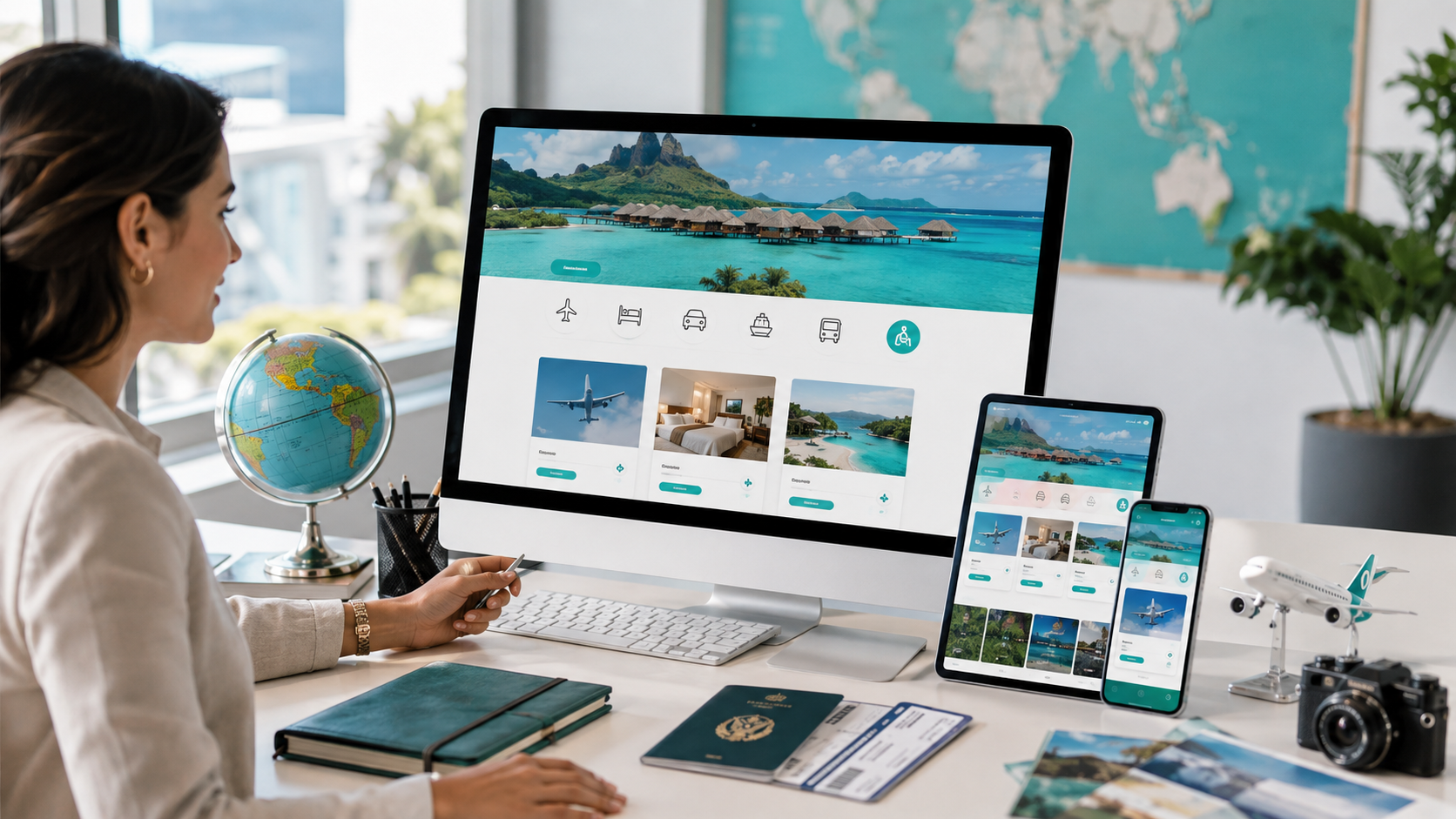
- 1Key Takeaways
- 2Why Your Travel Agency Website Matters
- 3What Makes a Travel Agency Website Convert?
- 4The 9 Must-Have Pages on a Travel Agency Website
- 1. The Homepage — Answer "Who Do You Help?" Instantly
- 2. The Services Page — Remove Every Doubt
- 3. Niche and Destination Pages — Where SEO Actually Happens
- 4. The About Page — Your Second-Most-Visited Page
- 5. The Testimonials Page — Proof You're Worth It
- 6. The Blog — Your Search Traffic Engine
- 7. The Lead Magnet Page — Capture the 97% Not Ready Today
- 8. The Contact / Booking Page — Make It Effortless
- 9. Legal Pages — Credibility and Compliance
- 5Travel Agency Website Design Rules That Drive Conversion
- 6What Should I Build My Travel Agency Website On?
- 7How Much Does It Cost to Build a Travel Agency Website?
- 8What Are Good Travel Agency Website Examples?
- 9How Do You Optimize a Travel Agency Website for Search?
- 10Before You Launch: A Practical Checklist
- 11Common Travel Agency Website Mistakes
- 12Frequently Asked Questions
- 13Final Thoughts and Your Website Checklist
Travel Agency Website: 9 Must-Have Pages That Convert Visitors in 2026
A travel agency website needs 9 specific pages to turn visitors into clients. Here's the exact structure, design rules, and conversion tactics that work in 2026.


A travel agency website converts visitors into clients when it has 9 specific pages: a homepage, services, niche/destination pages, an about page, testimonials, a blog, a lead magnet page, a contact/booking page, and a legal page. Miss any of them and you leak enquiries — most agency sites fail not on looks, but on missing pages and unclear next steps.
That's the short answer. Below, we walk through all 9 pages and what each must contain, cover the design rules that actually drive conversion, explain what to build it on, and share the mistakes that quietly cost you clients. If your site looks fine but generates no enquiries, this guide diagnoses why.
Key Takeaways
9 pages convert: homepage, services, niche/destination, about, testimonials, blog, lead magnet, contact, and legal.
Speed decides everything — most visitors abandon a page that takes more than about 3 seconds to load.
Mobile is the default — the majority of travel research happens on phones, so design mobile-first.
Trust converts in travel — testimonials, credentials, and a real photo of you matter more than gloss.
One clear call to action per page. Confused visitors don't convert; they leave.
WordPress powers roughly 43% of all websites, making it the most common platform choice.
Why Your Travel Agency Website Matters
Your travel agency website is the only sales asset you fully own. Social platforms change algorithms, hosts change commission splits, and suppliers change programs — but your website works for you around the clock, and nobody can take it away. It's where a stranger decides, usually within seconds, whether you look like a professional worth trusting with a $12,000 trip.
The stakes are high because the audience is enormous. The World Travel & Tourism Council forecasts Travel & Tourism to contribute $12 trillion globally in 2026, and Statista data confirms the overwhelming majority of travel research now begins online, mostly on mobile. Research from the Nielsen Norman Group consistently shows users form credibility judgments about a site almost instantly, long before they read your qualifications.
Here's the part most advisors get wrong, though: a beautiful travel agency website that doesn't ask for the enquiry converts nothing. In our experience reviewing agency sites, the common failure isn't ugly design — it's gorgeous photography with no clear next step, missing trust signals, and no reason to make contact today. The 9 pages below fix exactly that.
What Makes a Travel Agency Website Convert?
A travel agency website is your digital storefront and lead-generation engine — a set of pages designed to attract the right travelers, build trust in your expertise, and convert visitors into enquiries. Conversion comes from clarity and trust, not decoration.
A few core terms defined up front, since we'll use them throughout:
A conversion is a visitor taking your desired action — usually submitting an enquiry.
A CTA (call to action) is the button or prompt asking them to take that action.
A landing page is a focused page built around one offer or action.
A lead magnet is something valuable (a guide, checklist, or quiz) offered in exchange for an email.
Above the fold is what's visible before scrolling — your most valuable real estate.
Social proof is evidence others trust you: testimonials, reviews, and logos.
Bounce rate is the share of visitors who leave without interacting.
Responsive design means the site adapts properly to phones and tablets.
Core Web Vitals are Google's page-experience metrics, including load speed.
A niche page targets one specific travel type or destination you specialize in.
The 9 Must-Have Pages on a Travel Agency Website
Here's the full site structure at a glance, then each page in depth.
# | Page | Its job |
|---|---|---|
1 | Homepage | Say who you help, in 5 seconds |
2 | Services | Explain exactly what you do |
3 | Niche / destination pages | Rank and convert on specifics |
4 | About | Build human trust |
5 | Testimonials / reviews | Prove others trust you |
6 | Blog | Attract search traffic |
7 | Lead magnet page | Capture emails from non-ready visitors |
8 | Contact / booking | Make enquiring effortless |
9 | Legal (privacy/terms) | Compliance and credibility |
1. The Homepage — Answer "Who Do You Help?" Instantly
Your homepage has about five seconds to communicate who you serve and what you do. The most common mistake is a beautiful hero image with a vague slogan like "Your Journey Begins Here" — which tells a visitor nothing. Replace it with clarity: "I plan stress-free Italy honeymoons for busy couples."
Above the fold, your homepage needs: a clear headline naming your niche and client, a supporting line on the benefit, one prominent CTA ("Book a free consultation"), and an immediate trust signal (a review count, credential, or client photo). Everything else can wait until they scroll.
2. The Services Page — Remove Every Doubt
Visitors need to know exactly what working with you involves. Your services page should spell out what you plan (honeymoons, cruises, family trips), what's included (consultation, itinerary, support, rebooking help), how your fees work, and what the process looks like step by step.
Be explicit about fees. Advisors often hide their planning fee, fearing it puts people off — in practice, ambiguity puts people off far more. Stating "My planning fee is $250, credited toward your booking" filters out mismatched enquiries and pre-sells the serious ones.
3. Niche and Destination Pages — Where SEO Actually Happens
This is the page type most agency sites skip, and it's the biggest missed opportunity. A generic travel agency website struggles to rank for anything, but a dedicated page on "Amalfi Coast honeymoon planning" or "multi-generational Disney trips" can rank and convert precisely because it matches what people actually search.
Build one page per specialty — destination, travel type, or client segment. Each should answer that audience's specific questions, show relevant examples, and end with a CTA. These pages do the heavy lifting for search traffic, which is why serious travel agency website design always includes them.
4. The About Page — Your Second-Most-Visited Page
People buy from people, especially when handing over thousands of dollars for a once-a-year trip. Your about page is consistently one of the most visited pages on any travel agency website, so treat it as a sales page rather than an afterthought.
Include a real, professional photo of yourself (not a stock beach), your story and why you do this, your credentials (host agency, IATA/CLIA, certifications), your niche expertise and personal travel experience, and a CTA. Warmth plus credibility is the winning combination.
5. The Testimonials Page — Proof You're Worth It
Social proof is decisive in travel, because clients are buying an outcome they can't inspect in advance. Dedicate a page to testimonials, and sprinkle them throughout the site too.
The strongest testimonials are specific: "She rebooked our entire flight home within an hour when the airline cancelled" beats "Great service!" Include names, photos, and destinations where clients permit. Add review-platform ratings and any supplier badges. This page removes the last objection before someone enquires.
6. The Blog — Your Search Traffic Engine
A blog is how a travel agency website earns ongoing search traffic without paying for ads. Write for the questions your ideal clients actually ask — "best time to visit Japan with kids," "is a Mediterranean cruise worth it," "what does a travel advisor cost" — rather than generic destination roundups that compete with every publisher online.
Each post should end with a CTA and link to your relevant niche page. Consistency matters more than volume here; a handful of genuinely useful posts targeting real questions outperforms dozens of thin ones. Aim for depth on subjects you know exceptionally well, since that expertise is exactly what differentiates you from the generic content already flooding search results.
7. The Lead Magnet Page — Capture the 97% Not Ready Today
The overwhelming majority of visitors aren't ready to book on their first visit. Without a way to capture them, they leave and you never hear from them again. A lead magnet page fixes this by exchanging something genuinely valuable for an email address.
Effective travel lead magnets include a destination planning guide, a packing or documents checklist, a "which cruise line suits you" quiz, or a budget calculator. Then nurture those subscribers by email — see our guide to travel agency lead generation for the full system.
8. The Contact / Booking Page — Make It Effortless
Every barrier here costs you enquiries. Your contact page should offer multiple ways to reach you (form, email, phone, and ideally a calendar booking link), a short form asking only what you truly need, clear expectations ("I reply within one business day"), and reassurance about what happens next.
Keep the form short. Every extra field reduces completions, so resist asking for full trip details upfront — you can gather those on the call. A calendar-booking link ("Pick a time that suits you") converts noticeably better than a form for advisors selling consultations, because it removes the waiting.
9. Legal Pages — Credibility and Compliance
Privacy policy, terms of service, and any required disclosures (including your Seller of Travel registration number if you're registered in California, Florida, Hawaii, or Washington) are legally necessary and quietly build credibility. Sites lacking them look amateur to informed visitors, and they're required by privacy regulations if you collect emails — which every good travel agency website does.
Travel Agency Website Design Rules That Drive Conversion
Structure gets visitors to the right page; travel agency website design decides whether they act. These rules matter most:
Rule | Why it converts |
|---|---|
Load in under ~3 seconds | Most visitors abandon slower pages |
Mobile-first design | Most travel research happens on phones |
One clear CTA per page | Choice paralysis kills conversions |
Real photos over stock | Authenticity builds trust in travel |
Readable typography | Small or low-contrast text loses people |
Visible contact info | Never make people hunt for you |
Trust signals above the fold | Credibility must be immediate |
Speed is the ruthless one. Google's page-experience research, summarized through Think with Google, consistently finds that abandonment rises sharply with every additional second of load time — meaning a slow travel agency website loses visitors before they see a single word. Compress your images (travel sites are image-heavy and often bloated), choose quality hosting, and test on a real phone using a mobile connection, not office wifi.
The second most-neglected rule is one CTA per page. Agency sites frequently offer five competing actions — book a call, download a guide, follow on Instagram, join the newsletter, browse packages — and visitors, faced with everything, choose nothing. Pick the single most valuable action for each page and make it unmissable.
What Should I Build My Travel Agency Website On?
Most advisors build on WordPress, Wix, Squarespace, or a host agency's provided site builder. WordPress offers maximum flexibility and SEO control — it powers roughly 43% of all websites according to W3Techs — while Wix and Squarespace are faster and simpler for non-technical users. Host-provided sites are quickest but the most limited.
Our honest recommendation: if you're not technical and want to launch this month, Squarespace or Wix will get you a professional, mobile-ready site quickly. If you plan to invest seriously in blogging and SEO, WordPress rewards that investment with far more control. Whatever you choose, prioritize a template built for speed and mobile over one that merely looks impressive in a demo. For specific template picks, see our guide to travel agency website templates.
How Much Does It Cost to Build a Travel Agency Website?
To build a travel agency website costs anywhere from around $200 to $10,000+, depending on approach. A DIY site on Wix or Squarespace runs roughly $200–$500 per year including hosting and domain. A WordPress site with a premium theme costs about $100–$400 in setup plus hosting. A freelance designer typically charges $1,000–$5,000, and a full agency build runs $5,000–$10,000+.
For most new advisors, we'd suggest starting DIY on a quality template and reinvesting in a professional build once you're earning. A polished template-based site is entirely credible to clients — they cannot tell whether you paid $300 or $8,000, only whether the site loads fast, reads clearly, and makes them trust you. Spend the difference on marketing instead, at least initially.
What Are Good Travel Agency Website Examples?
Good travel agency website examples share the same traits regardless of budget: a clear niche stated immediately, one obvious call to action, genuine testimonials with names and specifics, a real photo of the advisor, fast mobile loading, and dedicated pages for each specialty. Rather than copying any single site, study those patterns across several.
The most useful travel agency website examples to study are ones in your niche, since they reveal what your specific audience responds to. Look at luxury advisors if you sell luxury, cruise specialists if you sell cruises. Note their headline structure, how they present fees, where they place testimonials, and what their primary CTA is. Then apply the pattern in your own voice — imitating the structure works, imitating the personality doesn't.
How Do You Optimize a Travel Agency Website for Search?
Optimizing a travel agency website for search means building pages that match what your ideal clients actually type into Google — then making those pages fast, clear, and genuinely useful. The structural work matters more than tricks: dedicated niche pages, a focused blog, clean URLs, and descriptive page titles do the bulk of the job.
Here's the practical priority order we'd follow:
Priority | Action | Impact |
|---|---|---|
1 | Build niche/destination pages | Highest — these rank and convert |
2 | Write a focused blog | High — compounds over time |
3 | Optimize titles & descriptions | High — decides click-through |
4 | Improve load speed | High — affects rankings and bounce |
5 | Add internal links between pages | Medium — spreads authority |
6 | Claim local listings | Medium — for local searches |
7 | Earn backlinks | Slow but durable |
The mistake most advisors make is chasing broad, hopeless terms like "travel agency" while ignoring the specific phrases their clients genuinely search. Competing for a head term against global OTAs is unwinnable for a solo advisor; ranking for "accessible cruise planning for wheelchair users" is entirely achievable. Specificity is your advantage, and it's why niche pages sit at the top of that list.
Speed and usability also feed rankings directly. Tools like Google PageSpeed Insights show exactly what's slowing your site down — on travel agency websites, the culprit is almost always uncompressed hero images. In our experience, compressing images alone often halves load time on an image-heavy travel agency website, which improves both rankings and conversions in one move.
Before You Launch: A Practical Checklist
Whether you build a travel agency website yourself or hire someone, run through this before going live:
Test on a real phone, on mobile data — not just a desktop browser window.
Click every link and submit every form. Broken contact forms are shockingly common.
Check load speed and compress any image over about 200KB.
Read every page aloud — awkward copy is obvious when spoken.
Confirm your CTA appears on every single page.
Verify legal pages exist and your registration numbers are displayed where required.
Ask two people outside travel what you do, after ten seconds on your homepage.
That last test is the most revealing one we know. If someone can't tell you within ten seconds who you help and what you'd do for them, the copy needs work — regardless of how good the design looks. Clarity beats beauty on every travel agency website that actually generates enquiries.
Design and usability research from established sources like Smashing Magazine reinforces the same conclusion across industries: users reward sites that are obvious and punish sites that are clever. Your travel agency website is not an art project — it's a tool for turning strangers into clients, and it should be judged on that alone.
Common Travel Agency Website Mistakes
These are the errors we see most often, and each quietly costs enquiries:
A vague headline. "Your Journey Begins Here" tells visitors nothing about who you help.
No clear CTA. If you don't ask, they won't act.
Slow load times. Oversized travel photos are the usual culprit.
Poor mobile experience. Most of your visitors are on phones.
Hidden fees. Ambiguity loses more clients than a stated price ever will.
Stock photos only. People want to see you.
No lead capture. Most visitors aren't ready today; capture them anyway.
Trying to serve everyone. A site for "all travelers" converts nobody.
Fix these, and conversion usually improves without changing a single design element.
Frequently Asked Questions
What pages does a travel agency website need? Nine: a homepage, services page, niche or destination pages, an about page, testimonials, a blog, a lead magnet page, a contact/booking page, and legal pages (privacy and terms). Each has a distinct job — the homepage clarifies who you help, niche pages drive search traffic, testimonials build trust, and the contact page converts.
How much does it cost to build a travel agency website? Around $200 to $10,000+. DIY on Wix or Squarespace costs roughly $200–$500 per year, a WordPress site with a premium theme about $100–$400 plus hosting, a freelance designer $1,000–$5,000, and a full agency build $5,000–$10,000+. Most new advisors should start DIY on a quality template and upgrade once they're earning.
What makes a travel agency website convert? Clarity and trust, not decoration. Convert with a specific headline naming your niche and client, one obvious call to action per page, genuine testimonials, a real photo of yourself, transparent fees, fast mobile loading, and an email capture for visitors who aren't ready to book yet. Most sites fail on missing next steps rather than looks.
What platform should I use to build a travel agency website? WordPress for maximum flexibility and SEO control (it powers roughly 43% of all websites), or Wix and Squarespace for faster, simpler setup if you're not technical. Host agency site builders are quickest but most limited. If you plan to invest in blogging and SEO, WordPress rewards it; if you want to launch this month, Squarespace or Wix is fine.
Do travel advisors need their own website? Yes. Your website is the only marketing asset you fully own — social platforms change algorithms and hosts change programs, but your site works for you continuously. It's also where credibility is established: clients researching whether to trust you with a major trip will look for a professional site, and its absence raises doubts.
How do I get traffic to my travel agency website? Primarily through a blog targeting the specific questions your ideal clients search, dedicated niche and destination pages that rank for specialized terms, social media pointing back to your site, email marketing to your captured leads, and referrals. SEO and content compound over time, which is why niche pages and consistent blogging outperform occasional generic posts.
How long does it take to build a travel agency website? On a DIY platform like Squarespace or Wix, a focused advisor can build a solid nine-page site in one to two weeks working part-time. A WordPress build typically takes two to four weeks depending on your technical comfort. A freelance designer usually delivers in four to eight weeks. The realistic bottleneck is rarely the building — it's writing the copy, so draft your page content before you start designing.
Should my travel agency website show prices? Show your fee structure, not fixed trip prices. Trip costs vary enormously by dates, party size, and preferences, so publishing them is misleading. But being transparent about your planning fee — "$250, credited toward your booking" — filters out mismatched enquiries and pre-qualifies serious clients. Hiding fees entirely tends to lose more prospects than stating them ever does.
Do I need a blog on my travel agency website? Not on day one, but it's the most reliable long-term source of free traffic. Without one, you depend entirely on social media and referrals for visibility. A blog answering the real questions your clients ask compounds over months into steady search traffic that costs nothing per visitor. Start with five strong posts targeting your niche rather than trying to publish weekly from the outset.
Final Thoughts and Your Website Checklist
A travel agency website doesn't need to be expensive or elaborate — it needs the right pages, clear next steps, and genuine trust signals. Here's your quick checklist:
✅ Build all 9 pages (most sites are missing 3 or 4)
✅ State your niche and client in your headline
✅ One clear CTA per page
✅ Real photos of you, not just stock
✅ Be transparent about fees
✅ Add a lead magnet to capture the not-yet-ready
✅ Test speed and layout on a real phone
Build for clarity over polish. The advisors winning enquiries online aren't the ones with the prettiest sites — they're the ones whose visitors immediately understand who they help and exactly what to do next.
Your website generates the enquiry; what happens next decides whether it becomes a booking. Start your free TravelBoost trial to capture every lead and follow up automatically — and download our free page-by-page checklist. Building your brand too? See our guide to designing a travel agency logo.
Want a CRM that's actually built for travel?
Leads, bookings, suppliers, Hajj operations, tours, car rental, finance — all in one platform. Set up in 10 minutes.
Start free 14-day trialWeekly playbook for travel-agency operators
One email a week — product updates, benchmarks, and behind-the-scenes changelog. No spam.