- 1Key Takeaways
- 2What Is a CRM for Tour Operators?
- 3Do You Need a CRM or a Booking System?
- 4What Does a Tour Operator CRM Need That an Agency CRM Does Not?
- 5The Booking Fee Is Bigger Than the Subscription
- 6The 11 Best CRM for Tour Operators Options in 2026
- Strongest on pipeline and leads
- 1. TravelBoost — enquiry pipeline with booking and margin attached
- 2. Pipedrive and general-purpose CRMs
- 3. Tourwriter — itinerary depth for bespoke operators
- 4. Ezus — proposals, budgets and margin awareness
- Strongest on bookings and distribution
- 5. Bókun — distribution with the lower fee structure
- 6. Rezdy — broad functionality, higher fee
- 7. FareHarbor and Peek Pro — high-volume day tours
- 8. Checkfront — flexible booking with reporting
- Strongest on operations
- 9. TourCMS — reservations and CRM for multi-day
- 10. Zaui — reservations plus dispatch
- 11. Tourplan — inbound operators and DMCs
- 7How Do the 11 Systems Compare?
- 8How Should You Choose?
- 9How Do You Migrate Without Losing Your Pipeline?
- 10Common Mistakes When Buying a CRM for Tour Operators
- 11Frequently Asked Questions
- What is a CRM for tour operators?
- Do tour operators need a CRM or a booking system?
- How much does tour operator CRM software cost?
- What is the difference between a tour operator CRM and a travel agency CRM?
- Which CRM is best for multi-day tour operators?
- Are booking fees or subscriptions more important when comparing platforms?
- Can I use a general CRM like Pipedrive for a tour business?
- What should I check before buying tour operator CRM software?
- 12The Bottom Line
- 13FAQ SCHEMA (JSON-LD)
CRM for Tour Operators: 11 Best Systems to Boost Bookings in 2026
Most CRM for tour operators products are booking engines with contact records. Compare 11 systems, real booking fees and what actually manages leads.

Key Takeaways
Most products marketed as a CRM for tour operators are booking engines with a contact list attached. They manage guests who already booked. They do not manage leads who have not.
The distinction decides your purchase: a booking system handles availability, checkout and post-booking guest records. A true CRM handles enquiries, pipeline, quote follow-up and revenue forecasting.
Booking fees usually cost more than the subscription. Bókun charges 1–1.5% depending on tier, Rezdy charges 3% across all tiers. At $1m in bookings that is $10,000–$15,000 versus $30,000 a year.
Entry pricing clusters tightly at $49/month for Bókun, Rezdy and several others — so the subscription is rarely the deciding number.
Tour operators need four things retail agency CRMs do not provide: departure-level capacity, per-departure margin, group and manifest management, and guide or vehicle allocation.
Multi-day FIT operators and high-volume day-tour operators need genuinely different systems. Buying the wrong category is the most common and most expensive error.
The honest test: if your problem is unconverted enquiries, you need a CRM. If your problem is managing bookings you already have, you need a booking system.
What Is a CRM for Tour Operators?
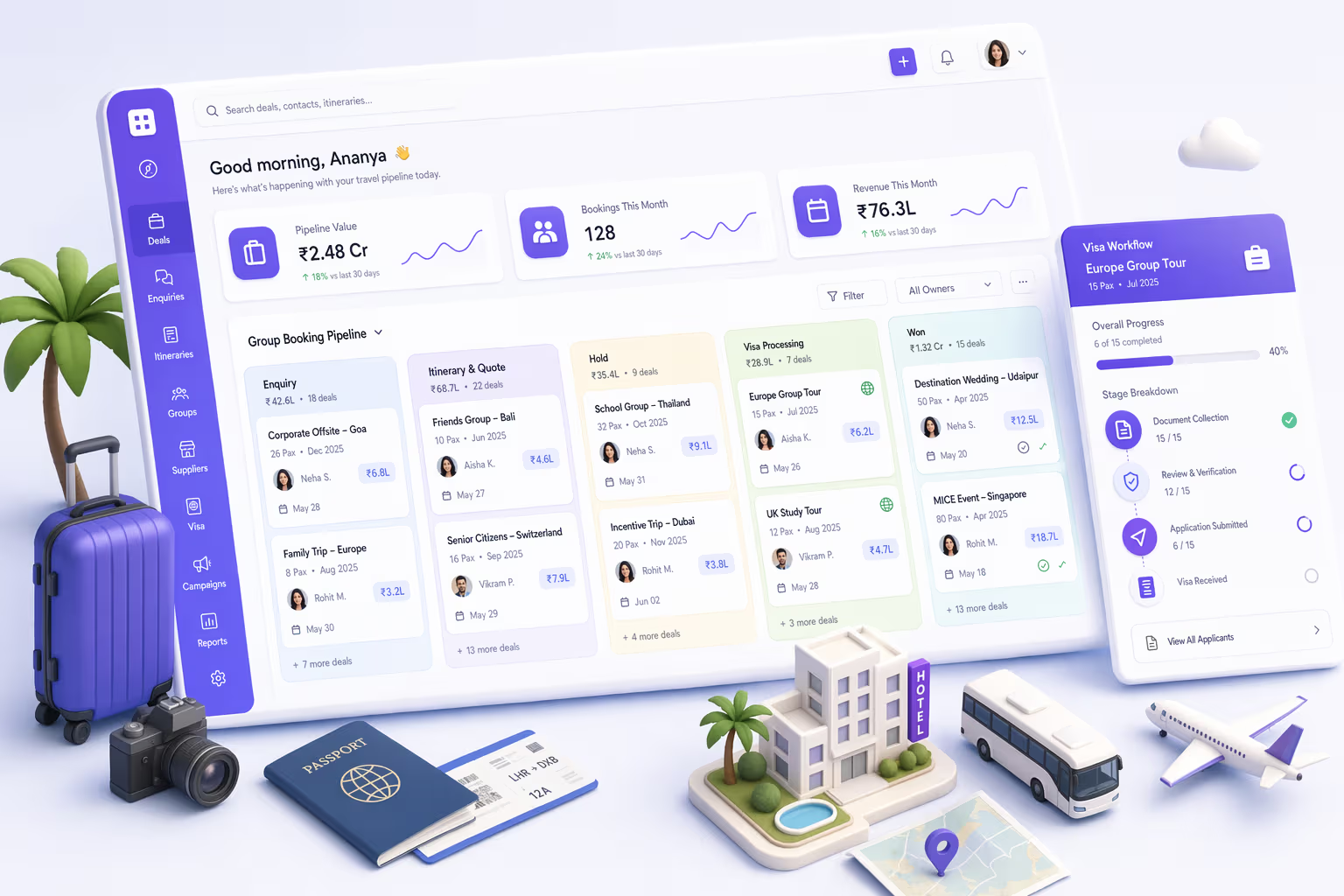
A CRM for tour operators is software that manages the relationship and the pipeline around your trips — capturing enquiries, tracking quotes and follow-ups, holding guest history and preferences, and forecasting revenue by departure. A CRM for tour operators is distinct from a booking engine, which handles availability, checkout and payment.
I want to open with an uncomfortable observation, because it will save you money.
Most systems marketed as CRM software for tour operators are reservation platforms with customer records attached. They are excellent at recording who booked, when they travel and what they paid. They are frequently poor at the thing a CRM is actually for: managing people who have not yet booked.
This is not a fringe view. Pipedrive's own analysis of tourism CRM makes the point about a leading itinerary platform directly — while it handles itinerary complexity well, operators still need a CRM to track leads, forecast revenue and manage follow-ups, which niche itinerary builders do not typically cover.
So the first question when shopping for a CRM for tour operators is not which product to buy. It is which problem you have.
Do You Need a CRM or a Booking System?
Booking system | CRM | |
|---|---|---|
Manages | Confirmed bookings | Enquiries and prospects |
Core question | Is there space, and did they pay? | Who is interested, and what next? |
Timeline | From booking onward | From first contact onward |
Key features | Availability, checkout, manifests, channel distribution | Pipeline, follow-up tasks, quote tracking, forecasting |
Typical failure | Enquiries sit unanswered in an inbox | You have leads but cannot take a booking |
Who needs it most | High-volume day tours | Multi-day, custom and high-value trips |
The pattern is fairly consistent across the operators we work with, and it maps neatly onto whether a CRM for tour operators is the right purchase at all.
A day-tour operator selling $80 kayak trips mostly needs a booking system. Demand arrives ready to buy, conversion happens in one session, and the work is availability, capacity and channel distribution. A pipeline for a two-minute purchase decision is overhead.
A multi-day operator selling $9,000 Peru itineraries mostly needs a CRM. The enquiry arrives months before the booking, there are five or six exchanges, a quote, revisions, and a decision involving several people. Lose track of that conversation and you lose the sale — and at $9,000 a booking, one lost enquiry a month is real money.
Most operators eventually need both, which is why the market has converged on platforms claiming both. The question is which side the product you are considering is actually strong on.
What Does a Tour Operator CRM Need That an Agency CRM Does Not?
This is where a CRM for tour operators genuinely differs from retail agency software, and the gaps are structural rather than cosmetic.
1. Departure-level capacity. A retail agency sells whatever the supplier has available. An operator sells seats on a specific departure — and the CRM has to know that the 14 October trip has four places left, because that changes what you tell a prospect and how hard you push.
2. Per-departure profitability. Your margin varies by departure depending on how full it is. Fixed costs — guide, vehicle, permits — spread across however many people booked. A CRM that cannot show margin per departure cannot tell you which trips to run again.
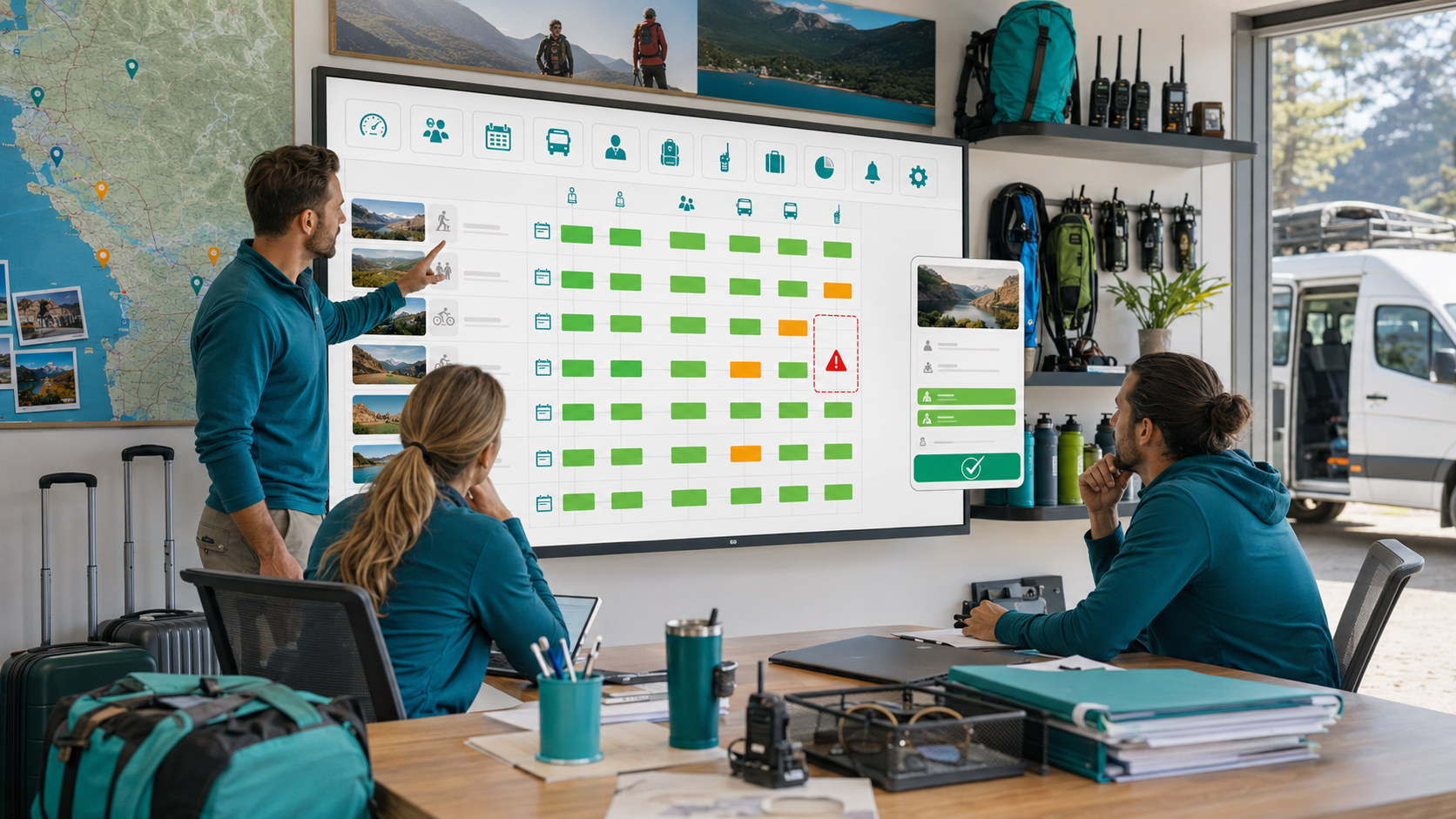
3. Group and manifest management. Multiple travellers on one booking, each needing passport details, dietary requirements, insurance confirmation and emergency contacts. Retail agency CRMs handle a booking; operators need a manifest.
4. Resource allocation. Which guide, which vehicle, which permit, on which date. Double-book a guide and the problem is operational, not administrative.
5. Supplier cost contracts. Operators buy components at contracted rates. Those rates need to sit against the departure so costing is automatic rather than reconstructed in a spreadsheet.
6. Waitlists and departure-triggered communication. Pre-departure sequences timed to travel dates, not booking dates.
Our comparison of travel agency CRM systems covers the retail side, where none of the above applies and the priorities are commission tracking and supplier reconciliation instead.
The Booking Fee Is Bigger Than the Subscription
This is the most valuable practical thing I can tell anyone comparing a CRM for tour operators, and it is routinely missed.
Most tour platforms charge a monthly subscription plus a percentage of every booking. The subscription is what you compare on. The percentage is what you actually pay.
Platform | Entry subscription | Booking fee |
|---|---|---|
Bókun | $49/month | 1–1.5% by tier ($49–$499/month tiers); 0% on Viator bookings |
Rezdy | $49/month | 3% across all tiers, no channel carve-out |
Checkfront | Tiered | Varies by plan |
Ventrata | $575–$5,750/month | Enterprise model |
Now apply that to real volume:
Annual bookings | At 1.5% | At 3% | Difference |
|---|---|---|---|
$250,000 | $3,750 | $7,500 | $3,750 |
$500,000 | $7,500 | $15,000 | $7,500 |
$1,000,000 | $15,000 | $30,000 | $15,000 |
$2,000,000 | $30,000 | $60,000 | $30,000 |
At $1m in bookings, the difference between a 1.5% and a 3% fee is $15,000 a year — more than twenty times the difference between two $49 and $99 subscriptions.
So model total cost at your actual volume before comparing feature lists. A platform that is $50 a month more expensive but half the booking fee is dramatically cheaper for anyone doing meaningful volume.
One further caution: fee structures have conditions attached. Bókun charges 0% on Viator bookings across all tiers — genuinely valuable if Viator is a major channel for you, irrelevant if it is not. And a lower fee only applies while you keep paying the subscription tier it belongs to.
The 11 Best CRM for Tour Operators Options in 2026
Grouped by what each is actually strongest at, because no single CRM for tour operators wins across day tours, multi-day and DMC work. A disclosure: TravelBoost is our own product and appears below on the same terms as the rest.
Verify pricing directly — several vendors in this space revised terms during 2026, and the Rezdy, Checkfront and Regiondo consolidation has moved things further.
Strongest on pipeline and leads
1. TravelBoost — enquiry pipeline with booking and margin attached
Best for: Multi-day and custom operators whose problem is unconverted enquiries
TravelBoost holds enquiries with source attribution, tracks quotes through follow-up, and connects each booking to payment schedules, supplier costs and margin — so pipeline and profitability sit in the same record rather than two systems.
Strength: Lead management and per-booking profitability in one place, with no per-booking percentage fee. Limitation: It is not a high-volume day-tour checkout engine with 200+ OTA connections. If your priority is channel distribution at scale, options 5 to 8 fit better.
2. Pipedrive and general-purpose CRMs
Best for: Operators whose pipeline problem is severe and whose booking needs are simple
A conventional sales CRM handles enquiries, stages, follow-up tasks and forecasting better than most travel-specific tools, because that is the entire product. What it does not know is anything about departures, capacity or manifests.
Strength: Genuine pipeline management and forecasting. Limitation: No travel logic at all. You will run it alongside a booking system.
3. Tourwriter — itinerary depth for bespoke operators
Best for: Luxury and bespoke operators designing complex multi-destination trips
Cloud itinerary software centralising supplier databases, pricing and branded proposal documents, with drag-and-drop building and automated pricing. Positioned for low-volume, high-value operators.
Strength: The strongest proposal and itinerary output for bespoke work. Limitation: As noted above, it is an itinerary builder rather than a CRM — lead tracking and forecasting sit outside it.
4. Ezus — proposals, budgets and margin awareness
Best for: DMCs, event travel and custom-programme businesses
Builds custom proposals with supplier catalogues and budget management attached, and engages directly with margin-based financial treatment.
Strength: Margin visibility built into the proposal. Limitation: Reported as oriented toward larger agencies in both features and pricing.
Strongest on bookings and distribution
5. Bókun — distribution with the lower fee structure
Best for: Operators where OTA distribution drives volume
Owned by Tripadvisor, with three paid plans from $49/month and booking fees of 1–1.5% by tier, plus 0% on Viator bookings across all tiers.
Strength: The most favourable fee structure at volume, particularly with Viator exposure. Limitation: Marketing claims in this category are combative — one competitor comparison from Bókun about Rezdy's OTA partnerships has been publicly contradicted. Verify claims independently.
6. Rezdy — broad functionality, higher fee
Best for: Operators wanting one platform across operations and distribution
A global platform now merged with Checkfront and Regiondo. Plans start at $49/month with the popular Accelerate tier around $99/month, and a 3% booking fee across all tiers.
Strength: Wide feature coverage and a large integration ecosystem. Limitation: The 3% fee with no channel carve-out is the highest of the mainstream options and dominates total cost at volume.
7. FareHarbor and Peek Pro — high-volume day tours
Best for: Attractions and day-tour operators at scale
Both are quote-only on pricing, so published figures are third-party estimates. Built around high-throughput checkout, waivers and dispatch.
Strength: Conversion and throughput for day tours. Limitation: Opaque pricing, and pipeline management is not the design goal.
8. Checkfront — flexible booking with reporting
Best for: Mixed inventory — tours, rentals, activities
Flexible booking engine with CRM features and reporting, now part of the Rezdy group following consolidation.
Strength: Adaptable to unusual inventory types. Limitation: Ongoing consolidation means terms may change; confirm current roadmap.
Strongest on operations
9. TourCMS — reservations and CRM for multi-day
Best for: Multi-day operators needing supplier and package management
Reservation and CRM software designed for tour operators managing itineraries, suppliers and multi-tour packages, with wide OTA syncing.
Strength: Genuine multi-day and multi-supplier handling. Limitation: Interface and setup are less immediate than newer entrants.
10. Zaui — reservations plus dispatch
Best for: Operators with vehicles, drivers and dispatch complexity
Full-suite reservation and dispatch for operators handling complex itineraries and resource allocation.
Strength: Resource and dispatch management, which most platforms handle poorly. Limitation: Heavier than a small operator needs.
11. Tourplan — inbound operators and DMCs
Best for: Inbound operators, DMCs and high-complexity contracting
Back-office depth around costing, margin and supplier contracting for the principal-model operator.
Strength: Contracting and costing sophistication. Limitation: Enterprise-weight implementation.
How Do the 11 Systems Compare?
System | Category | Pipeline / leads | Departure capacity | Booking fee | Entry price |
|---|---|---|---|---|---|
TravelBoost | Ops + pipeline | Strong | Yes | None | See current pricing |
Pipedrive | General CRM | Strongest | No | None | ~$14–$99/user |
Tourwriter | Itinerary | Weak | Partial | None | Quote-based |
Ezus | Proposals | Moderate | Yes | None | Quote-based |
Bókun | Distribution | Weak | Yes | 1–1.5%; 0% Viator | $49/mo |
Rezdy | Full suite | Moderate | Yes | 3% | $49/mo |
FareHarbor | Day tours | Weak | Yes | Quote-only | Quote-only |
Peek Pro | Day tours | Weak | Yes | Quote-only | Quote-only |
Checkfront | Flexible booking | Moderate | Yes | Varies | Tiered |
TourCMS | Multi-day | Moderate | Yes | Varies | Quote-based |
Zaui | Dispatch | Weak | Yes | Varies | Quote-based |
Tourplan | Inbound / DMC | Weak | Yes | Varies | Enterprise |
Pricing and fees reflect publicly published figures in mid-2026 and change frequently. Several vendors in this category have merged recently — verify current terms directly.
For the wider software picture beyond CRM, our guides to the best tour operator software and tour operator booking software cover reservation and distribution platforms in depth.
How Should You Choose?
Six questions to ask of any CRM for tour operators, in order. In our experience the first two eliminate most of the market.
# | Question | What it decides |
|---|---|---|
1 | Is my problem unconverted enquiries, or managing existing bookings? | CRM versus booking system |
2 | Am I high-volume day tours, or low-volume multi-day? | Which half of the market to shop in |
3 | What is my total cost at my actual annual booking volume? | The booking fee usually decides this |
4 | Does it show margin per departure, not just revenue? | Whether you can tell which trips to repeat |
5 | Can it allocate guides, vehicles and permits? | Whether operations stay in spreadsheets |
6 | What happens to my data if I leave? | Ask before signing |
Question 3 deserves the arithmetic. Take last year's gross bookings, apply each platform's percentage, add twelve months of subscription. The ranking frequently inverts once you do — and the cheapest headline subscription is often the most expensive system.
How Do You Migrate Without Losing Your Pipeline?
Switching a CRM for tour operators is riskier than switching most software, because the thing you are moving — half-finished conversations with people who have not yet paid you — is the easiest thing to lose and the most expensive.
I would sequence it like this.
1. Export before you decide, not after. Ask every shortlisted vendor for an export from a trial account. If you cannot get your own data out in a usable format during a trial, you will not get it out when you leave.
2. Migrate open enquiries first, closed bookings last. Your active pipeline is the revenue at risk. Historical bookings can follow, or stay in the old system as an archive, since they are reference rather than working data.
3. Rebuild your stages deliberately. Most operators inherit whatever pipeline stages the previous system imposed. A migration is the one chance to define stages that match how you actually sell — enquiry received, qualified, quoted, revised, deposit taken, confirmed.
4. Move in the shoulder season. Never during peak enquiry season and never in the fortnight before a major departure. Whatever goes wrong will go wrong at the worst moment otherwise.
5. Run parallel for one full booking cycle. For a multi-day operator that may be six weeks; for day tours, two. Tedious, and it catches every mapping error while both systems still hold the truth.
6. Reconcile one departure end to end before trusting anything. Take a single trip, and check that every enquiry, quote, booking, payment, supplier cost and margin figure matches what you know to be true.
A caution specific to this category. Several platforms charge percentage booking fees, which means your migration timing has a cost dimension most software moves do not. If you switch mid-year from a 3% platform to a 1.5% one, the saving starts immediately on new bookings but existing bookings may remain on the old fee structure until travelled. Ask how in-flight bookings are treated, in writing, before you commit to a date.
Common Mistakes When Buying a CRM for Tour Operators
Comparing subscriptions and ignoring booking fees. The costliest error when buying a CRM for tour operators. At $1m in bookings, 1.5 points of fee difference is $15,000 a year.
Buying a booking engine to fix a lead problem. If enquiries sit unanswered, more checkout capability will not help.
Buying a CRM to fix a booking problem. Equally, a beautiful pipeline does not sell seats on the 14 October departure.
Buying day-tour software for multi-day trips. Different products entirely, despite similar marketing.
Trusting vendor comparison pages. Competing claims in this category have been publicly contradicted. Verify independently.
Ignoring per-departure margin. Revenue reporting tells you what sold. Margin per departure tells you what to run again.
Assuming retail agency software fits. It handles commission and supplier reconciliation, not capacity and costing. Our overview of travel agency software covers that distinction.
Not modelling the merged vendors. Rezdy, Checkfront and Regiondo consolidating means product roadmaps and pricing are in motion.
Frequently Asked Questions
What is a CRM for tour operators?
A CRM for tour operators is software managing the relationship and sales pipeline around your trips — capturing enquiries, tracking quotes and follow-ups, holding guest history and preferences, and forecasting revenue by departure. It is distinct from a booking engine, which handles availability, checkout and payment. Many products marketed as tour operator CRM software are actually reservation platforms with customer records attached, which manage guests who already booked rather than prospects who have not.
Do tour operators need a CRM or a booking system?
It depends on where your revenue leaks. High-volume day-tour operators selling low-value trips mostly need a booking system, because demand arrives ready to buy and conversion happens in one session. Multi-day operators selling high-value custom trips mostly need a CRM, because the enquiry arrives months ahead and involves several exchanges, a quote and revisions. At $9,000 per booking, one lost enquiry a month is significant money. Most operators eventually need both.
How much does tour operator CRM software cost?
Entry subscriptions cluster around $49 per month for Bókun and Rezdy, with Rezdy's popular Accelerate tier around $99 and enterprise platforms such as Ventrata running $575 to $5,750 monthly. But subscriptions rarely decide total cost, because most platforms also charge a percentage of every booking — Bókun 1 to 1.5% by tier and Rezdy 3% across all tiers. At $1 million in annual bookings that difference alone is $15,000 a year.
What is the difference between a tour operator CRM and a travel agency CRM?
Tour operators need four things retail agency systems generally lack: departure-level capacity so the system knows how many seats remain on a specific date, per-departure profitability because margin varies with how full a trip is, group and manifest management for passport details and dietary requirements across multiple travellers on one booking, and resource allocation for guides, vehicles and permits. Retail agency CRMs prioritise commission tracking and supplier reconciliation instead, which operators selling their own product do not need.
Which CRM is best for multi-day tour operators?
Multi-day operators need itinerary depth, supplier cost contracting and pipeline management together. Tourwriter is strongest on bespoke itinerary and proposal output but is an itinerary builder rather than a CRM, so lead tracking sits outside it. TourCMS handles multi-day reservations, suppliers and packages. Ezus suits custom-programme businesses with margin visibility built in. Platforms designed for high-volume day tours, such as FareHarbor and Peek Pro, are generally the wrong category for multi-day work.
Are booking fees or subscriptions more important when comparing platforms?
Booking fees, for almost any operator with meaningful volume. Subscriptions cluster tightly around $49 to $99 monthly, so the spread between platforms is a few hundred dollars a year. Booking fees range from 1% to 3% of gross bookings, which at $500,000 in annual sales is $5,000 to $15,000 and at $2 million is $20,000 to $60,000. Model total cost at your actual volume before comparing features, because the ranking often inverts.
Can I use a general CRM like Pipedrive for a tour business?
Yes, and for pipeline management specifically it often outperforms travel-specific tools, because sales pipeline is the entire product rather than a secondary feature. What a general CRM cannot do is understand departures, capacity, manifests, guide allocation or per-departure margin. The practical approach is running one alongside a booking system, accepting that you will maintain two systems, or choosing a travel platform with genuine pipeline capability rather than a contact list.
What should I check before buying tour operator CRM software?
Six things: whether your actual problem is unconverted enquiries or managing existing bookings; whether you are high-volume day tours or low-volume multi-day, since these need different products; your total cost at real annual booking volume including percentage fees; whether it reports margin per departure rather than only revenue; whether it allocates guides, vehicles and permits; and what happens to your data if you leave. Ask the last one before signing, not after.
The Bottom Line
The phrase "CRM for tour operators" describes two quite different products, and most of the confusion in this market comes from vendors using it for both.
If your enquiries are converting well and your problem is capacity, checkout and channel distribution, buy a booking platform — and buy on the booking fee, not the subscription, because at $1 million in bookings that percentage is worth twenty times the monthly difference.
If your problem is that enquiries arrive and quietly disappear, a CRM for tour operators is genuinely what you need — you need genuine pipeline management: stages, follow-up tasks, quote tracking and forecasting. Many tour platforms are weak here, and a general-purpose CRM alongside your booking system is a legitimate answer.
And whichever CRM for tour operators you buy, insist on two things most operators discover they are missing a year in: margin per departure, so you know which trips to run again, and resource allocation, so guides and vehicles stop living in a spreadsheet.
Run last year's booking volume through each platform's fee structure before you compare a single feature. That one calculation reorders most shortlists.
Pipeline and profitability in one record. TravelBoost tracks every enquiry with its source, follows quotes through to booking, and shows supplier costs and margin per departure — with no percentage fee on your bookings. Start your free TravelBoost trial.
About the author Written by the TravelBoost team. We build travel agency and tour operator management software used to manage enquiries, bookings, itineraries, payments, supplier costs and commissions in one place. TravelBoost appears in the comparison above as one option among eleven, and we have been explicit about what it does not do.
Last updated: July 28, 2026. Platform pricing, booking fees and feature coverage change frequently, and several vendors in this category have merged recently — verify current terms directly with each provider before purchasing.
FAQ SCHEMA (JSON-LD)
Want a CRM that's actually built for travel?
Leads, bookings, suppliers, Hajj operations, tours, car rental, finance — all in one platform. Set up in 10 minutes.
Start free 14-day trialWeekly playbook for travel-agency operators
One email a week — product updates, benchmarks, and behind-the-scenes changelog. No spam.